AI Search Monitoring Tools for Brand Sentiment Shifts
Brands are now tracked by what AI models say about them, not what people do.

AI search monitoring tracks something genuinely new: how large language models talk about a brand, not how people talk about it. That distinction sounds small until you notice that a chatbot's phrasing now shapes purchase decisions before a buyer ever lands on a company's website, and most brands have no idea what tone they're getting.
This matters because the signal behaves nothing like the metrics marketers grew up with. Social listening captures human chatter, complaints on forums, praise in comment sections, the noisy back-and-forth of real conversation. AI brand sentiment is model-generated language, produced probabilistically, shaped by phrasing, personalization, and whatever sources the model decided to pull from that session. There's no fixed position to track the way a rank tracker follows a keyword up or down page one. Ask the same question twice and a model might answer differently both times.
The stakes are concrete. If ChatGPT calls a competitor "the leading solution" and describes another brand as merely "an alternative worth considering," that gap in language reaches the buyer directly, inside the answer, with no click required. One framing choice inside a widely-asked prompt can shape how thousands of people perceive a brand without a single one of them visiting its site. Traditional SEO tooling was never built to see this. A large and growing share of searches now get answered directly inside AI Overviews with no click at all, and that's exactly the space where brand perception is quietly forming, outside the reach of the analytics dashboards most teams still check every morning.
The three metrics that define AI brand sentiment
Three numbers matter here, and they need to stay conceptually separate or the whole exercise turns to mush.
Mention Rate is the simplest: the share of AI responses that name a brand at all. Say a brand shows up in a portion of responses to a set of tracked prompts; that ratio is its Mention Rate. It answers one question only: does the model know this brand exists in this context?
Citation Rate is different, and it can move in the opposite direction from Mention Rate without contradiction. It measures the share of responses that link back to a brand-owned domain. A model can name a brand in prose without ever citing its website, and it can cite a page on that website without naming the brand by name anywhere in the visible text. Treating these two as interchangeable is the fastest way to misread a dashboard.
Net Sentiment Score, or NSS, is the one that actually captures tone. It runs on a scale from -100 to +100, calculated as (Positive Mentions minus Negative Mentions) divided by Total Mentions, times 100. A brand mentioned constantly but described in mixed or negative terms will show a healthy Mention Rate and a rough NSS, and that combination is worth catching early.
Sentiment Breakdown works as a companion metric here, showing the percentage split across negative, neutral, and positive mentions. This catches a specific trap: a decent NSS score can hide a distribution that's mostly neutral mentions with a thin layer of positive ones propping up the average. Sentiment Count affects how much confidence a team should place in an NSS score, because an NSS of +60 built on 10 mentions tells a completely different story than the same +60 built on 500. One framework built specifically around AI sentiment tracking names this trio, Sentiment Breakdown and Sentiment Count alongside NSS, as the practical companions that keep a single score from being misread.
Nobody agrees on what "AI share of voice" even means, and that disagreement is the real problem behind all three. One vendor counts raw brand-name appearances in generated text. Another counts domain citations only. A third weights everything by position in the response. All three call the resulting number "AI share of voice," and all three produce wildly different figures for the exact same brand on the exact same day. Before comparing any two vendor dashboards side by side, find out which of the three metrics above each one is actually reporting under that label. What counts as strong performance varies widely by vertical and query set, so any benchmark should be treated as directional rather than a universal target.
How AI models form and update brand perception, and where the sentiment signal originates
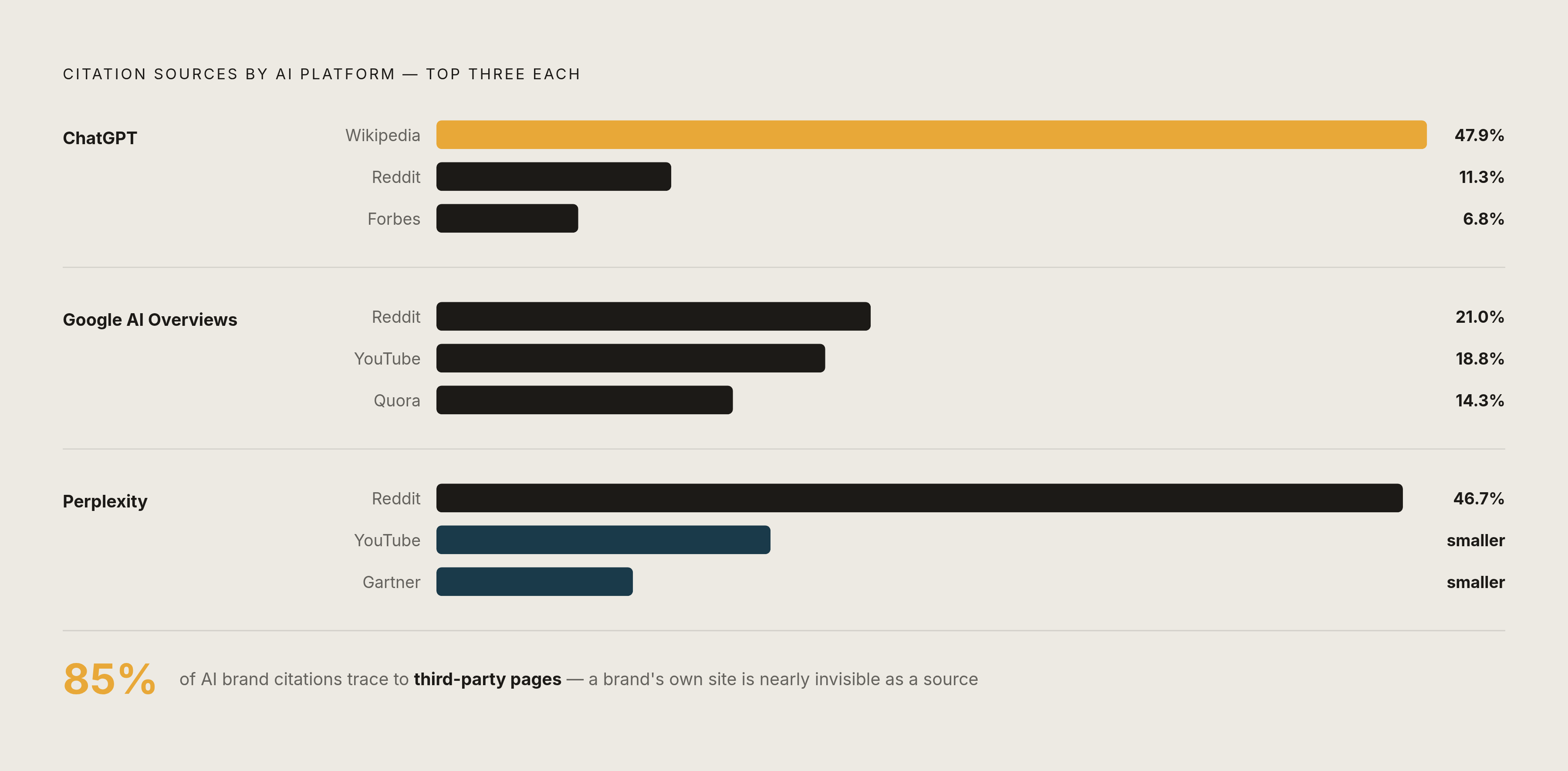
Most of what a model says about a brand doesn't come from that brand's own website. Roughly 85% of brand mentions in AI search trace back to third-party pages, and a brand is considerably more likely to get cited through someone else's domain than through its own.
The pattern shifts by platform, and the shifts are specific enough to plan around. ChatGPT leans hard on Wikipedia (roughly 47.9% of citations in one large-scale analysis), with Reddit and Forbes trailing well behind at 11.3% and 6.8%. Google's AI Overviews spread more evenly across Reddit (21.0%), YouTube (18.8%), and Quora (14.3%). Perplexity leans even harder into community content, pulling 46.7% from Reddit alone, with YouTube and Gartner picking up smaller shares.
LinkedIn's rise stands out on its own. It climbed from outside the top 20 to become the single most-cited domain for professional queries across AI search platforms broadly, in the stretch between November 2025 and February 2026. Separately, tracking from March to April 2026 found earned media and news coverage climbing to 39.5% of all AI citations, up from 38.3% the month before, the single strongest citation category tracked.
A brand's AI-generated sentiment is mostly a mirror held up to what other people and publications say about it. On-site content changes still matter, but they're a slow lever. One industry estimate puts third-party sourcing even higher, around 95% of all AI citations, which means monitoring only a brand's own pages catches almost none of what's actually shaping the answer.
There's also a decay problem. For fast-moving topics, content older than about 90 days starts sliding down the retrieval priority queue, according to FirstMotion's analysis of AI citation patterns. Sentiment can shift because the coverage describing a brand simply aged out of the model's preferred sources, even when nothing about the brand itself changed.
Platform mechanics diverge further in ways that affect what's worth tracking. Perplexity and Microsoft Copilot include external links in most of their responses, making citation tracking straightforward. Claude mentions brands often but links out less, favoring conversational integration over inline citations, making citation tracking less straightforward on that platform. ChatGPT tends to favor already well-known brands, while Perplexity mentions a wider spread of brands per answer. Copilot, notably, leans on LinkedIn heavily for B2B queries, which explains part of that platform's citation surge.
The AI search monitoring tool landscape in 2026: what each platform covers
The monitoring tool market has split into a handful of distinct approaches, and picking one starts with knowing which slice of the problem each platform was actually built to solve.
One category is purpose-built for measuring brand visibility inside AI-generated answers directly, covering source citations, sentiment, and prompt-level volume tracking, with tiered pricing running from roughly $99 a month up through custom enterprise plans. Another set of platforms focuses on crawler and citation intelligence specifically, offering SOC 2 certification and a real-time feed showing exactly when bots like GPTBot or PerplexityBot hit a given page, which lets a team line up crawler activity against citation shifts on a timeline.
For teams already running SEO tooling, a few platforms extend an existing rank-tracking workflow to cover AI visibility rather than replacing it outright, adding AI citation tracking, brand mention monitoring, and competitor benchmarking alongside the traditional keyword data. The overlap between Google's top-10 organic results and the sources AI platforms actually cite has fallen to just 12% across platforms, so ranking well in classic search tells a team almost nothing about whether it'll get cited in an AI answer.
On the affordable end, at least one tracker covers Google AI Overviews, ChatGPT, and Perplexity with regional monitoring across multiple countries, tracking mentions, sentiment, citations, and competitor visibility, priced from $69 a month at the entry tier up to $159 for the full feature set. Broader SEO suites have folded in prompt tracking and AI visibility research alongside their existing rank tracking and audit tools, and at least one has published large-scale research analyzing a huge volume of AI search prompts to map visibility patterns across the market.
One platform distinguishes itself with dual-layer tracking, watching both the LLM's generated responses and the real-time web searches the model runs behind the scenes to gather current information, combined with traditional SEO rank tracking in the same dashboard, starting at $29 a month. Another delivers daily tracking with unlimited seats and sentiment metrics aimed at agencies juggling multiple client accounts, suggesting prompts based on a site's own content and, as of mid-2026, extending share-of-voice measurement down to the individual product level for AI shopping answers, tracking specific SKUs rather than just brand names, priced around €89 a month.
A more analytics-focused entrant calculates Share of Voice, Mention Rate, and Citation Rate with multi-model aggregation on a weekly cadence, covering ChatGPT, Perplexity, Gemini, and both Google AI surfaces, with plans starting at €49 a month for 50 tracked prompts and a 14-day free trial. And at least one major marketing platform has folded AI visibility scoring, share of voice, and citation tracking directly into its existing marketing suite, bundled with its higher-tier plans, available standalone for around $50 a month, with a free one-off grading tool for teams that just want a snapshot.
Every one of these platforms uses the phrase "share of voice" somewhere in its marketing. None of them mean quite the same thing by it. That inconsistency from the metrics section doesn't go away just because a vendor built a nice dashboard around it, so ask each one directly what formula sits behind the number before trusting it.
Matching monitoring tools to team type and use case
The decision comes down to five variables that don't always pull in the same direction: how many platforms a tool covers, whether it goes deep on sentiment or deep on crawler data, what it costs, whether it needs to slot into an existing SEO workflow or stand alone, and whether the team actually wants monitoring or wants action.
Enterprise teams running full answer-engine-optimization programs across multiple models at once need cross-platform command more than anything else, the ability to catch a hallucination on one model and a citation shift on another inside the same view. Marketing teams and agencies running generative-engine-optimization campaigns tend to need the opposite depth: prompt-level, per-response sentiment drill-down that shows exactly which query triggered which tone shift. SEO teams looking to bolt AI visibility onto existing workflows are usually better served by tools that extend what they already use rather than asking them to learn an entirely new platform from scratch.
Security and compliance requirements point toward platforms offering formal certification and transparent crawler logging, since some enterprise procurement processes won't clear a vendor without it. Agencies managing brands across several countries and languages need seat limits and language coverage that scale without renegotiating a contract every time a new client signs. And teams just getting started, without budget for an enterprise contract, have real entry points in the $29 to $69 monthly range that still cover the core platforms.
One data point should settle any argument about whether single-platform monitoring is good enough: Consistency across platforms is rare enough that measuring only one gives a badly distorted picture of actual visibility. Whatever platform a team lands on, use the trial period deliberately. Run the free 14 days and ask one question honestly: does this tool hand back an executable brief, or just a dashboard full of numbers with nowhere to go? That distinction is what separates a monitoring tool from a strategy tool.
Turning sentiment data into content and PR action
Sentiment data is only useful if it changes what a team publishes and who it pitches. Three actions follow directly from it.
The first is content gap identification. When a tracked prompt keeps returning neutral or negative mentions, that usually indicates missing or stale owned content: a product page that's never been written, a comparison page that hasn't been updated in a year, or simply no third-party coverage anywhere on a topic the model keeps getting asked about.
The second is digital PR prioritization, and this is where the third-party citation data from earlier becomes actionable rather than just descriptive. Given that the overwhelming majority of AI citations trace to sources outside a brand's own site, earning a mention in a well-regarded trade publication or a widely-read community thread can shift a model's tone faster than any amount of on-site editing. Prompt-level sentiment tracking tells a team precisely which topics are starving for third-party coverage, rather than leaving PR teams guessing at which pitch might land.
The third is measuring whether any of it worked. Tracking NSS over time after a piece of content goes live or a press mention lands is the only way to know whether that investment actually moved the needle, or whether the sentiment shift was already happening for unrelated reasons.
One useful technique is to deliberately run adversarial prompts like "which tools in this category should I avoid," alongside the normal neutral queries, since that phrasing pushes a model to surface specific negative attributes it associates with a brand that balanced questions never reveal. It's an extreme-sentiment lens, and it tends to expose exactly what's dragging a score down.
Shifting how a model talks about a brand takes real volume, not a single blog post. One cited target is around 250 published pieces, spanning owned content, guest posts, editorial placements, forum contributions, and video reviews, since models tend to favor listicles, comparison guides, and pages loaded with question-and-answer content over straight marketing copy. Research out of a 2024 academic study (Aggarwal and co-authors, presented at KDD, with researchers behind the GEO study (Aggarwal et al., KDD 2024)) found that adding direct quotations from credible sources raised a page's share of AI answers by roughly 41%, adding statistics lifted it by about 31%, and citations themselves added roughly 28%. The same body of research found adding quotations from credible sources raised a source's share of the AI answer by roughly 41%, and full structured-data implementation lifted AI extractability by 27%. These aren't abstract SEO best practices, they're specific, testable levers a content team controls directly.
Freshness closes the loop. For anything time-sensitive, pricing pages, feature comparisons, regulatory guidance, content older than 90 days starts losing retrieval priority on at least one major platform's citation logic. Reviewing and refreshing that content every six to nine months is the baseline cited for staying inside the window models actually pull from.
The gap between traditional search performance and AI search presence
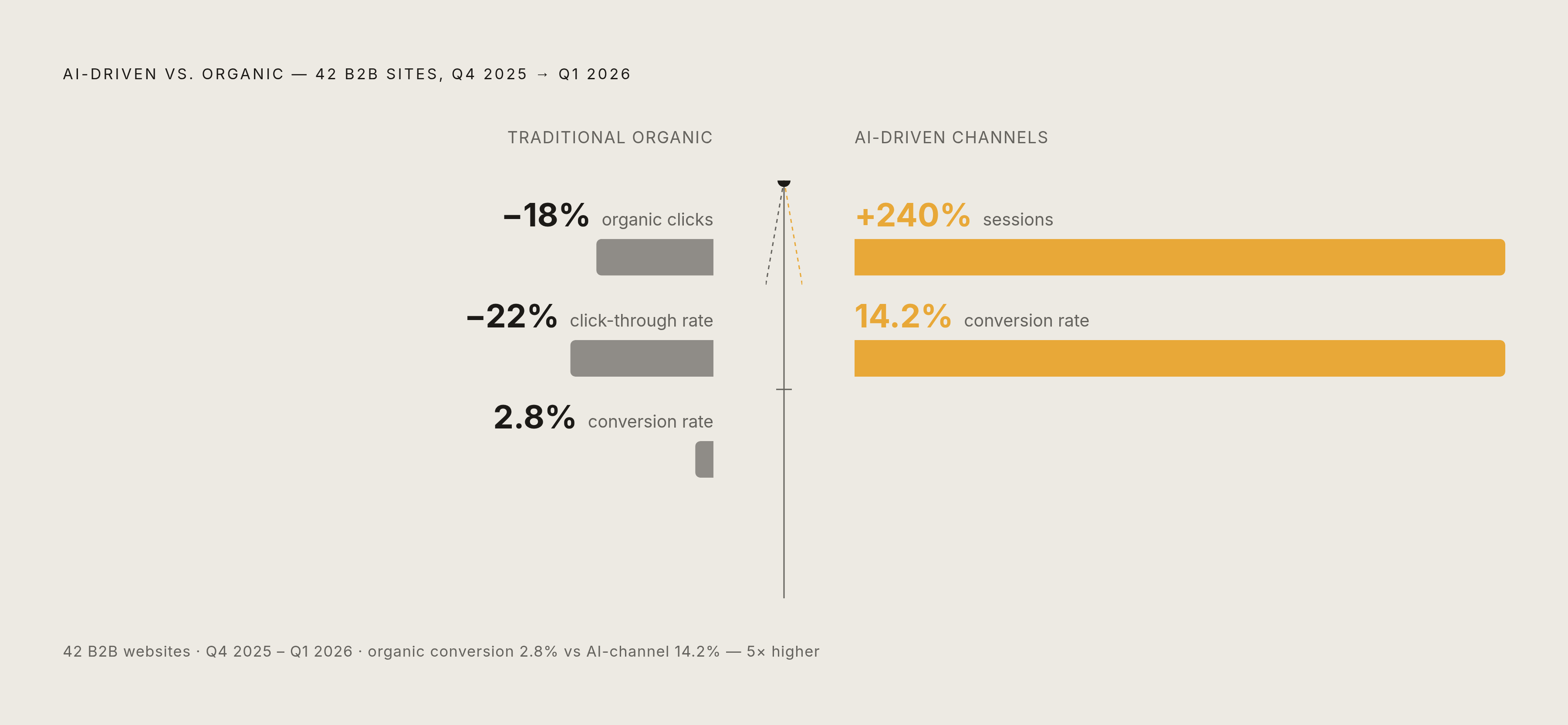
A pattern across 42 business-to-business websites tracked from the fourth quarter of 2025 into the first quarter of 2026 makes the stakes plain. Adding statistics raised a source's share of the AI answer by roughly 31%, which sounds like growth, until the rest of the numbers land: organic clicks fell 18%, and click-through rate dropped 22%. Meanwhile, sessions arriving through AI-driven channels jumped 240%, and those sessions converted at 14.2%, against just 2.8% for the traditional organic traffic sitting alongside them.
That's what gets called the crocodile mouth: visibility climbing on one jaw, clicks collapsing on the other, and a much smaller but far more valuable stream of traffic referred by AI tools opening up in between. A brand can watch its impression count rise in a traditional dashboard and still be losing the fight for how it gets described the moment a buyer asks an AI model directly. The websites still measuring success by click-through rate alone are reading half a signal, and that half matters less every quarter.