DeepSeek and Emerging LLMs in Brand Visibility Tracking
Brands now lose visibility across a fragmented AI search landscape they aren't tracking.
Search engines are losing ground, and the timeline moved faster than most forecasts expected. Gartner had predicted a 25% drop in traditional search volume by 2026, and the research brief behind this piece found that decline had already materialized. The channel that replaced it is a dozen platforms, and most brand tracking still only watches one or two of them. It's a dozen, and most brand tracking still only watches one or two of them.
The numbers explain why this matters. ChatGPT now reaches 883 million monthly users. Google's AI Overviews show up in nearly 55% of all Google searches. HubSpot data found AI-referred traffic up 527% year over year, while traditional organic traffic dropped 27% over the same stretch. An Eight Oh Two study puts the share of consumers who now start their searches in an AI tool, rather than a search engine, at 37%.
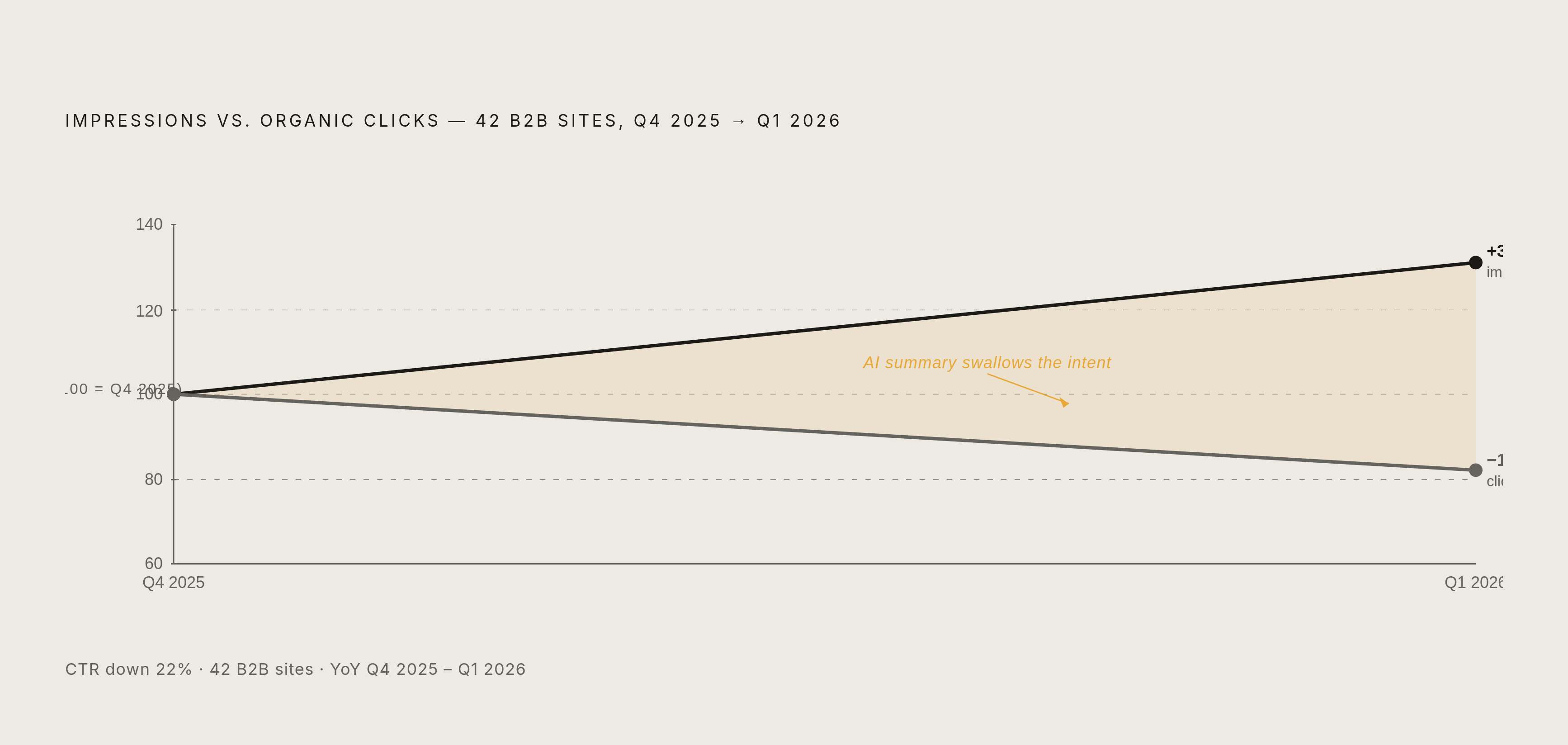
None of that traffic behaves like the old kind. Available data puts roughly 93% of AI search sessions ending without a click. If a brand isn't named in the answer itself, it doesn't get a second chance further down a results page, because there is no results page. A pattern documented across 42 B2B websites between Q4 2025 and Q1 2026 makes the mechanism plain: impressions grew 31% year over year while organic clicks fell 18% and click-through rate dropped 22%. The label for this is the "Crocodile Mouth Effect," and it describes what it sounds like: the AI summary swallows the intent before the click ever happens. A brand's marketing team can watch its impressions climb on a dashboard while its actual traffic quietly bleeds out, and the dashboard will look fine the whole time.
Any team still optimizing purely for ranked page visits is measuring a channel that's structurally shrinking. The audience already moved into the answer box. What's less understood is that the answer box is now several boxes. It's several, built by different companies, trained on different data, and increasingly, not all of them are Western.
Why the AI search landscape is no longer one platform's territory
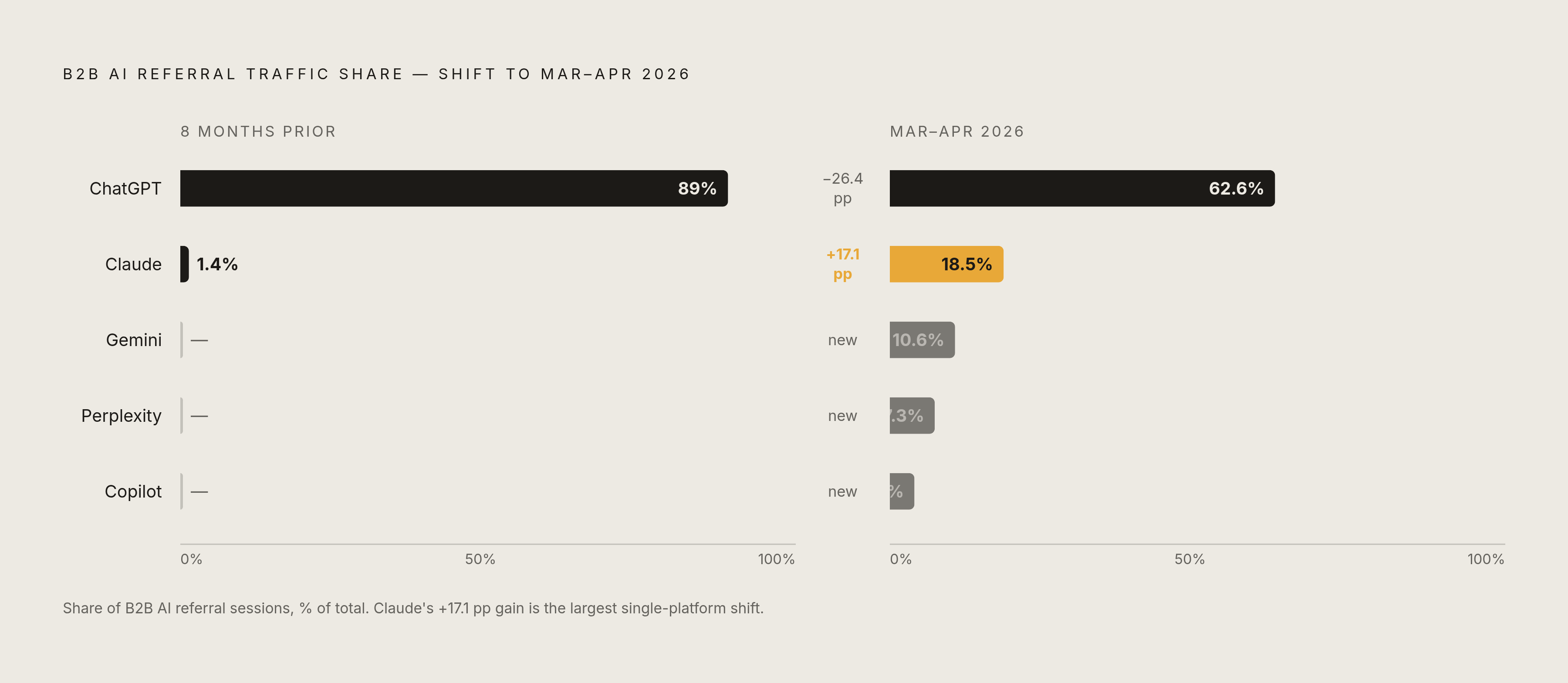
Eight months before this research was compiled, ChatGPT accounted for 89% of B2B AI referral traffic. By March and April of 2026, that share had fallen to 62.6%. The "Big One" became the "Big Four" in under a year.
Claude climbed from 1.4% to 18.5% of that referral mix. Gemini reached 10.6%. Perplexity hit 7.3%. Copilot held near 4%. Each of those gains came from a different audience finding a different reason to trust a different assistant, not from users abandoning ChatGPT wholesale. OpenAI itself reported 800 million weekly users in the first quarter of 2026, so the pie grew even as ChatGPT's slice of the referral mix shrank.
The reason this fragmentation matters for brand visibility is plumbing. It's plumbing. Each platform runs on a separate retrieval system, a separate training corpus, and a separate logic for deciding what gets cited. ChatGPT pulls search results from Bing and rewards a strong Wikipedia presence along with broad editorial authority. Claude retrieves through Brave Search and favors long-form content with explicit, traceable sourcing. Gemini draws on Google's own index and leans toward brand-owned domains that use structured schema markup. Perplexity crawls the live web directly, and it leans on Reddit threads, vertical directories, and data-heavy pages, weighting recency far more heavily than the others do.
A Yext analysis covering more than 6.8 million AI citations found that only 11% of cited domains show up across multiple platforms for the same query. Getting cited on one model tells you almost nothing about whether you'll get cited on the next one. Optimizing for a single platform, even the biggest one, leaves a brand structurally invisible everywhere else buyers are asking questions.
And the field keeps widening. KIME's March 2026 landscape review, "Most Significant LLMs of 2026 for Brands," lists GPT-5, GPT-4o, o3, Gemini 2.5, Gemma 3, Llama 4, DeepSeek R1, DeepSeek V3.1, Claude, Command, Amazon Nova, Magistral, Qwen3, and Grok 4, all active at once, each with its own access model and its own user base. That list keeps growing, and the newest entrant with the largest non-Western footprint deserves its own explanation.
What DeepSeek is, how it reached scale, and why it behaves differently from Western models
DeepSeek R1 launched in January 2026 as a state-of-the-art reasoning model built by a Chinese AI lab and released with open weights, developed on notably constrained hardware compared to rival Western labs. It set off a wave of industry attention that hasn't really faded since.
Its current flagship model holds up well against comparable frontier systems on general benchmarks, and an optional reasoning mode makes it one of the more flexible open alternatives to closed, proprietary models like GPT-5 or Gemini. On the API side, the V4 Flash and V4 Pro models have already been superseded: V4 Flash retired in favor of V4.1 Flash, and as of September 14, 2026, calls to deepseek-v4-pro route to V4.1 Flash instead. Because the weights are open, third parties can also run and fine-tune the models entirely outside DeepSeek's own API, which matters more than it might sound.
DeepSeek's training corpus skews differently from the corpora behind ChatGPT or Gemini, and that difference directly shapes what gets said about a brand. It can surface different competitors for the same query, cite different sources, and land on different sentiment toward the same company, without anything resembling a technical hallucination. Its coverage of APAC brands runs deeper, and a Western brand with thin press presence across Asia may simply recall differently, sometimes less favorably, on DeepSeek than it does on a model trained mostly on English-language, Western media.
The open-source structure compounds this. Because self-hosted and fine-tuned deployments can diverge from the official API, a tracker watching only DeepSeek's hosted API doesn't see every version of DeepSeek that a buyer might actually be talking to.
Geography makes the stakes concrete. LLM Pulse's July 2026 data shows DeepSeek has become one of the most-used AI assistants in China, Japan, South Korea, and Southeast Asia, and it's gaining ground internationally among cost-conscious enterprises and developer audiences. This is an active discovery surface for millions of buyers in some of the fastest-growing markets in the world, running on assumptions that most Western brand teams have never had to account for. It's an active discovery surface for millions of buyers in some of the fastest-growing markets in the world, running on assumptions that most Western brand teams have never had to account for.
The blind spot that single-platform tracking creates for global brands
Go back to that 11% overlap figure from the Yext citation study. A brand that shows up in a ChatGPT answer has roughly an 89% chance of being absent from the identical query on a different platform. DeepSeek doesn't shrink that gap. It widens it, because its training data and retrieval logic diverge from the Western models more sharply than Claude or Gemini do from ChatGPT.
The zero-click environment is what makes this gap invisible on a dashboard. A brand can vanish from DeepSeek's answers on the exact queries shaping purchase decisions across Southeast Asia, while its Google organic traffic in one large Western market and another holds perfectly steady. No alert fires. No line drops on the chart marketing is watching, because that chart was never built to see the platform where the drop is happening.
That blind spot creates three risks. First, sentiment: a training-data skew can produce a brand position on DeepSeek that differs from what ChatGPT or Gemini generate for the exact same brand, without any error occurring in the technical sense. Second, competitive framing: DeepSeek's different training corpus means the competitive landscape it surfaces for a given query can differ meaningfully from what Western LLMs present. Third, the open-weight problem again: third-party fine-tuned deployments can produce brand responses that differ from what the official API returns, because the weights are open and deployable outside DeepSeek's own infrastructure.
The research behind this piece found that 73% of B2B buyers now use AI tools somewhere in their research process, as of early 2026. For any brand with meaningful exposure across APAC markets, a real slice of that research is happening on a platform most tracking setups don't even list as an option.
The next question follows directly: DeepSeek isn't the only model creating this kind of exposure, and a brand team needs a way to sort the growing list by actual risk rather than by whichever name is loudest in the press.
Which other emerging models are creating new brand-visibility surfaces in 2026
KIME's March 2026 landscape review names several models confirmed active with distinct ways of reaching users, and each one changes the calculus differently depending on who a brand is trying to reach.
Llama 4, built by Meta, runs open and multimodal, and it's integrated into Meta's family of apps as Meta AI, reaching a massive base of monthly active users. It behaves more like a conversational companion than a discovery engine, so its brand-visibility weight is real but different in kind from a search-style query. Qwen3, from Alibaba Cloud, runs open with API access and carries strong multilingual training across 119 languages, with particular strength in Chinese-language and broader regional tasks, carrying much the same geographic implications for brands as DeepSeek does. Grok 4, built by xAI, is multimodal and available through both API and chatbot, and its citation habits lean away from the mainstream media stack that feeds most Western models, which makes it disproportionately important in categories where X functions as the primary conversation surface. Magistral, from Mistral, adds reasoning capability across API, chatbot, and open-model access. Amazon Nova is multimodal with API access and matters most for brands embedded in AWS infrastructure or e-commerce. Gemma 3, from Google, runs open and isn't a standalone consumer chatbot, but it shows up embedded inside third-party applications.
One pattern cuts across nearly all of them. The AI Platform Citation Source Index 2026, compiled by 5WPR from more than 680 million individual citations across ChatGPT, Google AI Overviews, Perplexity, Gemini, and Claude, found Reddit is the single most-cited source across every major AI engine studied, showing up at roughly 40% frequency and appearing in answers for 56% of audited brands. YouTube followed at 51%. Those five platforms were the ones studied directly, but the underlying reason, that these models train on public web content where Reddit and YouTube dominate discussion volume, plausibly extends to newer models trained the same way.
None of these models deserve equal urgency. A brand with real APAC exposure should treat DeepSeek and Qwen3 as the priority. A brand competing in categories where conversation happens on X should watch Grok closely. A brand selling into enterprise cloud buyers should keep an eye on Amazon Nova. Triage by where the actual buyers are, not by which model got the most coverage that month.
What the tracking tooling landscape covers for DeepSeek and emerging models
Search Influence's comparative analysis, covering more than 15 platforms, shows a tracking category that's grown fast. DeepSeek coverage specifically, though, is still the exception rather than the rule.
LLM Pulse's own July 2026 guide describes its DeepSeek tracking as the most complete on the market: mentions, sentiment, and share of voice, all available. It sits as an optional Enterprise or custom-plan add-on alongside five models included by default (ChatGPT, Perplexity, Gemini, Google AI Overviews, and Google AI Mode), with Claude and Copilot offered as separate paid add-ons. Pricing starts at €49 a month with a 14-day free trial, and DeepSeek tracking is available within the paid Enterprise tier specifically.
A handful of other tools confirm DeepSeek coverage too, each with its own shape. Rankscale tracks DeepSeek alongside ChatGPT, Gemini, Perplexity, Claude, Copilot, Grok, and Meta AI, refreshing anywhere from hourly to monthly depending on plan, starting at $20 a month. Promptmonitor covers DeepSeek plus ChatGPT, Claude, Gemini, Grok, and Perplexity, with Google AI Mode and AI Overviews unlocked on its Pro tier, refreshing at varying frequencies across its Starter, Growth, and Pro plans, with a promotional Starter rate of $29 a month. FinSEO confirms DeepSeek tracking alongside ChatGPT, Gemini, and Perplexity, refreshing weekly, with pricing available by direct contact.
Some platforms explicitly leave DeepSeek out. One enterprise analytics tool named in LLM Pulse's July 2026 comparison table doesn't list DeepSeek in its model coverage at all, tracking a range of platforms including ChatGPT, Perplexity, Google AI Overviews, and Microsoft Copilot, starting at $250 a month.
KIME and other tools flagged in Search Influence's broader May 2026 review offer domain citation tracking and competitor comparison dashboards showing how different AI models reference brand information, described in that analysis as an emerging platform still proving... KIME offers domain citation tracking and competitor comparison dashboards showing how different AI models reference brand information, described in that analysis as an emerging platform still proving itself. Akii offers a free, on-demand visibility check across ChatGPT, Gemini, Claude, and Perplexity, though DeepSeek coverage isn't documented in LLM Pulse's comparison table.
The pattern across nearly every tool in this space: ChatGPT, Gemini, Perplexity, and AI Overviews get first-class treatment by default. DeepSeek is usually an add-on, sometimes absent entirely. Qwen3, Magistral, and Amazon Nova coverage isn't confirmed across any of the tools sourced here. A brand relying only on off-the-shelf tracking is, by construction, missing a widening share of the field.
Research flagged in Search Influence's analysis, credited to SparkToro, found real variability in AI-generated brand recommendations even when the exact same prompt gets run more than once. Research flagged in Search Influence's analysis, credited to SparkToro, found real variability in AI-generated brand recommendations even when the exact same prompt gets run more than once. A single snapshot query might just be catching noise about how a brand actually performs on that model. Trend lines built from repeated tracking over time reveal durable performance, while any single query result may not.
How to measure brand share of voice across a multi-model landscape
The metric that actually normalizes across all of this is straightforward: AI Share of Voice equals the number of times a brand gets mentioned, divided by total brand mentions across every tracked prompt, multiplied by 100. It's a ratio, not a raw count, so it works across platforms that generate wildly different response lengths and mention different numbers of competitors by default.
Absolute mention counts hide the story that matters. A brand can rack up plenty of mentions on ChatGPT while quietly losing ground to a competitor on DeepSeek, and a dashboard tracking raw counts alone will never surface that shift, because the climbing ChatGPT number masks the DeepSeek decline. Share of voice, calculated per platform and then compared across platforms, is what actually reveals a shift like that.
Given that 73% of B2B buyers now use AI tools somewhere in their research process, AI share of voice functions as a leading indicator of pipeline.
A handful of supporting metrics fill in what raw share of voice can't capture on its own. Sentiment needs to be tracked per model, separately, since DeepSeek's different training corpus can produce a systematically different sentiment reading than ChatGPT generates for the identical brand. Citation rate and source influence matter too, and they carry different weight depending on the platform: a Spotlight analysis of more than 2.4 million AI responses found that Perplexity and Copilot include external links in over 77% of responses, so a missing citation means something different on each. Answer position matters as well, distinguishing a brand that's named first from one buried among alternatives or left out entirely.
Prompt coverage deserves its own scrutiny: is the query set actually built from the language and phrasing real buyers use, across the regions and languages those buyers speak, or is it a handful of English-language prompts run through every platform out of convenience? Hallucination risk, meaning outdated or simply incorrect brand claims that need active correction, belongs on the list too, along with regional visibility, particularly relevant for DeepSeek given how differently APAC-market prompts can perform against English-language ones. And competitor visibility, tracked model by model, closes the loop, because a brand's own numbers only mean something in relation to who's beating it, on which platform, and why.