AI Overviews Tracking Tools for Marketing Teams
Discover which platforms cite your brand and how to measure what actually matters.

What AI Overviews tracking tools measure, and where they differ
The way people search has changed, and most marketing teams still measure the old thing. AI engines now hand users one synthesized answer instead of ten blue links, which turns the real question from "did I rank?" into "did I get named?" OpenAI figures put ChatGPT's weekly active users at roughly 900 million, and SparkToro's analysis of Similarweb clickstream data found that about 68% of Google searches in early 2026 ended without a single click. Ranking on page one buys almost nothing if the answer never leaves the AI interface.
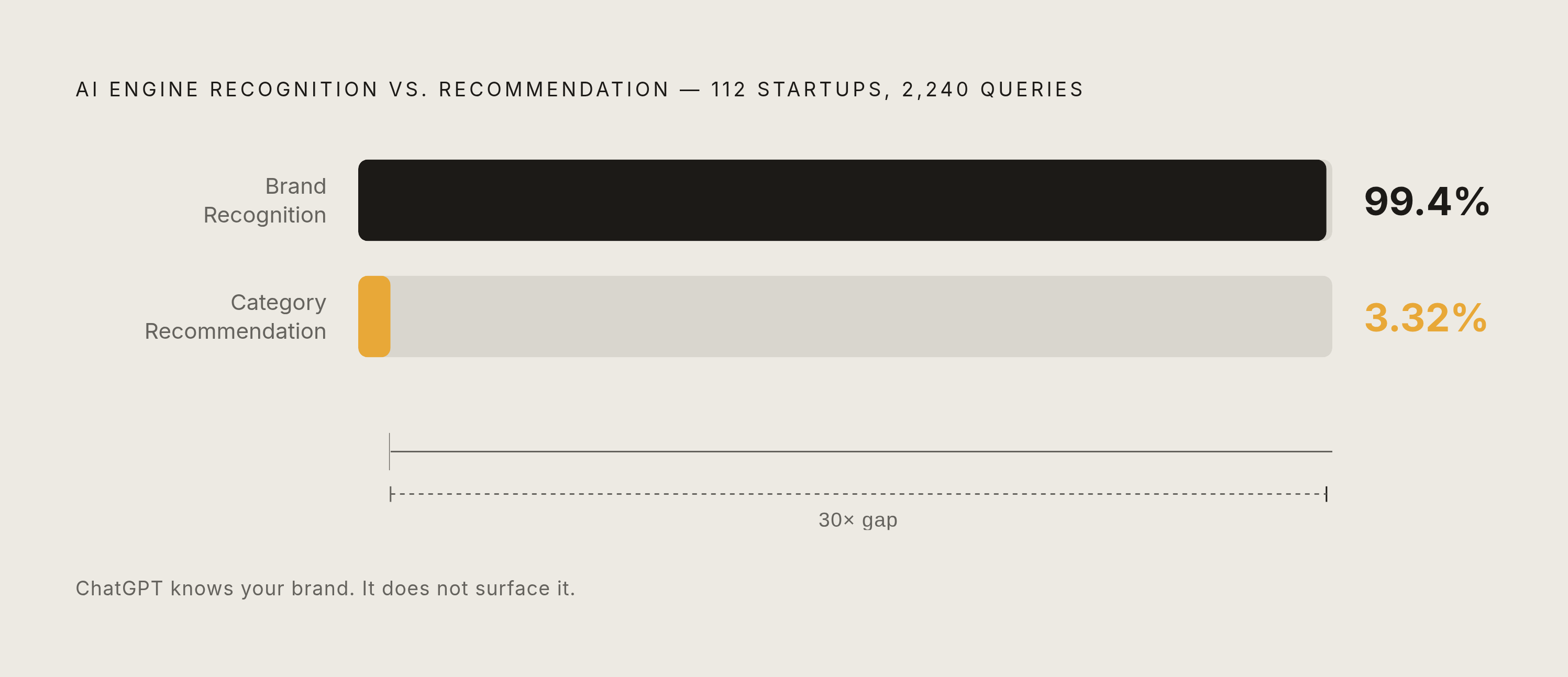
A study covering 112 startups across 2,240 queries makes the gap concrete: ChatGPT recognized these brands by name with 99.4% accuracy, but recommended them in category searches only 3.32% of the time. That is roughly a 30-to-1 drop between being known and being chosen, and it is the reason a rank tracker built for a web of blue links cannot do this job. Rank trackers report position and stop there. They say nothing about whether ChatGPT actually recommends a brand, whether Perplexity cites its product guide, or how any engine describes that brand once it shows up. Treating an AI Overviews tool as a bolt-on to an existing SEO suite means misreading everything it tells you, because it is measuring a different thing.
Four dimensions separate one tool from another here, and buyers who skip past them end up comparing dashboards instead of substance. The first is engine coverage: which platforms a tool actually queries, whether that's ChatGPT, Perplexity, Google AI Overviews, Gemini, Claude, Copilot, or Grok. The second is the split between citation tracking and mention tracking, and this is where most teams get tripped up. A tool can record that a brand got named in the generated text without ever noticing that a different URL got cited as the source, or the reverse. It is possible for an engine to cite a brand's URLs without ever naming the brand in the generated text, a ghost citation that a shallow tool misses every time.
Citation rate, defined properly, is the share of responses that cite a given domain, and it moves independently of how often the brand's name shows up in prose. A 2026 measurement framework analyzing 21,143 citations pushed a layer deeper, distinguishing between which sources get referenced and how much each one actually shapes what the model says. Counting citations alone tells half the story while calling it the whole thing.
Then there's prompt variance, and this is the one most vendors would rather you not think too hard about. AI answers are probabilistic, so running a query once tells you almost nothing. Research has documented real, meaningful swings in AI brand recommendations even when the identical prompt gets asked twice, a pattern that holds across engines. A tool worth paying for runs each prompt multiple times and reports an average; a tool that samples once is reporting a single roll of the dice and dressing it up as a measurement.
Refresh cadence decides what decisions are even possible. Daily tracking catches a citation gained or lost this week. Monthly tracking is too slow to catch much of anything before the moment has already passed. Sentiment matters just as much as frequency, too: a mention is not a win if the engine gets the brand's details wrong or pairs it with a competitor's features by mistake. Before comparing vendors, know which of these four dimensions actually matters for your situation. That question should drive everything that follows.
How each major AI engine sources answers differently
The engines don't draw from the same wells, and treating them as interchangeable is the single most common mistake teams make when reading a visibility report. An analysis of 6.8 million citations across 1.6 million responses found Gemini leans hard on Google's organic ranking signals, pulling 52.15% of its citations from brand-owned websites. ChatGPT does close to the opposite: 48.73% of its citations come from third-party directories and general internet consensus, not the brand's own pages. Perplexity favors industry expertise and customer reviews, and it's chatty about sourcing: five to twelve footnotes per answer, more citations than most engines produce, though each individual source carries less weight in shaping the final answer. ChatGPT works the other way, using just two to four citations per answer but squeezing more influence out of each one. Claude sits in the middle, citing two or three sources per response and favoring long-form editorial content over quick reference pages.
One detail cuts across every engine: Reddit commands an outsized share of citations, which alone should redirect where a content team spends its time this quarter.
The practical consequence is that a brand can dominate ChatGPT's answers for a given query and barely register on Perplexity for the identical query. Research consistently shows that the source overlap between the two platforms is narrow. Separate research from an AI visibility index found only 36 of 1,200 brands studied showed up consistently across every major AI platform. Consistent, durable presence across engines is the exception, not the rule. A single-engine tool is close to useless for this job.
A tool that tracks one engine, or worse, blends everything into a single averaged score, hides the exact engine where a brand is quietly losing ground. Per-engine breakdowns are the entire point of buying one of these tools. They're the entire point of buying one of these tools.
The hallucination risk that tracking tools must expose, not just ignore
General-knowledge queries carry an average hallucination rate of 9.2% across major AI models, right where brand facts, pricing, and product specs live. That's not a rounding error tucked into a footnote somewhere.
PAN Communications' research on senior B2B buyers in the US found 73% of them now use AI as their first stop when researching vendors. Of the citations ChatGPT provided for those exact queries, 31% were either misattributed or made up. Fabrication appears in a few recognizable patterns: invented statistics attributed to a brand that never published them, fake citations pointing to studies that don't exist, and entity confusion, where a model borrows the wrong founder, the wrong headquarters, or the wrong founding date from a competitor and pins it on the brand actually being researched.
There's a strange wrinkle in the 2026 data, too. Top models have pushed hallucination rates on simple document summarization down to as low as 0.7%, but the strongest reasoning models drift more on complex tasks, not less. More "thinking," it turns out, sometimes pulls a model further from its source material instead of closer to it.
Currently, no formal correction mechanism exists for brand-specific hallucinations on any major AI platform. The only real lever is fixing the underlying sources these models trust: correcting the third-party pages an engine draws from, since there's no one to appeal to at the engine itself. A tool that only counts how often a brand's name appears, without checking what's actually said about it or whether that description holds up, cannot catch one of the most damaging failure modes in this whole category. Sentiment and factual-accuracy layers are core to the job here. They're core to the job.
The business world has already priced this risk in. Research from The Conference Board and ESGAUGE found 38% of large US companies named AI reputation risk their top business concern in 2025, ahead of cybersecurity at 20%. That marks the first year AI reputation risk outranked cybersecurity in that survey, and it says something about how fast this shifted from theoretical to operational.
Evaluating the tools: coverage and gaps across leading platforms
Two distinct groups of vendors are building in this space, and neither one is automatically the right pick. One group is bolting AI monitoring modules onto existing SEO suites. The other is building AI-native platforms from scratch, with no legacy rank-tracking product sitting underneath. Fit depends on which of the measurement dimensions above a team actually needs, not on how a vendor markets itself.
An enterprise-grade platform in this space runs daily tracking across major engines against a large, published database of LLM prompts, combining citation reporting, sentiment analysis, and prompt-volume research in one place. Entry pricing runs around $99 a month billed yearly, though broader engine coverage and organizational features push serious buyers into a higher tier fast. This suits a team with a dedicated person who owns the research and follows through on what the tool surfaces, since the entry tier rarely includes the widest engine coverage.
Other platforms position themselves as a single command center covering multiple major answer engines with prompt and competitor tracking built in, at entry pricing closer to $250 a month. Some of these are noticeably stronger at monitoring than at telling a team what to actually do next. They show what's happening more clearly than they prescribe a fix, and that gap matters once the invoice arrives.
At the low end sits a tool starting around $29 a month for a modest prompt allowance with daily checks, covering ChatGPT, Perplexity, Google AI Overviews, and Copilot as base engines, with Claude, Gemini, and AI Mode as paid add-ons. Tools at this price point often bundle citation reports showing which URLs actually surface, content-brief generation, and crawlability checks, plus reporting connectors and agency partner programs on higher tiers. Add up the real total once extra engines and prompt volume get tacked on, before comparing that number against anything else on this list.
Some platforms lean into visibility, sentiment, and source reporting with daily tracking and screenshot-based audit trails, built for marketing teams and agencies that need to show their work to a client. These tend to be monitoring-only, with no in-platform content generation, so check model coverage, project limits, and integration allowances against actual need before signing anything.
Other tools fold traditional SEO rank tracking and monitoring of how a brand appears in AI-generated results into one workflow, with geographic breakdowns and daily tracking of those AI-generated results. That suits a team that doesn't want to run two separate systems for organic search and AI visibility.
Among the more budget-conscious, agency-focused options, some platforms fold AI visibility into a broader toolkit at the lowest entry price in the category, with multi-brand support built into every tier. The tradeoff is thinner, newer engine coverage than the dedicated platforms offer, and no content workflow layered on top. Reasonable enough for a team already living inside that ecosystem for other reasons.
A large SEO suite added an AI Visibility Toolkit in October 2025, drawing on a database of 213+ million LLM prompts, priced at $165.17 a month billed annually for the entry plan that includes AI features (the base SEO plan without AI visibility starts at $117.33 a month). Engine coverage on the AI side is narrower than what the SEO half of the product implies, which matters for any team expecting parity between the two.
Another established SEO platform added AI monitoring under a "Brand Radar" style feature, but its prompts come from search-behavior data (a keyword database and People Also Ask results) rather than actual AI conversations, and most engines refresh only monthly rather than daily. That's a real limit for any campaign moving faster than a month-long cycle. It suits a team bridging established SEO habits into early AI visibility work, not one trying to catch a citation loss this week.
A newer entrant tracks visibility across ChatGPT, Perplexity, Claude, Gemini, Google AI Overviews, and Reddit in a single view, and generates queries automatically instead of making a team write them by hand. It produces daily briefs with ranked action items and pre-drafted content responses, and claims to measure attributed revenue tied back to AI-sourced pipeline. Its Reddit engagement feature answers directly to that roughly 40% citation frequency Reddit commands across engines.
Another platform covers ten or more engines, the broadest set among the tools reviewed here, and pairs content and outreach automation with its tracking layer. It also runs its own AI SEO agency service alongside the platform, its analytics run lighter than what dedicated monitoring platforms offer, and it comes with a partner directory and recurring revenue share for agencies that want to resell it.
A newer platform still building its track record offers domain citation tracking, competitor comparisons, and dashboards showing how different AI models reference brand information, priced at €99 a month. It's young enough that independent, extended review data is still thin on the ground.
Across this whole set, the cheapest published entry point is around $29 a month, mid-tier pricing clusters near the low three figures, and command-center platforms start closer to $250. Enterprise contracts get negotiated case by case. None of these ranks cleanly above the rest in some universal sense, and the criteria that matter, engine coverage, prompt methodology, citation attribution, sentiment layers, and the path from insight to action, are what a buyer should actually navigate by, not the size of the logo.
Five criteria that separate tools worth buying from tools that produce dashboards
Engine coverage has to match where a brand's actual buyers search. ChatGPT, Claude, and Google AI Overviews are the floor for nearly every vertical. Whether Perplexity, Gemini, Copilot, or Grok matter beyond that depends entirely on the audience, and a tool should get judged against the specific engines that audience uses, not against completeness for its own sake.
Prompt methodology comes second, and it's where a lot of tools cut corners nobody notices until the numbers stop making sense. Does the tool run each prompt multiple times and average the results, or sample once and call that a score? Given how much variance SparkToro found even in identical, back-to-back prompts, a single snapshot measures noise, not signal. Trend lines built over time are the only defensible basis for a real decision here.
Third, citation source attribution. Knowing which pages earn citations, and whether those pages belong to the brand or sit on someone else's site, tells a team exactly where to put its next piece of content. Between 82% and 85% of AI citations come from third-party sources rather than a brand's own website, so a tool that reports domain-level citation rates without ever surfacing the actual source URLs leaves the real optimization question unanswered.
Fourth, sentiment and accuracy monitoring. With a 9.2% hallucination rate on general-knowledge queries and PAN Communications finding 31% of ChatGPT's B2B citations misattributed or fabricated outright, a tool with no accuracy layer simply cannot catch the failure modes that carry the most reputational weight.
Fifth, and this is where most tools quietly fall short: a real path from insight to action. The weakest tools stop the moment they generate an alert. The strongest ones connect that alert to the actual content and optimization work needed to close the gap. Before signing anything, ask a vendor to walk through, step by step, what happens after a visibility drop gets flagged.
Agency teams carry an extra checklist on top of all this: per-client workspaces, a live environment that can show a prospect their AI visibility during a pitch call, and white-label or co-branded reporting. Pure monitoring tools don't always build these in, so ask directly. And across this whole category, pricing and packaging shift often enough that any figure quoted here needs confirming with the vendor before a contract gets signed.
Turning visibility data into content decisions, what the tracking output should drive
None of this tracking is worth paying for if nobody acts on what it finds. A visibility drop or a lost citation only creates value once someone digs into why it happened, decides what to fix, and checks whether the fix actually worked. A dashboard doesn't buy better recommendations by itself; someone still has to do the work it points toward.
Certain content formats get pulled into AI answers more reliably than others, and this is exactly where tracking data should steer a content calendar. Pages with a clear, well-structured heading hierarchy get extracted cleanly. "X versus Y" comparison pages, especially ones built around a table, perform well because the structure maps directly onto how these models summarize a decision. Step-by-step content with numbered instructions gets lifted intact far more often than prose paragraphs saying the same thing. Direct "What is X" framing, answering one narrow question, is the format these engines reach for first.
A tracking tool earns its cost when it points at the specific page, the specific engine, and the specific gap between what's true and what a model is currently saying. Everything past that point is a person's job, not the dashboard's.