E-Commerce Brand Visibility in AI Shopping Recommendations
Brands invisible to AI shopping assistants lose sales before shoppers click through.

A shopper asks an AI platform "what's the best running shoe for flat feet" or "which mattress brand is best for side sleepers," and the answer that comes back has already done the work a search results page used to leave to the shopper. It does not hand you ten blue links to sort through. It synthesizes a shortlist, sometimes a single name, from everything it has gathered about that category, often before the shopper has opened a single product page. By the time a buyer lands on a brand's site, that buyer may have already decided, inside the AI conversation itself, whether the brand belongs on the list or has been crossed off it. This is a structurally different mechanism from traditional search. A brand's organic search rankings and what AI platforms cite barely overlap, so if you rank well on the SERP, that does not mean you show up in AI recommendations. A brand can hold page-one rankings across its category and still be absent from every AI-generated shopping answer, invisible at the exact moment a shopper is forming a preference, not merely searching for options.
What the research shows
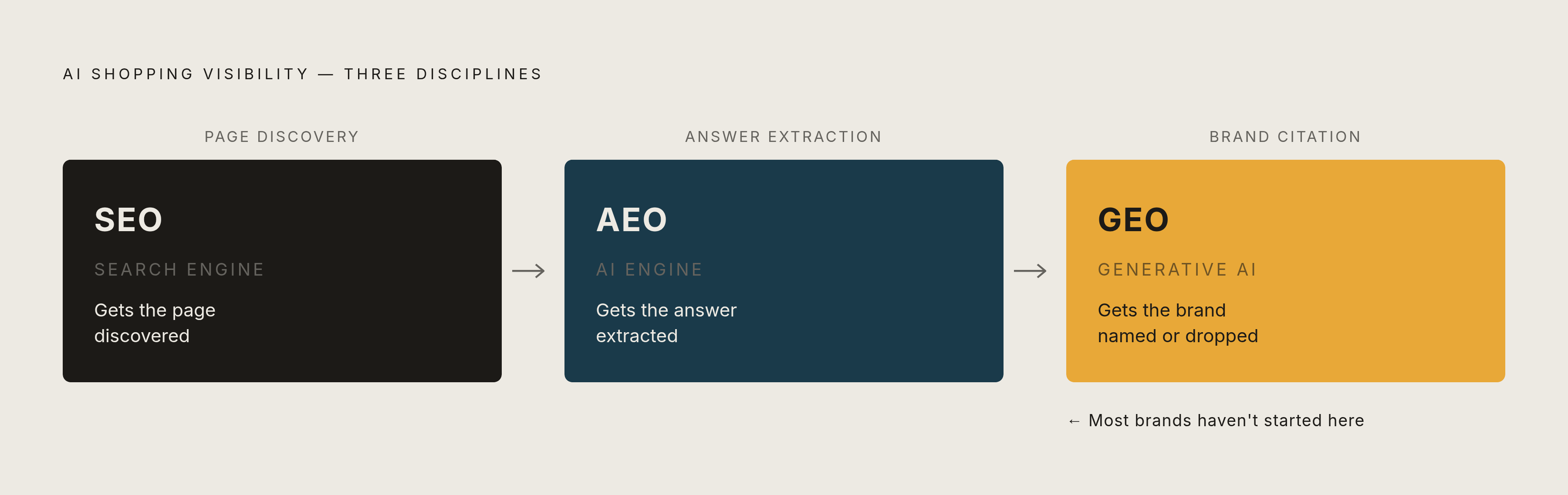
Three disciplines now sit alongside each other in e-commerce marketing: SEO, AEO, and GEO. SEO gets a page discovered. AEO gets a specific answer extracted and surfaced in response to a direct question. GEO is what gets a brand cited and recommended by name inside an AI-generated answer. For AI shopping recommendations specifically, GEO is the discipline that decides whether a brand appears in the conversation.
What matters most for e-commerce is the line between AEO and GEO. AEO operates at the level of the page and the content on it, optimizing a single piece of content so it answers a single question well. GEO operates at the level of the brand and the entity, shaping how an AI model perceives the brand as a whole across every source that mentions it. GEO serves the queries that arrive later, when the shopper is choosing between named brands.
Why GEO is primarily a reputation problem
GEO runs roughly 80% on strategy, positioning, ecosystem presence, and brand authority, and only about 20% on technical execution. That ratio has a direct consequence for e-commerce teams: brands that pour their effort into schema markup and structured data are investing heavily in the smaller side of the problem. AI does not read a brand's website first. It reads the brand's reputation, built from everything other sources have said about it.
GEO works as a third-party game more than a first-party one. When a shopper asks an AI engine which brand to trust in a category, the answer gets synthesized from industry publications, analyst reports, consumer reviews, trade press, and earned media, not primarily from the brand's own homepage copy. That makes public relations one of the most effective levers available to GEO: earned media coverage, expert commentary, analyst mentions, and influencer content all help a generative engine recognize a brand as one that others already regard as credible.
Some argue strong technical SEO should already cover this ground, but that misreads what GEO draws from. None of this makes technical optimization worthless. Technical work still runs into diminishing returns if a healthy third-party presence is not feeding the model accurate, repeated signals about who the brand is and what it sells.
Content requirements for confident AI engine citations
Citing a brand with confidence requires an AI engine to draw on content with factual density, semantic clarity, structured formatting, and freshness, and most e-commerce product content falls short on more than one of those dimensions at once. The shift starts with the questions the content answers. AI engines answer prompts phrased as questions, so if you write content to match fragmented keyword phrases, it misses the shape the model is looking to fill.
Certain structural choices raise the odds that a model will pull a brand's content into its answer. FAQ sections, HowTo formats, and structured lists improve how easily a model can extract and reuse the content; research analyzing over 5.5 million LLM responses found that structured content, direct quotes, and embedded statistics correlate with meaningfully higher visibility in AI-generated answers. Schema.org Product markup gives AI engines clean signals on product names, categories, descriptions, attributes, reviews, availability, and pricing, the exact information a model needs to describe a product accurately.
Freshness is not optional. Live product data carries the same weight: AI platforms connected to real-time search tools will flag outdated stock levels or pricing and start treating the brand as unreliable, so structured API feeds that keep product data current with major AI crawlers cut that risk substantially. The underlying principle is architectural. Optimizing for generative engines means building stronger product content, clearer category explanations, sharper FAQs, visible review signals, useful comparison content, and brand positioning written in language an AI system can read and reuse.
How AI models build their silent shortlists
AI platforms do not pull from the same source set or weight those sources the same way, so a brand's AI shopping visibility is never a single number. It is a profile that can vary sharply from one engine to the next. The metric "share of model," coined by Jack Smyth and Tom Roach, measures how often a brand appears in AI-generated answers relative to its competitors, and that figure moves substantially depending on which platform is being measured. A brand can hold a strong share of model on one engine and a near-zero share on another, which is not a measurement quirk but a reflection of how differently these systems are built.
Perplexity, Google AI Overviews, Gemini, and Claude each have distinct citation habits and source preferences, so the content and ecosystem signals that earn a citation on one platform will not necessarily carry the same weight on another. Presence on review platforms such as Trustpilot and G2 amplifies visibility across several of these engines at once, because review aggregators are trusted third-party sources that multiple AI systems draw on independently. Generative engines also evaluate authentic customer sentiment and review data across the broader web to validate a brand's credibility. Review management now functions as an AI visibility discipline, not only as a conversion-rate lever.
Assuming that optimizing for one major platform covers the field underestimates how fragmented AI-assisted shopping has become. If a brand shows up on ChatGPT but not on Perplexity, Gemini, and Google AI Mode, it stays invisible to a large share of AI-assisted shoppers, no matter how strong its presence looks on the one engine it tracks. This is precisely why platforms like Athenahq track brand visibility across multiple LLMs simultaneously: a single engine's recommendation behavior does not predict another's, and a brand needs real-time visibility across the full ecosystem to know whether it is genuinely on the shortlist at the moment a shopper is deciding.
The hallucination risk in AI shopping recommendations
AI engines do not only leave brands out of their answers. They sometimes misrepresent brands outright, inventing product specifications, fabricating pricing, stating false availability, or synthesizing a review consensus that does not exist, and the brand absorbs the reputational damage when a shopper acts on that bad information before ever reaching the brand's own site. Sentiment fabrication occurs when a model synthesizes a false consensus from reviews that were never written or were misread.
A brand cannot reach into a model and edit its weights directly, but it can shape the information environment the model draws from. Publishing accurate, structured, frequently updated product content on owned domains gives the model better raw material to work from. Schema.org Product markup narrows the gap between what a brand states and what a model reports back to a shopper. Making sure third-party content, reviews, press coverage, analyst mentions, reflects a product's current attributes reduces how much a model has to lean on outdated or inaccurate secondary sources when it fills in gaps. Brands that watch for these errors and fix the underlying sources see far fewer reputation problems than brands that wait for a customer complaint to surface the issue. Because GEO draws its signals from a corpus of third-party sources a brand does not directly control, industry publications, analyst reports, reviews, earned media, monitoring what AI engines are actually extracting and citing about a brand across multiple platforms becomes the clearest way to catch a reputation gap before it turns into a lost recommendation or a client acting on a wrong number.
Measuring AI shopping visibility: the metrics that reflect whether a brand is being recommended
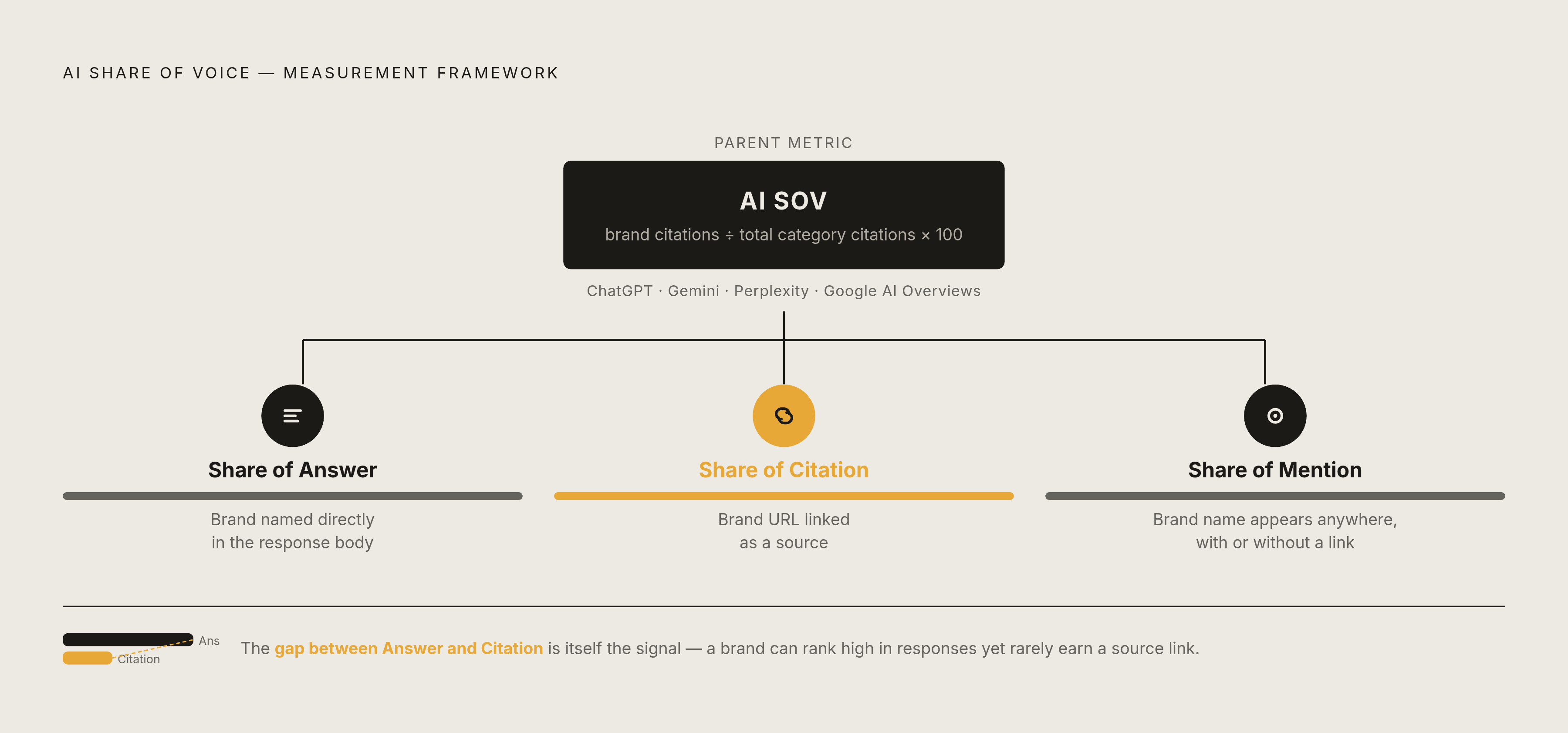
AI shopping visibility needs its own measurement framework, separate from traditional search analytics, and if a brand skips it, it has no data on one of the fastest-growing discovery channels in e-commerce. The central new KPI is AI Share of Voice, or AI SOV: the percentage of brand mentions a brand receives relative to its competitors across AI-generated responses on platforms including ChatGPT, Gemini, Perplexity, and Google AI Overviews. You divide brand citations by total category citations and multiply by 100, and that gives a team one comparable figure across competitors in a category.
A complete picture needs three sub-metrics, not one aggregate number. The brand is named directly in the body of a response for share of answer. Share of citation tracks how often the brand's URL is linked as a source the model points back to. Share of mention tracks how often the brand's name shows up anywhere in the response at all, even without a link. These numbers often diverge meaningfully, since many models answer a question without surfacing any source links, so a brand can post a healthy share of answer alongside a much lower share of citation, and that gap is itself worth tracking as a signal of how the model is using the brand's content without crediting it.
The business case for tracking AI SOV goes beyond brand awareness. AI-referred traffic arrives in a far more advanced state of purchasing readiness than standard organic traffic, and it generates meaningfully higher revenue per session, so AI SOV works as a leading indicator of pipeline quality, not a vanity metric about mentions. GEO works at the brand and entity level rather than the page level, so you need to monitor and strategize for it separately from traditional SEO tracking. A unified command center that tracks how a brand is cited and recommended across answer engines and generative platforms, the kind of tracking Athenahq runs across eleven large language models, can show which discipline, SEO, AEO, or GEO, is driving or blocking visibility at each stage of a buyer's journey in that tracking, and can turn that into board-ready reporting rather than a scattered set of screenshots from individual chatbot queries.
The content and ecosystem actions that move AI shopping visibility in practice
Moving AI shopping visibility requires action on two fronts at the same time: the owned content layer, meaning what a brand publishes and how that content is structured, and the third-party ecosystem layer, meaning where the brand gets mentioned, cited, and reviewed across the rest of the web. Neither front moves the needle much on its own.
On the content side, the audit should start from buyer questions rather than keywords: a team needs to map every sub-question a shopper might realistically ask within the brand's category, then check whether existing content directly answers each one, since the gaps in that map are the brand's actual GEO gaps. Product pages, category pages, and FAQs need restructuring around definition-first answers, structured lists, and claims anchored to specific data that an AI engine can extract without ambiguity. Schema.org Product markup needs implementation across the full catalog, giving AI crawlers clean, structured signals on attributes, availability, pricing, and reviews rather than forcing a model to infer those details from unstructured prose. A content refresh cadence needs to be built into the publishing calendar so pages do not age past the point where AI recency bias pushes them out of consideration. Product data feeds need to run in real time or close to it, so AI engines are not surfacing stale pricing or availability and quietly marking the brand as unreliable in the process.
On the ecosystem side, earning coverage in industry publications, trade press, and analyst reports gives AI engines the kind of authoritative third-party source they already treat as trustworthy, which is the PR-as-GEO strategy that sits among the most effective levers available to a brand working to shape its own reputation from the outside in. When a brand pursues expert commentary, influencer content, and analyst mentions, a generative engine can see it as one that others in the category already recognize as an authority. Brand visibility in AI search now depends on content, product pages, brand positioning, technical SEO, authority building, and performance measurement all working in concert, not any single tactic carrying the weight alone. Agentic commerce is the next layer e-commerce teams need to prepare for: environments where AI agents complete native checkouts on a shopper's behalf are approaching, and a brand's product data and trust signals will need to meet machine-readable standards, not just standards built for a human reader.
Most enterprise marketing teams already run active GEO initiatives, while most smaller brands have not yet started, leaving a window open for any e-commerce brand willing to move now. That window closes as more competitors build out the content and ecosystem signals described above, and the brands that treat AI shopping visibility as measurable, through tools like Athenahq that track citation behavior across the full landscape of AI platforms, will know where they stand while others are still asking the question.