AEO Tool Requirements for Mid-Market SaaS Companies
Buyers form vendor preferences in AI chatbots before visiting your site.

A mid-market SaaS vendor can show up nowhere in an AI-generated answer, lose the deal before a single page view registers, and never find out why. Buyers now ask ChatGPT, Perplexity, Gemini, and Claude the category questions they used to type into Google, and they settle on vendor preferences inside that conversation long before visiting a company's site. Writer's 2026 guide on AI visibility calls these preferences "silent shortlists," a fitting name for something that forms without leaving a trace in the tools marketing teams already use. By the time a prospect actually clicks through to a homepage, the shortlist is often already fixed, and a vendor absent from the AI answer was simply never in the running. The real damage compounds because AI referral traffic does not pass clean referrer data into GA4 the way a Google search does, so a team watching only Google Search Console has no way to see the deals it is losing before they ever reach a pipeline stage.
AEO and GEO for B2B SaaS Marketing
AEO and GEO get used interchangeably in a lot of marketing conversation, and that habit causes real damage once budget and headcount decisions depend on telling them apart. AEO, or answer engine optimization, targets direct answers inside featured snippets and AI Overviews; these are AI-enhanced features that sit on top of a traditional search results page, where content still competes for a click. GEO, generative engine optimization, targets the standalone platforms, ChatGPT, Perplexity, Claude, where the model writes a complete answer and may or may not point back to a source. Writer's guide frames the practical difference well: AEO work asks how to make a passage easy to lift into a snippet, while GEO work asks how to make a brand safe to recommend inside a generated response. The two also get measured differently. AEO still lives in a world of rankings and click-through rate. GEO is tracked through share of model and citation rate, metrics that describe whether a brand gets named.
For a B2B SaaS marketing team, both disciplines deserve budget, but GEO carries the higher stakes, because silent shortlists form inside generative answers, not inside AI-enhanced search snippets. SEO has not become irrelevant, since it underlies both AEO and GEO by making a site crawlable and credible before either discipline can work. But a team that keeps funding SEO alone is optimizing for a surface that decides less and less of who actually makes a buyer's shortlist.
Why the mid-market SaaS position creates a tooling problem neither lightweight nor enterprise solutions solve
Mid-market SaaS companies sit in an uncomfortable middle. Their categories are competitive, and their buyers are sophisticated, so they need the same cross-platform, multi-LLM coverage an enterprise brand would need. Their teams are lean, usually without a dedicated AEO hire. The tooling has to do analytical work a bigger organization would assign to a person. Writer's guide is specific about why coverage alone is a real requirement: AI search is now fragmented across ChatGPT, Perplexity, Gemini, Claude, Copilot, and Grok, and each platform cites sources differently and reaches a different slice of the buyer audience. A tool that watches one or two of those platforms leaves a team blind to whatever is happening on the ones it ignores, including a competitor quietly winning citations there.
Enterprise-tier AEO programs exist for organizations where AI search visibility is already a meaningful revenue driver at scale, and they're built accordingly: coordinated PR, funded original research, full-time monitoring staff. That scope and price point make sense if a company is already converting AI visibility into material revenue. At the other end, lightweight, template-based packages give a business new to AEO a way to test the channel with basic monitoring on a handful of platforms, which suits a company still deciding whether AI search deserves a real budget line. Neither option fits a mid-market SaaS company in a competitive category, because it needs consistent, reliable citation across every platform where its buyers actually show up. What that company needs sits between the two: active monitoring across multiple LLMs, a way to identify where competitors are winning citations it is not, and content optimization guidance a lean team can act on without adding headcount. That gap between enterprise programs and lightweight packages is precisely what platforms like Athenahq are built to fill, offering cross-platform visibility tracking at enterprise depth without the enterprise staffing or budget commitment behind it.
Cross-LLM visibility tracking as the AI chatbot monitoring requirement every team needs first
A mid-market SaaS team cannot manage a problem it cannot see, and seeing this one means tracking brand presence separately on each major LLM. Writer's guide names the platforms that matter most for this kind of tracking: ChatGPT, Perplexity, Google AI Mode, Claude, and Gemini, each of which surfaces brands differently and reaches a partly different audience. The same brand can carry real share of voice on Perplexity while registering almost nothing on ChatGPT, and averaging those two figures into a single visibility score erases the gap along with the competitive exposure it represents. A team that only checks its blended score might believe it is performing adequately while losing every deal that started with a ChatGPT query.
A lean team can realistically sustain a cadence of running a defined set of prompts across platforms on a weekly basis, then watching for trends over four to six weeks before drawing any conclusion from the data. Single snapshots mislead, because answer composition shifts as models update and as competitors publish new material. AthenaHQ tracks brand visibility across eleven or more major LLMs, including ChatGPT, Perplexity, Gemini, Claude, Copilot, and Grok, from a single command center, which is the kind of architecture a mid-market team needs to avoid running a separate dashboard for every model it cares about.
Citation gap identification: finding where competitors are being recommended and the brand is not
Knowing a brand's share of model matters only if the tool also shows which queries, topics, and funnel stages are producing competitor citations in its place. Writer's guide describes the underlying dynamic clearly: GEO is mostly a third-party game, so when a buyer asks ChatGPT which vendor to trust in a category, the model synthesizes its answer from industry publications, analyst reports, reviews, and earned media. So citation gap analysis has to start from the prompts buyers actually type, not from keywords a team assumes they'd use. The tool needs to run the real questions asked at each funnel stage, category education, problem framing, shortlisting, and show exactly which sources and brands get cited in each response.
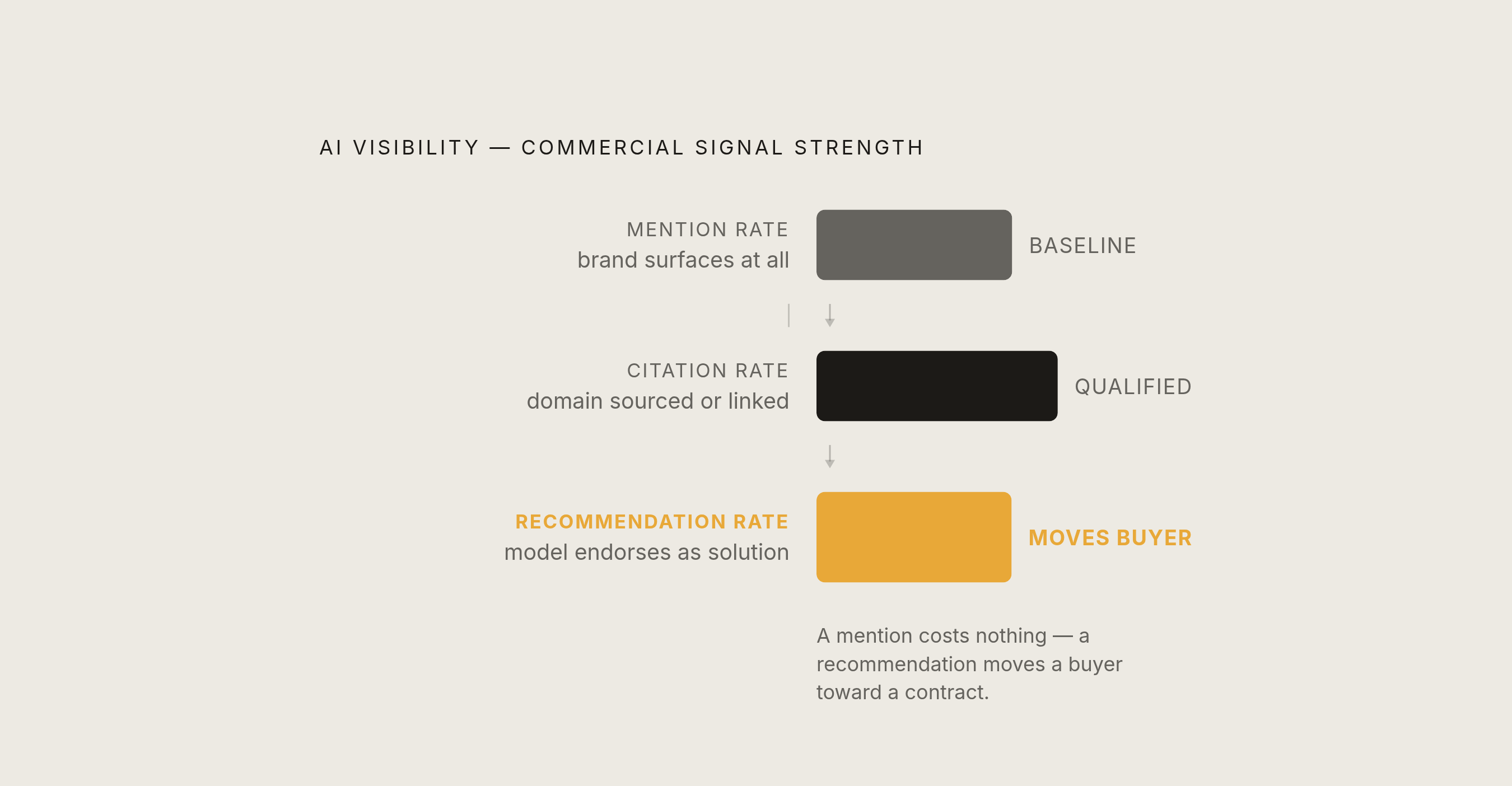
ShopOS's guide to GEO best practices states the shift directly: "Are we being mentioned, cited, and recommended when AI gives the answer?" has replaced "Are we ranking?" as the operative question. So answering it well means tracking three distinct sub-metrics, not one blended figure. Mention rate shows baseline presence, whether the brand comes up. Citation rate shows how often the model actually sources or links the domain behind that mention. Recommendation rate shows how often the brand gets endorsed outright as a solution, and for B2B SaaS pipeline, that third number carries the most value, since a mention costs nothing and a recommendation moves a buyer toward a contract.
The prompt that matters most commercially for a SaaS company is the shortlisting query, something like "best X for a mid-market SaaS company" or "which platform should I use for Y." A tool has to run and track prompts like these at scale, not just monitor queries that already contain the brand's name. Content gaps and citation gaps are not the same failure, either: a brand can publish plenty on a topic and still go uncited if that content isn't structured for extraction, lacks any third-party corroboration, or has gone stale past a platform's recency threshold. AthenaHQ's citation gap identification is built to separate these two failure modes, showing both where content exists but earns no citations and where no content exists at all, turning a flat data export into a prioritized list of what to fix first.
Monitoring what AI engines say about a brand and catching hallucinations before clients act on them
An AI model that encounters inconsistent or missing information about a brand does not pause and wait for a correction. It synthesizes an answer from whatever it can find, and for a SaaS company that can mean fabricated integrations, deprecated features described as current, or a pricing figure that is simply wrong. Each of those mistakes creates a real support burden and genuine friction in a sales cycle, since a prospect who was told something false by an AI tool is a harder conversation to recover than one who never got an answer. The same accurate, consistent, well-distributed content that earns citations in the first place is also the best defense against this kind of error, making brand signal monitoring both an offensive and a defensive requirement at once.
Entity consistency, a brand described the same way across directories, review sites, and other third-party sources, functions as both a GEO tactic and a measure of brand integrity, and a tool needs to flag where that consistency actually breaks down. ShopOS's guide to GEO best practices covers content clarity, entity strength, structured data, trust signals, and third-party validation as the elements that matter, and each one can drift out of alignment without anyone noticing until a prospect repeats back something false. No mid-market SaaS team has the staff to manually audit how a brand gets described across ChatGPT, Perplexity, Gemini, Claude, and Copilot on an ongoing basis, so the tool itself has to surface anomalies and flag weak or contradicted signals before they calcify into a pattern. AthenaHQ's brand signal monitoring handles this directly, tracking how a brand gets described across LLMs and flagging where that description drifts from what's accurate, so a lean team can step in before a single wrong answer turns into a recurring one that shapes how an entire category thinks about the product.
Content architecture requirements for AI citation
Earning a citation from an AI model takes content built differently from a page written for a human reader scanning search results, and a mid-market SaaS team needs a tool that names the specific change required, not just a citation rate that happens to be low. Writer's guide frames the underlying shift this way: traditional SEO was mostly a first-party exercise, built around optimizing a brand's own site, while GEO depends on third-party material, the industry publications, analyst reports, reviews, and earned media an AI model pulls from when it builds an answer. A content strategy that only tends to the brand's own website is addressing half the problem.
ShopOS's guide to GEO best practices lays out eight practices for 2026 strategy, covering how to build content around the actual questions buyers ask, how to make a brand's identity unambiguous to a model, how to structure a page so a model can pull from it cleanly, how to strengthen product pages specifically, and how to build third-party proof that corroborates what the brand says about itself. A content gap analysis tool needs to check against all of these, not just scan on-page text for keywords. For a B2B SaaS brand specifically, original data and first-party analysis tend to be the most citable material it can produce, since AI models favor a source that offers something no other source has. A tool that shows competitors earning citations for original research the brand could have produced, but hasn't, is pointing at a genuine opportunity.
The workflow a lean team can actually run looks like this: track how AI platforms answer the priority questions buyers ask, check which sources get cited in those answers and why, find where existing content is structurally wrong or simply stale, then update it and confirm the citation rate actually moves afterward. AthenaHQ's content gap analysis and content deployment tools are built around that exact loop: they surface what needs fixing and let a team publish the fix without needing a dedicated content operations function to run the process.
Measuring AI search ROI in a way that satisfies both the marketing team and the leadership reporting it answers to
The biggest obstacle to sustained AEO investment at a mid-market SaaS company usually isn't leadership skepticism about AI search as a channel but the inability to connect a visibility metric to actual revenue in a format a CMO can defend in a board meeting. AI-referred traffic doesn't pass clean referrer data into GA4 the way a Google search does, so a team relying only on standard analytics misses a real share of AI-driven pipeline, which lands in the "Direct" bucket and gets credited to nothing. That measurement gap becomes a credibility problem fast: a CMO who can't point to pipeline produced by AEO investment has a hard time defending that budget line next to channels with far cleaner attribution.
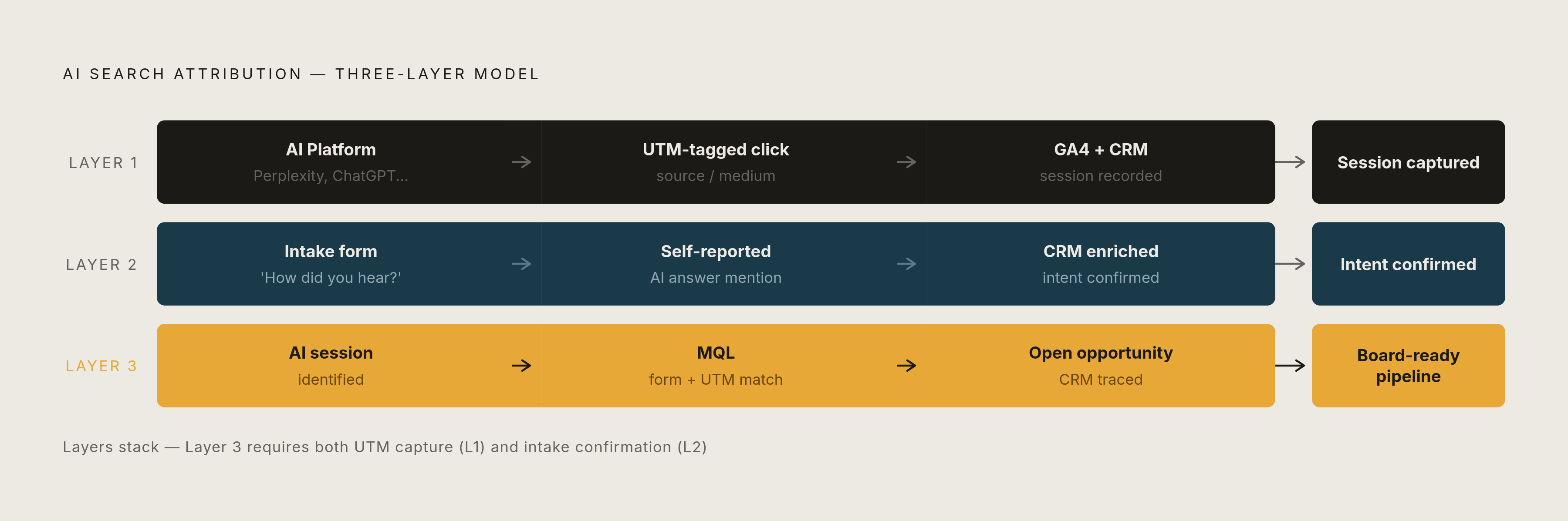
A three-layer attribution approach closes most of that gap. The first layer tracks AI-referred sessions with UTM parameters flowing into GA4 and the CRM. The second layer captures self-reported attribution: intake forms ask how a prospect heard about the company. The third layer closes the loop, following a session from an AI platform all the way through to a marketing-qualified lead and an open opportunity. Share of model, the headline metric from Writer's guide, only earns its keep once it gets translated into language a CMO already speaks, so a tool needs to support both views at once: the marketer's operational read on citation rate, mention rate, and recommendation rate by platform, and the executive's board-level view of AI-attributed pipeline and competitive share trend over time.
Competitive share of voice across AI platforms is the framing that actually lands with leadership, because a rising share next to a competitor's falling one is a defensible leading indicator of a pipeline shift already underway. To get a number leadership will trust, you need a consistent prompt set run across platforms, tracked over weeks, with a position-weighted share of voice standing in for a single snapshot that could mislead either way. AthenaHQ is built around exactly this reporting requirement: it pairs board-ready reporting and ROI tracking with pipeline impact measurement across the major LLMs, so a mid-market marketing team gets the operational detail it needs to act and the executive summary it needs to keep the budget alive. The SaaS companies building that visibility now are the ones that will be hardest to dislodge from a buyer's shortlist once the silent shortlist becomes the only shortlist that matters.