LLM Coverage Breadth as a Vendor Evaluation Criterion
Vendors that monitor only one or two LLMs miss most of your AI visibility picture.

LLM Coverage Breadth stands as a Vendor Evaluation Criterion.
Why the number of LLMs a vendor monitors is a foundational question, not a feature comparison
Buyers no longer type their questions into a search box first. They ask ChatGPT, Perplexity, Google AI Mode, and Claude, building what amounts to a shortlist of vendors before a single brand website ever loads. That shift alone would matter. What makes it urgent is scale: ChatGPT alone fields over 2 billion queries a day, AI Overviews now show up in nearly 55% of Google searches, and the 25% decline in traditional search volume that Gartner predicted for 2026 has already happened Frase / Answer Engine Optimization Sentient AEO. Against that backdrop, evaluating an AEO or GEO vendor by counting features (dashboards, alert thresholds, report templates) misses the actual question Sentient AEO Writer / GEO, AEO, and SEO in 2026. The real question is how much of that discovery landscape the vendor can even see.
AI search answers are binary in a way that traditional search never was. A brand either gets named in the response or it doesn't, and there's no page two to fall back on. Roughly 93% of AI search sessions end without a single click, which means the answer itself is the entire encounter Alhena AI. Missing the citation leaves no consolation traffic, no long-tail recovery, nothing. So when a vendor only watches one or two models, it's giving a partial view of the truth. It's measuring a sliver of the discovery landscape and calling it the whole picture.
How different LLMs produce different brand visibility outcomes for the same query
Treating ChatGPT, Perplexity, Gemini, Claude, Copilot, and Grok as if they were interchangeable makes the numbers stop making sense fast. Each one runs its own retrieval architecture, trained on data with a different vintage, weighting citations by its own internal logic, so a brand's standing on one doesn't carry over to the next. Model-specific visibility is a core metric that deserves attention outside an appendix. It's one of six core measures practitioners track precisely because an aggregated, all-models-blended score papers over exactly the differences that matter.
Recency is a clean example of how this plays out. On ChatGPT, 76.4% of the most-cited pages were updated within the past thirty days, a pattern that rewards fresh content aggressively. Other platforms don't weight recency that way at all, leaning instead on pages with longer track records and established authority. A content team optimizing purely for ChatGPT's appetite for freshness could be doing everything right on one model and still be functionally invisible on another, for reasons that have nothing to do with content quality.
The citation sources themselves diverge too. An analysis of 30 million citations across ChatGPT, Gemini, Perplexity, and AI Overviews found Reddit was the most-cited domain across all four, but everything below Reddit shuffled substantially depending on the platform. That means the rest of a brand's off-site citation strategy, the trade publications, review sites, and forums that actually move the needle, has to be built model by model, not assumed to transfer.
Together these pieces produce a brand that can hold strong share of voice on ChatGPT while nearly disappearing on Gemini, for structurally different reasons that a single-model vendor cannot diagnose. A vendor watching only one of those models has no way to know the other exists, let alone diagnose it. And even within a single model, the ground keeps shifting: about 30% of brands visible in one AI response reappear in the very next response to the identical query, so a single snapshot on a single model is already shaky ground Alhena AI. Six metrics compose a complete AI visibility score (Brand Mention Rate, Recommendation Rate, Prompt Coverage, Share of Voice, Model-Specific Visibility, and Visibility Volatility), and five of the six require multi-model data to be meaningful, so the case for narrow tracking gets harder to defend, not easier.
What AI share of voice measures across multiple models
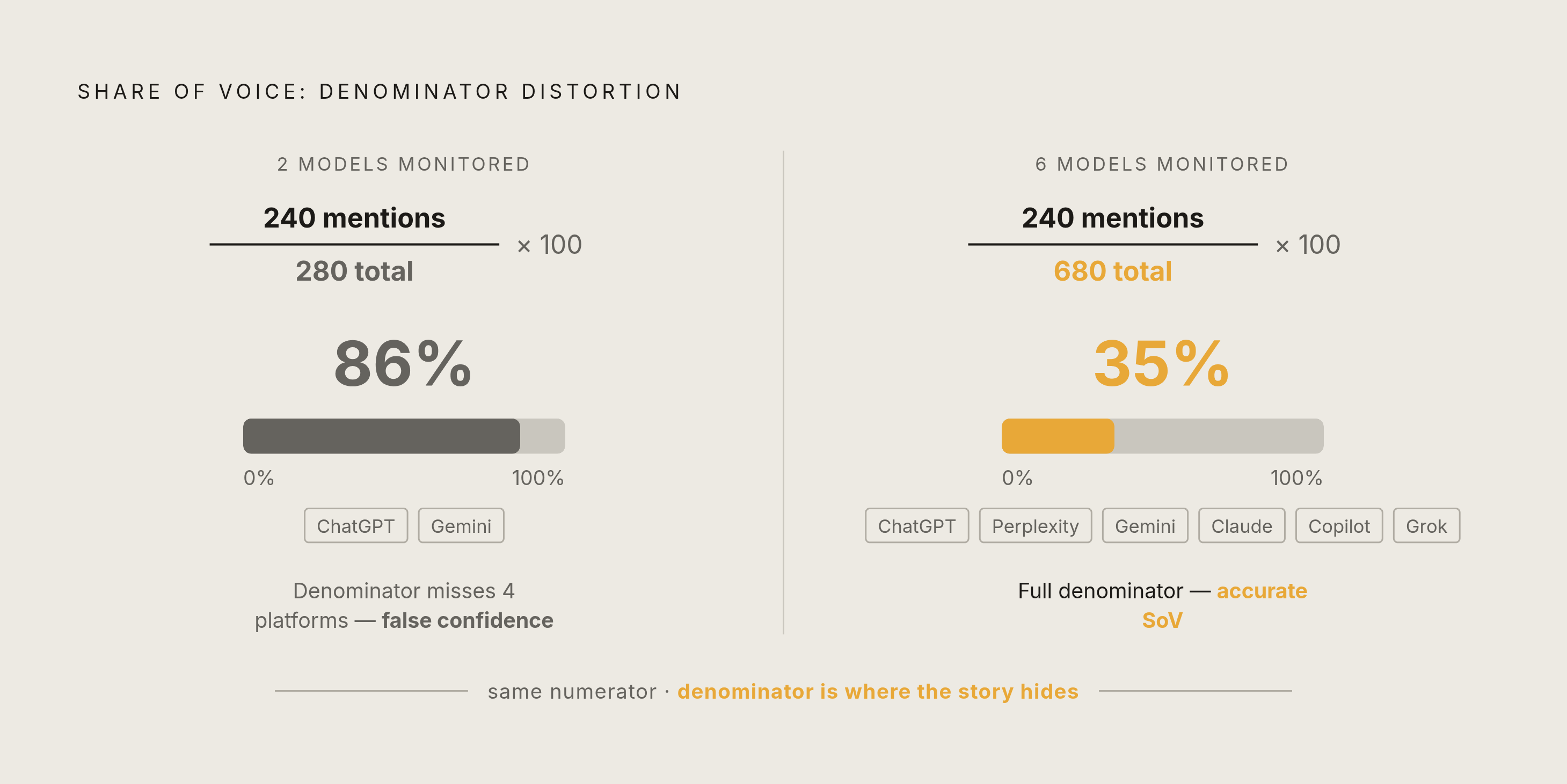
AI share of voice, at its cleanest definition, is the percentage of brand mentions a company gets across AI-generated responses relative to every mention for its category on those same platforms: brand mentions divided by total category mentions, times 100. Straightforward math. The trouble sits entirely in the denominator.
Two versions of this metric get used interchangeably, and they shouldn't be. Citation-based share of voice counts a brand's citations against total citations in a tracked prompt set. Entity-based share of voice counts how often a brand shows up as a recommended entity against every entity listed in the answer set. Both are legitimate, but they answer slightly different questions, and a vendor should be explicit about which one it's reporting.
Narrow coverage quietly breaks the formula. If a vendor only tracks two models, the "total category mentions" figure it's dividing by is artificially small. A brand can look like it dominates its category on one model, while a vendor tracking only that one model cannot distinguish model-release-driven volatility from a genuine share shift, since a 5-point SoV swing in one week is usually noise but the same swing held for three to four weeks is a real change. The percentage is real. The confidence it's supposed to justify is not.
A complete visibility score runs on six metrics: Brand Mention Rate, Recommendation Rate, Prompt Coverage, Share of Voice, Model-Specific Visibility, and Visibility Volatility. Five of those six only mean anything with multi-model data behind them. Some practitioners have started calling the underlying concept "share of model," a deliberate rhyme with the old media-buying term "share of voice," except this version has to be earned through citation and can't be bought through ad spend, and it's only measurable once you're actually looking at the full model landscape. Right now, only 16% of brands track their AI search performance in any systematic way, which means the competitive window for locking in an accurate baseline is still open. Every brand that settles for a narrow-coverage vendor is handing that window to a competitor working with a wider lens. There are two distinct flavors worth distinguishing.
The coverage gap that single-model or narrow-coverage vendors create in practice
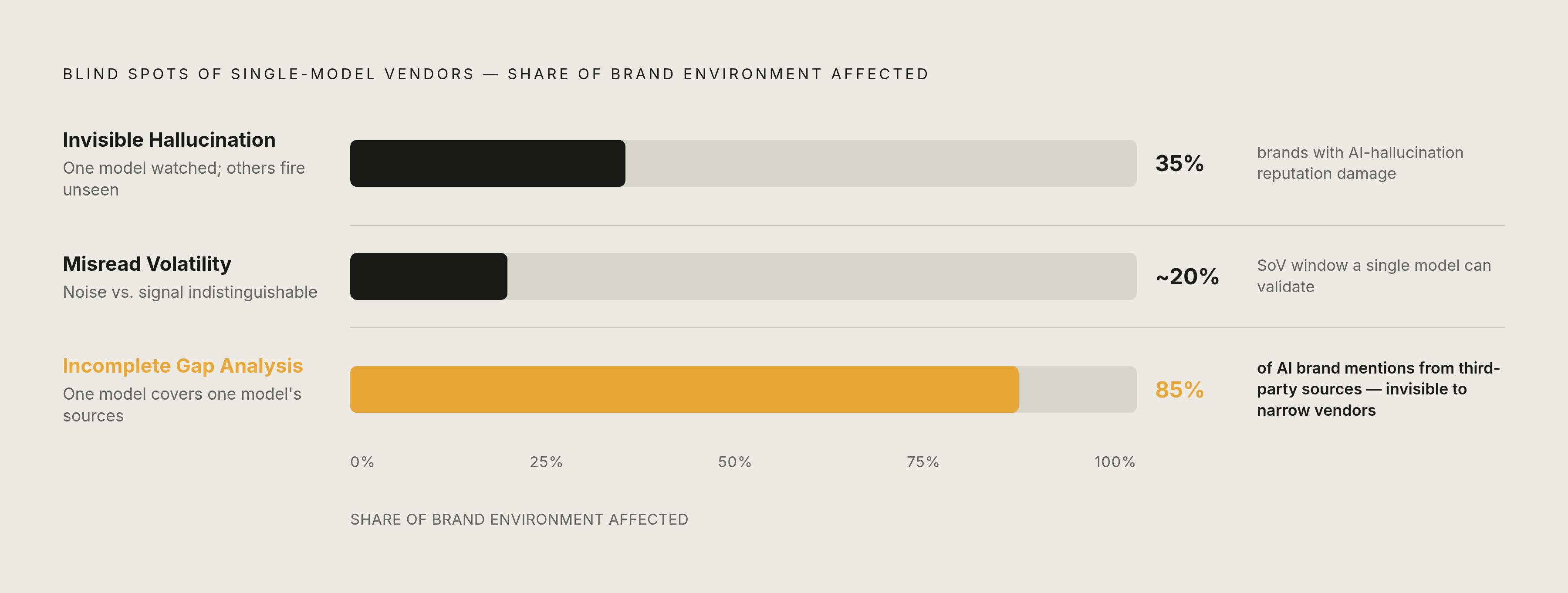
Narrow coverage doesn't just produce an incomplete number. It creates blind spots that fall into three categories, and they appear as real operational damage.
The first is invisible hallucination. About 35% of brands report that an AI hallucination, some invented statistic, fabricated claim, or misattributed fact, has already damaged their reputation Nick Lafferty / LLM Tracking Tools. Hallucinations are model-specific by nature: a false claim that Perplexity picked up and ran with might never appear on Claude at all. A vendor watching only one model doesn't just fail to catch the hallucination quickly. It never sees it happen.
The second is volatility that gets misread. A five-point swing in share of voice on a single model over a single week is usually just noise, the kind of fluctuation that self-corrects. The same swing holding steady for three or four weeks is a real signal. But a vendor tracking one model has no way to tell whether a dip followed a competitor's genuine gains or just a model's routine update cycle. Every reaction becomes a guess dressed up as an insight.
The third is content gap analysis that never sees the whole map. A brand's own website accounts for only 5% to 10% of the sources AI search actually references, with the remaining 85% coming from third-party sources, and which third-party sources matter differs by model, so gap analysis on one model produces a partial remediation roadmap Sentient AEO Writer / GEO, AEO, and SEO in 2026. Which third-party sources matter most differs by model. Running a gap analysis against one model's citation pattern produces a resulting content roadmap that addresses maybe a fifth of the actual problem.
Entity confusion layers on top of all this. When a brand's name, description, or category gets represented inconsistently across the sources an LLM pulls from, that model's internal picture of the entity starts to fragment, and it fragments differently depending on which model is doing the parsing Nick Lafferty / LLM Tracking Tools. An audit run against a single model can look clean while entity confusion is quietly eroding visibility on another model. Compounding the difficulty, the newest reasoning models have gotten hallucinations on simple tasks down to as low as 0.7%, genuine progress, but those same stronger reasoning models are drifting more on complex, multi-step tasks Medium / Write a Catalyst. Risk now also depends on factors beyond the brand's own content hygiene. It's a function of which model is doing the reasoning, and that argues directly for coverage across models, not consolidation onto one.
There's a simple diagnostic any buyer can run before signing a contract: ask the vendor to produce a model-specific share of voice breakdown. A vendor that can't produce that breakdown is, almost by definition, working from narrow coverage, whatever the sales deck claims.
What meaningful LLM coverage requires from a vendor platform
Set a floor first. The platforms where buyer research is actually happening right now include ChatGPT, Perplexity, Gemini, Claude, Copilot, and Grok, and a vendor covering fewer than that set is leaving real discovery surface dark. That's the minimum.
Coverage of that breadth only pays off if the reporting is built to use it. Visibility scores need to be broken out per model, not folded into one aggregate number, with trend lines that flag when a model's release or retraining cycle might explain a shift. Citation tracking needs to separate citation-based share of voice from entity-based share of voice, and do it for each model separately. Content gap recommendations have to account for the fact that ChatGPT rewards freshness (recall that 76.4% figure on recently updated pages) while other models reward established authority instead, so a single universal content checklist doesn't hold up across the board.
None of this stays inside a brand's own domain, either. Model-specific visibility is one of six core metrics practitioners track, and aggregating across models masks critical performance differences between platforms. Managing eight or more models separately without a unified platform creates reporting fragmentation that undermines the cross-model comparison that makes breadth valuable in the first place. The third-party coverage dimension matters because 85% of AI brand mentions originate from third-party sources and brands are 6.5x more likely to be cited through third-party sources than owned domains, per AirOps analysis cited in Writer, so a vendor's coverage must extend beyond a brand's own site to the off-site citation environment, and do so across all monitored models.
How to evaluate vendor claims about LLM coverage during procurement
The market here is moving fast enough that coverage claims are hard to take at face value without testing them directly. Tools confirmed as operating in this space as of early 2026 include Profound, Scrunch (acquired by Sitecore in June 2026), and Peec AI, with Semrush, HubSpot, Siteimprove, and others entering, and the field is expanding rapidly, making coverage claims harder to verify without explicit testing. Some vendors have bundled citation tracking, share-of-voice measurement, and sentiment analysis into single suites launched within weeks of each other, and at least one visibility add-on prices around €99 a month per domain, tracking across a named list of major platforms. The pricing and platform lists show that "tracks major AI platforms" sometimes means three named models and sometimes means six.
Watch for a few tells during procurement. Coverage limited to two or three models paired with vague promises about "adding more soon" is a signal the roadmap, not the product, is doing the selling. Citation tracking that only monitors a brand's owned domains misses the 85% third-party citation environment Sentient AEO Writer / GEO, AEO, and SEO in 2026. Reporting with no volatility tracking or no way to flag when a model release might explain a shift leaves a team unable to tell noise from a genuine competitive loss.
Push past the sales pitch with direct requests. Request a live demo running the same brand query across at least five different models side by side. Ask for a sample report that shows model-specific share of voice with trend data over time. Ask how hallucination detection differs across models with different reasoning architectures, and ask whether content gap recommendations are tailored per model or handed over as one generic list. The answers to those four questions will tell a procurement team more than any feature comparison chart.
Building the internal case for cross-platform AI visibility as a budget line, not an experiment
The number to put in front of a budget committee is 16%, the share of brands currently tracking AI search performance in any systematic way. That means the competitive window for building an accurate cross-model baseline is still open. It will not stay open indefinitely.
The revenue case is not abstract. AI-referred sessions to websites grew 527% year over year through mid-2025, and ChatGPT Search alone already accounts for 87.4% of all AI referral traffic Frase / Answer Engine Optimization. A platform that monitors ChatGPT while leaving Perplexity, Claude, and Gemini dark is watching the largest single channel and missing the rest of the map entirely. For a board, buyers are forming preferences inside AI conversations before they ever land on a website, and a brand invisible on two of the five major models is absent from a meaningful share of those conversations in a way that ordinary web analytics never register.
None of this needs to be treated as a soft, unmeasurable initiative either. AI share of voice is measurable and trackable to the same standards as any paid channel (the formula is defined, the denominator is auditable, and the trend is chartable). Brands cited inside AI Overview results see organic click-through rates roughly 35% higher on those same queries, which means citation isn't just a vanity metric, it drives traffic that can be measured downstream. The catch is that a narrow-coverage vendor's baseline is built on a partial picture from the start, so any ROI number that vendor reports back is only as complete as the models it happened to watch, a limitation that belongs in the budget conversation rather than being discovered later.
Teams that build cross-model measurement into their infrastructure now are training their content and citation strategy against real, multi-model data while most of the market is still working blind. That gap compounds. Waiting to move narrows the advantage further with every quarter that passes, because the brands acting today are learning things about model behavior that latecomers will have to relearn from scratch. A brand that evaluates vendors on feature lists rather than coverage breadth ends up optimizing its AI presence against a map that only shows part of the territory where its buyers are actually standing.