Due Diligence Questions That Expose AEO Vendor Capability Gaps
Ask vendors which LLM platforms they actually track and how their citation counts differ by model.

What AEO and GEO mean in 2026, and why the distinction matters when evaluating vendors
SEO gets a page discovered. AEO gets an answer pulled out and shown on its own. GEO gets a brand actually recommended by name. Most vendor pitches blur these into one motion, and that blur is the tell: a vendor who uses "AEO" and "GEO" interchangeably on a sales call has already told you they haven't built separate playbooks for separate problems.
AEO, answer engine optimization, is the narrow one. It shapes a specific piece of content, a paragraph, a table, a definition, so a retrieval system can lift it cleanly into a featured snippet, a knowledge panel, or an AI Overview box. It's mechanical work, and a contract should treat it that way: specific pages, specific formatting fixes, specific outcomes tied to each.
GEO, generative engine optimization, is bigger and messier. It's about shaping what a model actually thinks and says about a brand across ChatGPT, Claude, Perplexity, and Gemini. Industry analysis puts the real split of GEO work at roughly 80% strategic, positioning, authority, and presence across the sources a model draws from, and only 20% technical fixes. That ratio should reset what a buyer expects to pay for. A vendor selling GEO as a checklist of schema markup and page speed tweaks is selling the 20% and pricing it like the whole job.
GEO didn't come out of a marketing deck. It came out of academic research, with early papers tracing back to Princeton, Georgia Tech, the Allen Institute for AI, and IIT Delhi, before it crossed into marketing vocabulary sometime in 2025. Most enterprise marketing teams have some GEO initiative running by now. Most small and mid-sized teams don't. That gap matters when a vendor hands over case studies. Ask specifically whether the results came from enterprise accounts or SMB accounts, because the tactics that move a household-name brand's share of model rarely move a niche B2B vendor's, and a vendor who can't tell you which bucket their proof came from is hoping you won't ask.
Probing a vendor's actual multi-LLM coverage before signing anything
Every major AI platform runs its own retrieval index and its own citation logic. A vendor claiming "multi-LLM coverage" without being able to walk through those differences is reading off a feature list, not describing a system they actually built.
ChatGPT uses its own retrieval layer and rewards broad web authority and editorial press coverage. Claude has its own retrieval approach and favors well-sourced content its crawler can actually reach and parse. Gemini draws on Google's own index and applies its own citation logic distinct from the other platforms. Perplexity shows its sources openly, which gives buyers a relatively direct view of what the platform is actually citing. ChatGPT still matters most for referral traffic: it accounts for an estimated 87.4% of all AI referral traffic reaching websites, so a vendor thin on ChatGPT specifically is thin exactly where the traffic lives.
Ask direct questions; expect direct answers. Which models does the vendor track, and which of those retrieve live from the web versus answering out of static training data? Can they produce platform-by-platform citation numbers, or only a single blended score that hides which platform is doing all the work? Does the platform distinguish a brand mention in the answer's prose from an actual domain citation used as a source? Those are different events, and only one of them sends traffic. And how does the vendor handle platforms, including some platforms and configurations that don't surface citations publicly?
Watch for the tells. A vendor puts five or six model logos on a slide and can't explain how any two of those models differ in retrieval behavior. Everything comes back as one aggregate number, so there's no way to tell that Perplexity is thriving while Gemini has gone quiet. Perplexity, Claude, or Gemini quietly drop off the reporting as standalone lines somewhere between the pitch and the first invoice. Listen too for a vendor who blurs "we optimize content for LLMs" into "we track your visibility across LLMs" in the same breath. Writing for a model and measuring a model are two different jobs, and a vendor doing one while billing for both isn't being straight with you.
"Share of model," a term credited to industry commentary rather than any single source, measures how often a brand shows up in AI-generated answers relative to competitors. It can't be bought the way paid share of voice can. It has to be earned through the content and authority signals models actually pull from. Ask whether the vendor's reporting uses this concept, something functionally equivalent, or nothing close to it.
The citation measurement questions that separate real platforms from dashboards of noise
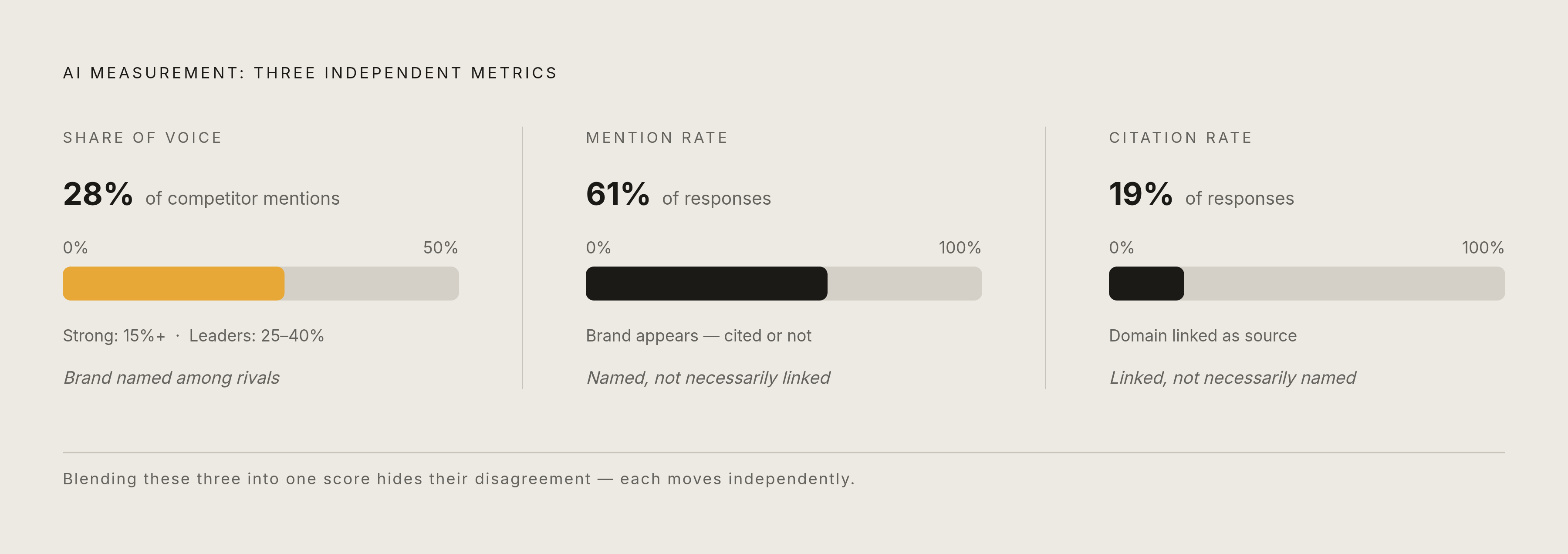
Every AI visibility vendor shows up with a "share of voice" number. Almost none of them mean the same thing by it, and that's the first thing to pin down before looking at a single chart. One vendor counts every time a brand's name appears anywhere in an answer's text. Another counts only actual domain citations used as a source. Those two numbers can move in opposite directions on the same set of queries, and a vendor handing over one blended figure is hiding that disagreement, not resolving it.
Insist on three separate numbers, reported separately, every time. AI share of voice is the brand's mentions as a portion of all mentions across a defined competitor set on a defined set of prompts. Brand visibility, or mention rate, is how often the brand shows up at all, cited or not. Citation rate is the share of responses that actually link to or name a domain the brand owns as a source. These move independently: an answer can praise a brand by name and never link to its site, or cite a page as a source and never say the brand's name in the surrounding text.
Some numbers give the conversation a floor to argue from. Analysis of top-performing brands' LLM tracking data puts a strong share of voice at 15% or higher across a core query set, with category leaders in specialized verticals reaching 25 to 30%. A separate 2026 metric analysis frames 10 to 15% as solid for an established player, with market leaders pushing toward 25 to 40%. Ask where the vendor's own benchmark came from and how it was built. A benchmark built from a handful of client accounts is not the same claim as one built from a broad market sample, and vendors rarely volunteer which one they're handing you.
Push on mechanics past that point. Request a live report, not a slide, showing citation rate, mention rate, and share of voice as three distinct columns. Ask who controls the prompt set the vendor tests against; find out if it can be rebuilt around the buyer's actual competitive set instead of a generic template. Ask how the vendor handles platforms that don't expose citations publicly: do they model an estimate, or just drop that platform from the report? And get a timestamp on the last data pull, because "real-time" is a word vendors throw around loosely, and it needs to mean something specific once it's in a contract.
How to test whether a vendor can prevent AI from hallucinating about your brand
The operational question here is simple. Does the vendor monitor for hallucinations before they spread, or only find out when a customer forwards a screenshot? Most vendors default to the second mode and call it monitoring anyway.
Hallucinations about a brand fall into a few recognizable patterns, and a competent vendor should name them without prompting. Invented statistics appear in the response as a suspiciously round number with nothing cited behind it. Fake citations look like a model referencing a study that doesn't exist, sometimes inventing an author's name to go with it. Entity confusion happens when a model mixes up a brand's founding date, headquarters, or founders with a competitor's, blending two separate histories into one wrong one.
Ask directly about a real paradox in how these models behave. Research shows the strongest models have pushed hallucination rates on simple tasks, document summarization, for instance, down to a small fraction of a percent. But on complex reasoning tasks, some of those same models drift further from the source material rather than closer to it. Spending more computation "thinking through" an answer does not reliably produce more fidelity to the facts; the extra computation itself opens up more room for the model to wander from the source. Ask how the vendor's monitoring accounts for that specific failure mode, because it runs opposite to the assumption most buyers walk in with: that newer and "smarter" always means more accurate.
Most vendors treat a thin digital footprint as a visibility problem. That's the wrong frame. It's a hallucination risk. When a model has little or no training data about a brand, it doesn't just say less about it: it starts filling the gaps with invented facts to complete the answer anyway. A brand with a sparse online presence is a hallucination risk. It's exposed to being wrong about, confidently, in front of the exact buyer trying to research it.
Content gap analysis questions expose whether a vendor understands how AI citation selection works.
Citation happens in two stages, and most vendors talk about it as one. Stage one is selection: a page has to get chosen as a plausible source based on its authority, how recently the content was updated, and its presence inside the model's retrieval index. Stage two is absorption: once selected, the model has to pull the actual claim out of the page cleanly. Generic, hedge-everything prose fails constantly at this second stage, even on pages that cleared stage one without any trouble. A vendor who treats these as one problem ends up "optimizing" a page that gets selected but never quoted, never noticing that being selected and being quoted are not the same outcome.
Content that just restates consensus already sitting on the web carries almost no citation value. A model has no reason to cite a paraphrase of something ten other sources already say word for word. Research has found that content demonstrating genuine information gain, an actual new fact, framework, or data point, ranks three times higher in AI-generated responses than content without it, according to analysis cited by content strategy researchers. Ask how a vendor's gap analysis finds missing arguments and missing perspectives in addition to missing keywords. A keyword gap and an information gap are not the same thing, and closing one does nothing for the other.
A handful of structural signals move citation rates consistently, and a competent vendor's process should reference all of them rather than cherry-picking whichever one is easiest to sell. FAQ sections and structured Q&A formatting get cited substantially more often than pages without that structure. Pages mixing text with images and video get cited more often than text-only pages. Content carrying real statistics, citations, and direct quotations shows 30 to 40% higher visibility in AI responses. Pages updated within the last two months earn 28% more citations than older pages sitting untouched. And a TLDR-first structure, where the first 200 words answer the core question completely on their own, recurs constantly across content that performs well in generative search.
Freshness decay deserves its own line of questioning, separate from everything above. Content older than 90 days starts losing retrieval priority on fast-moving queries, dropping out of consideration quietly even when nothing about the page's actual quality has changed. In categories where facts shift constantly, pricing, product specs, regulatory rules, ask whether the vendor's gap analysis flags that decay before it costs citations, or only becomes visible after a client notices the traffic is already gone.