AEO Tool Data Freshness and Query Sample Size Requirements
Two technical variables explain why AEO tools report wildly different metrics.

Buyers now form their shortlists before a brand ever knows they exist. They ask ChatGPT to compare vendors, ask Perplexity what the market looks like, ask Gemini which tool fits their budget, and by the time anyone lands on a company's website, the decision has already narrowed. Roughly 16% of brands track this kind of AI search performance in any systematic way. Most are optimizing blind. And the tools built to close that gap have a problem of their own: ask three of them for the same brand's "AI share of voice," and you'll get three different answers, sometimes wildly different, even though all three claim to measure the same thing. The discrepancy traces back to two technical variables that almost nobody asks about: how recently the tool's data was collected, and how many queries it actually sampled.
Definition of "data freshness" in an AEO tool
Freshness gets used as a single word for two separate things, and conflating them is where a lot of bad reads start.
Content freshness is about the page: how recently it was published or updated, and whether an AI engine's retrieval system still considers it current enough to cite. Query-run freshness is about the tool itself: how recently it actually sent prompts to ChatGPT, Perplexity, Gemini, or Claude and logged what came back. A brand's page can be freshly updated while the tool reporting on it is showing prompt results from six weeks ago, and a dashboard built on that lag will describe a market that no longer exists.
Both matter, just for different reasons. Content freshness determines eligibility, whether a page is even in the running to be cited. Query-run freshness shows whether the number on the screen reflects this week's competitive landscape or last month's. Layer on a third wrinkle: every AI engine has its own training cutoff and its own update rhythm, so a freshness standard that works for one platform doesn't automatically apply to the next. ChatGPT, Perplexity, Gemini, and Claude don't refresh on the same clock, so a tool claiming one blended freshness number across all four is already smoothing over something real.
How content age affects whether AI engines cite a page
Recency isn't a nice-to-have here, it's measurable as a ranking signal. URLs surfaced by AI engines run about 25.7% fresher, on average, than the URLs that show up in traditional search results for the same queries. That gap says something concrete about how these systems weight time.
The decay pattern that follows from this is steep. For commercial and evaluation-stage queries, 83% of AI citations trace back to pages updated within the past twelve months. Pages that go a full quarter without a refresh are three times more likely to fall out of the citation set. Fast-moving topics decay even faster than the twelve-month pattern suggests, while evergreen content has more runway but isn't exempt from the same gravity.
It gets tricky for anyone reading a tool's dashboard. If a report shows a citation rate without noting where each cited page sits inside that decay window, the number can look healthier than it is. A page cited today might be three weeks from falling out of rotation, and a static report has no way to show that. The rate looks like a stable fact when it's really a countdown.
Why query-run freshness makes a tool's numbers signal or history
AI engines don't hold still. Model updates, index refreshes, and new competitor content all push answers around continuously, so a prompt run six weeks ago can produce a materially different answer than the same prompt run today. That's the mechanism by which every one of these tools can go stale without anyone noticing.
A tool that presents last month's prompt runs as "current" visibility is functionally the same as a web analytics dashboard that hasn't pulled new data since the last quarter closed. It still looks authoritative. The chart still renders. But it's describing a past state dressed up as the present.
This is the time dimension of a problem that also appears in sample size: a single snapshot, however large, is a historical artifact the moment it stops being refreshed. Daily or near-daily re-sampling is the line between a tracking system and a one-time audit. The question to put to any vendor isn't "how much data do you have," it's how often that data gets re-run, and how old the numbers currently sitting in the dashboard actually are.
What query sample size means and why the floor matters
A query sample is simply the set of prompts a tool runs against AI engines on a brand's behalf, and the cadence at which it re-runs them, in order to estimate visibility across the different ways people actually ask about a category.
Practitioner guidance sets a manual floor of 20 to 30 category prompts, spread across discovery, comparison, evaluation, and implementation questions, run weekly across at least ChatGPT, Claude, Perplexity, and Gemini, for four to six weeks before anyone draws a conclusion. That's the baseline for someone doing this by hand.
Audit-grade work runs higher. A single audit's prompt bank typically is between 40 and 120 prompts. But volume isn't the point, distribution is: ten prompts spread evenly across funnel stages beat a hundred near-duplicates of the same question phrased slightly differently. And on the engine side, the floor for a credible multi-engine read in 2026 is ChatGPT, Claude, Perplexity, and Gemini together. Testing against one model alone produces an anecdote, not an audit, no matter how many prompts feed into it.
How sample design, not just sample size, shapes what the data can tell you
Two prompt banks can be the same size and still tell two different stories, because the query types they cover and the platforms they hit change everything downstream.
Four query types need representation: discovery, comparison, evaluation, and implementation. Each one produces a different set of citations and, often, a completely different set of competitors. Skip one, and the resulting picture is incomplete in a way that's easy to miss because the total prompt count still looks respectable.
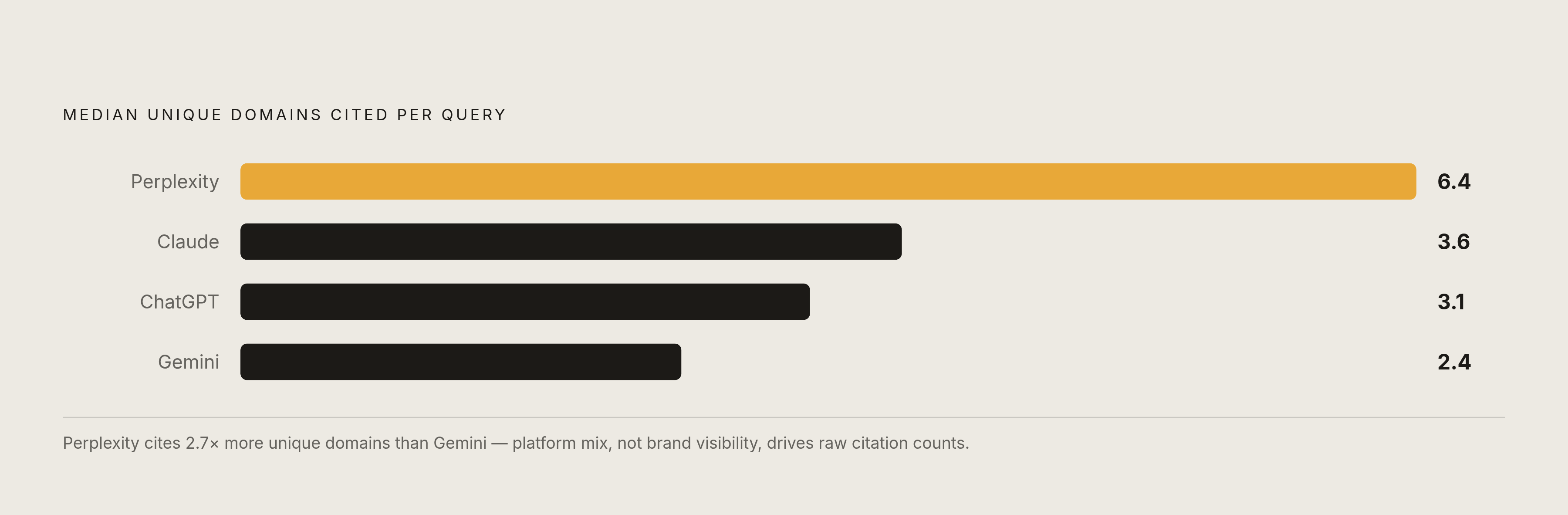
Platform mix matters just as much. Research into citation behavior found median unique domains cited per query running at 6.4 for Perplexity, 3.6 for Claude, 3.1 for ChatGPT, and 2.4 for Gemini. Perplexity, in other words, cites more than double the unique domains that Gemini does across that same dataset. A prompt set that leans too heavily on Perplexity will inflate a brand's raw citation count; one that undersamples it will understate that same brand's reach. Without knowing the platform mix behind a number, the number itself can't really be interpreted.
The engines also have distinct personalities that shape what content surfaces. ChatGPT tends encyclopedic, Perplexity leans community-driven, and Google's AI Overviews pull heavily from forums. The same page of brand content can perform completely differently across these four systems for structural reasons. A sample skewed toward one engine therefore produces a skewed read on the brand as a whole.
How to read "AI share of voice" across tools that define it differently
Ask five vendors to define "AI share of voice" and expect five different answers. One counts raw brand mentions inside the answer text. Another counts domain citations specifically. A third weights by position, so a first mention counts for more than a fifth mention buried at the bottom of a response. All five call the resulting number the same thing. None of them are wrong, exactly, but they're just measuring different objects and slapping a shared label on the output.
Three metrics stand apart: Brand Visibility, or how often a brand shows up at all across the prompt set; AI Share of Voice, meaning brand mentions as a proportion of all competitor mentions tracked; and AI Visibility Score, which weights mention rate by where in the response the brand actually appears. A tool that reports one of these without naming which one is handing over a number stripped of its own definition.
The prompt mix changes the outcome too. Median non-branded mention rate across tracked brands is around 31% in available research. Branded prompts run much higher, roughly 64% at the median, while comparison prompts run much lower, around 18%. A tool that blends all three prompt types into one headline figure without disclosing the blend is really just reporting however it happened to weight its own prompt set that week.
Per-engine breakdowns aren't optional extras, they're the whole point. A brand can appear in half of ChatGPT's answers to a given prompt and in 15% of Perplexity's answers to the identical prompt. Average those two together and the blended number hides exactly the engine where that brand is quietly losing ground.
What to check in a tool's methodology before trusting its output
Five questions separate a real measurement from a plausible-looking chart. How often are prompts re-run, and how old is the data currently sitting in the dashboard? How many prompts make up the set, and how are they distributed across query types and funnel stages? Which engines are included, and are their results shown separately or folded into one composite score? How exactly is "share of voice" defined, mention rate, citation rate, or something position-weighted? And does the tool flag content decay, surfacing an alert when a cited page has aged out of its relevant freshness window?
Pricing tends to track methodology depth, though not perfectly. A tool priced around $50 a month may track only three engines. Others start similar tracking features around $139 a month as part of a broader plan. Some vendors offer entry tiers covering only a single engine, with multi-engine tracking available only at higher price points. Another option runs from roughly $398 a month with a large prompt database but no Claude coverage. Other options allow configuration across a selection of engines at varying coverage levels.
That gap, no Claude coverage, is a sample-design problem. It's a sample-design problem, and it will skew any share-of-voice number the tool produces, because an entire engine's citation behavior simply never enters the calculation. A tool that can't answer all five questions above with specifics is handing over a number stripped of its own definition. It's handing over a number.
How freshness and sample size connect to the optimization decisions brands make
None of this is academic. The output of an AEO tool feeds directly into which pages get refreshed, which prompts get added to the tracking set, which platforms get budget, and which don't. Bad inputs at this stage don't just produce a slightly-off dashboard, they produce the wrong decision at every step downstream.
Consider that roughly 85% of brand mentions in AI search come from third-party pages, not from anything the brand itself owns or controls. A brand working off stale data might spend a quarter refreshing its own site while the actual third-party sources driving its citations decay quietly in the background, unmonitored and unaddressed.
Structure compounds the problem. Around 44.2% of citations trace back to the first 30% of a page's content, meaning front-loaded structure matters enormously for extractability. A brand whose tool sample is too thin to reveal which specific pages are getting cited has no way of knowing which pages need restructuring.
And the competitive gaps this creates can be stark. In practice, leading vendors in a given category can show up in 100% of buying-intent prompt runs, while a functionally comparable competitor shows up in a small fraction of those same runs, a gap of more than 90 points inside one identical question set. A brand that only discovers a gap like that after six weeks of running on stale data has already lost six weeks in a market where these advantages compound fast, and don't wait around for anyone to catch up.