Pilot Program Design for AEO Platform Proof of Concept
Define your baseline and success threshold before optimizing a single page.

Most AEO pilots die of vagueness, not bad execution. A brand decides to "test AI search," someone builds a spreadsheet, three months pass, and nobody can say whether anything actually moved. Ask five people on a marketing team what the pilot is supposed to prove. Expect five different answers back. No defined scope, no baseline, no agreed line for what counts as success: what gets called a pilot is usually an open-ended rollout wearing a pilot's name tag. Open-ended rollouts don't produce evidence. They produce activity, and activity is not the same thing as proof.
The bill comes due months later, when someone asks for results and the data can't answer the question. Stakeholders lose faith because nobody can point to a number and say this changed because of what we did, even when the underlying idea was sound. Budgets freeze, sometimes get cut outright, and the team that pitched the pilot spends the next quarter defending an idea instead of building on one.
Sharper prompts or a smarter content template won't fix this. Fixing it means treating the pilot the way a lab treats a hypothesis: define what's being tested, define how it's measured, define what result would justify moving forward, and settle all three before a single piece of content changes. Skipping that order makes the pilot just a rollout with a shorter name.
Pilot Measurement: AI Search Visibility Explained for Stakeholders
SEO gets a page discovered. AEO gets an answer pulled out and handed to a user directly. GEO gets a brand recommended inside that answer. Three different jobs, three different surfaces, and each one needs its own dashboard.
These terms aren't vendor invention. Generative Engine Optimization and Answer Engine Optimization were named formally in a research paper out of Princeton, done alongside Georgia Tech, the Allen Institute for AI, and IIT Delhi. That gives the field an academic spine instead of just a pitch deck behind it. Google's own documentation frames the discipline as SEO done with more rigor, not something separate, which is the easiest way to get a skeptical, SEO-native stakeholder on board without starting a turf war.
The case for urgency doesn't need dressing up. ChatGPT reaches 883 million monthly users. Google's AI Overviews now show up in nearly 55% of all Google searches. Impressions climb while clicks fall in the same analytics dashboard, because an AI answer increasingly satisfies the question before anyone reaches a website. Visibility rising, clicks dropping, the two lines splitting apart like an open jaw.
A pilot has to stay honest about its own edges too. It's a bounded test against a defined set of questions on a defined set of AI surfaces, and the rest of the site's content, along with whatever SEO work is already in motion, stays untouched.
GEO itself runs roughly 80% strategic work, positioning, ecosystem presence, brand authority, and only about 20% technical execution. Scope the pilot like a dev ticket, a checklist of on-page fixes, and the actual signal gets missed.
Choosing which LLM surfaces the pilot will cover
Testing ChatGPT alone feels like the obvious starting point. It's also the wrong one. Averaged across March and April 2026, ChatGPT's share of measurable B2B AI referrals sat at 62.6%, which sounds dominant until the rest of the math lands: over a third of the referral landscape lives somewhere else. Only 11% of domains get cited by both ChatGPT and Perplexity, so a content approach built for one model doesn't transfer to the next.
Each platform retrieves and rewards content differently, and that difference is what the pilot should actually be testing.
ChatGPT triggers live web search on roughly 34.5% of queries. The rest draws from training data already baked into the model, so it rewards depth and topical authority built up over time rather than one well-optimized page.
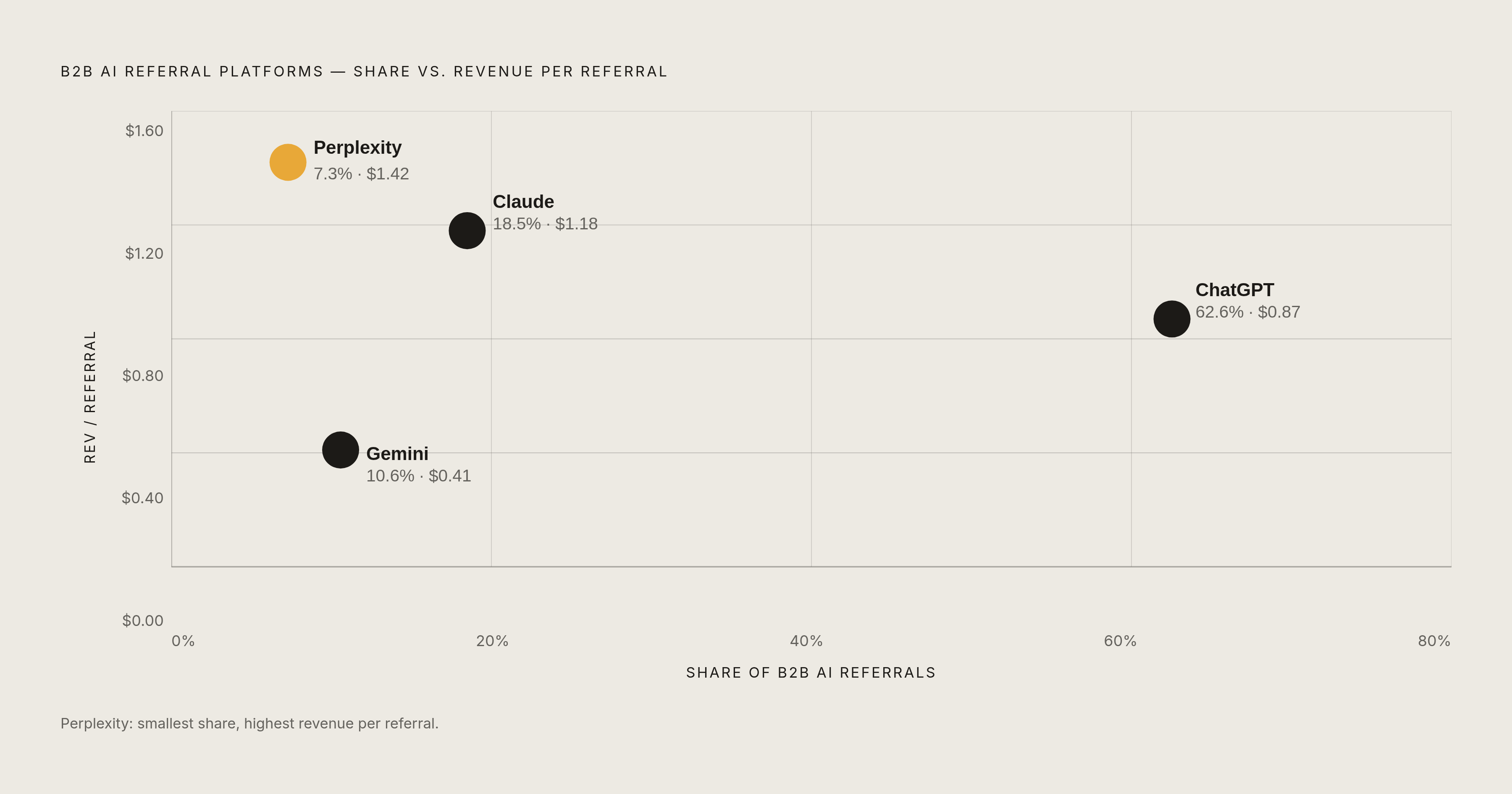
Claude leans on parametric knowledge instead of live retrieval and now accounts for about 18.5% of B2B AI referrals, pulling a developer and technical audience that has moved here in noticeable numbers. Revenue per referral runs around $1.18.
Perplexity holds a smaller slice, around 7.3% of B2B traffic, but carries the highest revenue per referral among the major surfaces, at roughly $1.42. It runs on retrieval-augmented generation, favors real-time and credible sourcing, and rewards being mentioned by someone else over saying something about yourself. No paid placement option exists on Perplexity. Organic work is the only lever there.
Gemini is around 10.6% of B2B AI referrals and uses RAG with query fan-out, splitting one prompt into several smaller intents and rewarding content written in tight, modular passages of about 40 to 60 words. Its retrieval also surfaces inside Google's own results through AI Overviews, so its real reach runs past its direct referral number.
Google AI Overviews carry the lowest revenue per referral, well under a dollar per click, but the widest reach simply because Google's query volume dwarfs everything else. A 300,000-keyword study found AI Overviews cut click-through rate for position-one organic listings by 58%. Getting cited inside that AI answer, though, correlates with about 35% higher organic click-through on the same queries. Losing the click doesn't mean losing the value, if the citation lands where a buyer can see it.
Matching surfaces to audience is the scoping decision, and it's where most pilots get lazy. B2B tech and developer-facing brands should put Claude and Perplexity first, since that's where tool recommendations actually happen. Consumer and local brands get more out of starting with one leading AI chatbot, then layering in a second model for AI Overview visibility. Enterprise teams need cross-platform coverage eventually, even if the rollout happens in phases.
Start with two or three surfaces matched to a known audience. Write down which surfaces got excluded and why. That exclusion list belongs in the pilot's scope document, not buried in an appendix nobody rereads.
Setting measurable objectives before any optimization work begins
Objective-setting gets skipped constantly, usually because it's the least exciting step and the easiest one to wave past. Skipping it still kills the pilot. Teams default to importing SEO objectives, rankings, traffic, click-through rate, none of which map onto how AI retrieval behaves. The pilot then produces a pile of data nobody knows how to read, and without a stated objective going in, there's no threshold that turns a pilot into a funding decision.
The core AI-native metric is AI Share of Voice: brand mentions divided by total AI responses across the target query set, multiplied by 100. Running 100 target queries across three platforms and showing up in 18 of those responses produces an AI SoV of 18%. For context, 10 to 15% counts as solid for an established player, while market leaders push toward 25 to 40%.
A pilot objective should be framed as directional movement from an unknown starting point, because nobody knows the baseline until measurement actually starts. The target has to bend around whatever that baseline turns out to be.
A handful of supporting metrics round out the dashboard. Brand Mention Rate tracks raw appearance frequency across sampled responses. Recommendation Rate tracks something sharper: how often the brand gets named as the actual suggested option, which signals real intent rather than a passing reference. Prompt Coverage measures what percentage of the target query set returns any brand mention. Model-Specific Visibility breaks Share of Voice out by platform, since the numbers diverge sharply between surfaces. Visibility Volatility tracks how often a brand appearing in one response shows up again in the very next response to the same query, and that figure runs around 30%, so week-to-week swings need tracking before anyone calls a change real.
Connecting all of this to business outcomes is what makes the pilot land with an executive audience. Triangulate AI Share of Voice against GA4 or Plausible traffic segmented by AI referral source, then against CRM conversion data, and the chain gets AI visibility onto a board slide instead of leaving it a marketing curiosity. The revenue-per-referral figures, Perplexity at $1.42, Claude at $1.18, ChatGPT at $0.87, Gemini at $0.41, give a pilot proposal something concrete to frame the upside around, instead of a vague promise of more visibility.
Establishing the baseline: how to measure where the brand stands before any changes
Baselines in AI search don't behave like baselines in traditional SEO, where a keyword rank holds fairly steady day to day. AI responses shift with phrasing, with timing, with whichever model version happens to be running that query. Only around 30% of brands visible in one AI response for a given query appear again in the very next response to that same query. A single day's snapshot is a coin flip caught mid-air, and treating it as a stable measurement is the fastest way to build a pilot on sand.
The more defensible approach: run the target query set daily for two to four weeks before touching any optimization work, then use the average across that window as the baseline, not whichever peak day happened to look best.
Building the query set takes real care. Map it to actual buyer journey stages, awareness questions, evaluation questions, comparison questions, direct recommendation requests, and make sure branded, category, and competitor-adjacent phrasing all show up somewhere in the mix. A tightly scoped set of queries run every day beats a sprawling list checked whenever someone remembers to.
On tooling, a few paths exist, and none of them fully substitutes for another. Purpose-built AI visibility platforms offer multi-model aggregation, weekly tracking cadence, and competitive benchmarking across surfaces like ChatGPT, Perplexity, Gemini, and Google's AI Mode and AI Overviews, though model coverage varies by provider and needs confirming before anyone commits budget. HubSpot rolled out AEO tracking in 2025 and has expanded it to cover visibility scores, share of voice, and citations across ChatGPT, Gemini, and Perplexity. Established SEO platforms have bolted on AI-mode reporting too, useful for spotting overlap between SEO and AEO performance, but their underlying metric model still runs on links rather than citations, so they can't stand in for a full AI Share of Voice measure on their own. Free options exist: Bing Webmaster Tools has an AI Performance report, and Google Search Console has added its own AI performance view, both useful but limited to the surface each one comes from.
Whatever gets chosen has to actually cover the surfaces picked back in the scoping stage. A tool that tracks ChatGPT and Gemini when the pilot is built around Claude and Perplexity produces a baseline that's incomplete before it's finished being built.
Competitor baselining belongs here, not tacked on after the fact. Run the identical query set against two or three direct competitors. Frame the pilot's success threshold relative to where they land. That 10 to 15% benchmark for an established player gives the pilot's success threshold a concrete anchor to work from.
The content interventions the pilot changes and why
Content that just restates what's already out there earns close to nothing in AI retrieval, because a model has no reason to cite a source that adds no new information. Forrester's 2026 research found content carrying genuine information gain, something not already stated elsewhere, ranks about three times higher in AI responses than content rehashing existing consensus. Proprietary data builds something close to a moat: when an organization is the original source of a specific number, an LLM has nowhere else to pull that number from and has to cite whoever owns it.
A handful of structural changes carry real evidence behind them, not just intuition. Writing in modular paragraphs of roughly 40 to 60 words matters because RAG systems chunk content by paragraph or heading, and each chunk has to make sense on its own once it's pulled out of context. Tables carry outsized weight too: comparison tables built with proper HTML structure get cited noticeably more often than plain prose covering the same ground. The Princeton-led study identified citations, statistics, direct quotations, and authoritative phrasing as the strongest optimization levers available, and found that targeted work along those lines lifted visibility in generative responses by as much as 41%. Schema markup deserves particular attention heading into 2026: it now ranks as the single most impactful technical lever available, with LLMs depending on structured data even more heavily than traditional search engines ever did. Freshness matters as well. Research comparing AI-surfaced URLs against traditional search results found the pages cited by one AI system ran about 25.7% fresher on average, which points to recency carrying real weight inside retrieval ranking.
Third-party presence is the intervention most pilots quietly skip, and it's the biggest miss on this list. Roughly 85% of brand mentions inside AI search responses trace back to third-party pages rather than the brand's own site. A pilot that only touches on-page content and skips digital PR or earned placements can't attribute whatever gains occur, since the third-party variable was never tracked. Perplexity in particular rewards factual consensus pulled from outside sources, so external mentions carry more weight there than anything self-published ever will.
One last piece belongs in the pilot regardless of budget: an entity integrity audit. If AI platforms are already misstating basic facts about a brand, wrong founders, invented statistics, confusion with a competitor, optimization built on top of that corrupted profile just amplifies the wrong information faster. Fixing that means getting brand facts consistent across every channel the brand controls, which starves the model of noise and gives it something accurate to draw from instead. RAG-based retrieval can cut hallucination rates by more than 60% compared to open generation, in pilots run inside enterprise environments with RAG-enabled internal tools, since the model shifts into summarizing retrieved material rather than generating freely from memory. That's the structural reason to fix the entity record first, before a single dollar goes toward content optimization built on top of it.