Reporting Quality Standards for AEO Platform Procurement
Procurement teams need reporting that ties AI visibility to revenue, not vanity metrics.

Buying an AEO platform is, whether procurement teams realize it or not, a bet on the quality of its reporting. AI search has already replaced much of the traditional search funnel as the first stop in buyer research, with prospects building what amounts to a silent shortlist inside a chat conversation long before they ever land on a brand's website. Yet only a small slice of brands currently track their AI search performance in any systematic way, which tells you the AEO platform market right now is being pulled forward by urgency rather than shaped by any settled sense of what good measurement even looks like. That gap is exactly where a procurement trap opens up: a vendor can hand a buying committee a dashboard full of busy-looking numbers, mention counts, trend lines, colorful charts, none of which actually proves the platform moved a single dollar of pipeline. So the question a procurement team should lead with isn't "what does this platform track?" It's whether what it tracks connects to revenue at all. This piece lays out the reporting standards that separate the platforms built to answer that question from the ones that were never asked to.
What the AI visibility landscape requires platforms to measure
Scale is the first reason old reporting habits stop working. A brand can be seen more than ever and clicked less than ever, at the same time. That's the whole point: most AI search sessions end without a click at all, so if a brand's name never comes up inside the answer itself, it simply doesn't exist in that buyer's head when the shortlist gets built. GEO is predominantly strategic (positioning, ecosystem presence, brand authority) and only a small share technical, per Writer's enterprise guide, so a platform whose reporting is heavily weighted toward technical signals such as crawl errors or schema flags is measuring the wrong dimension.
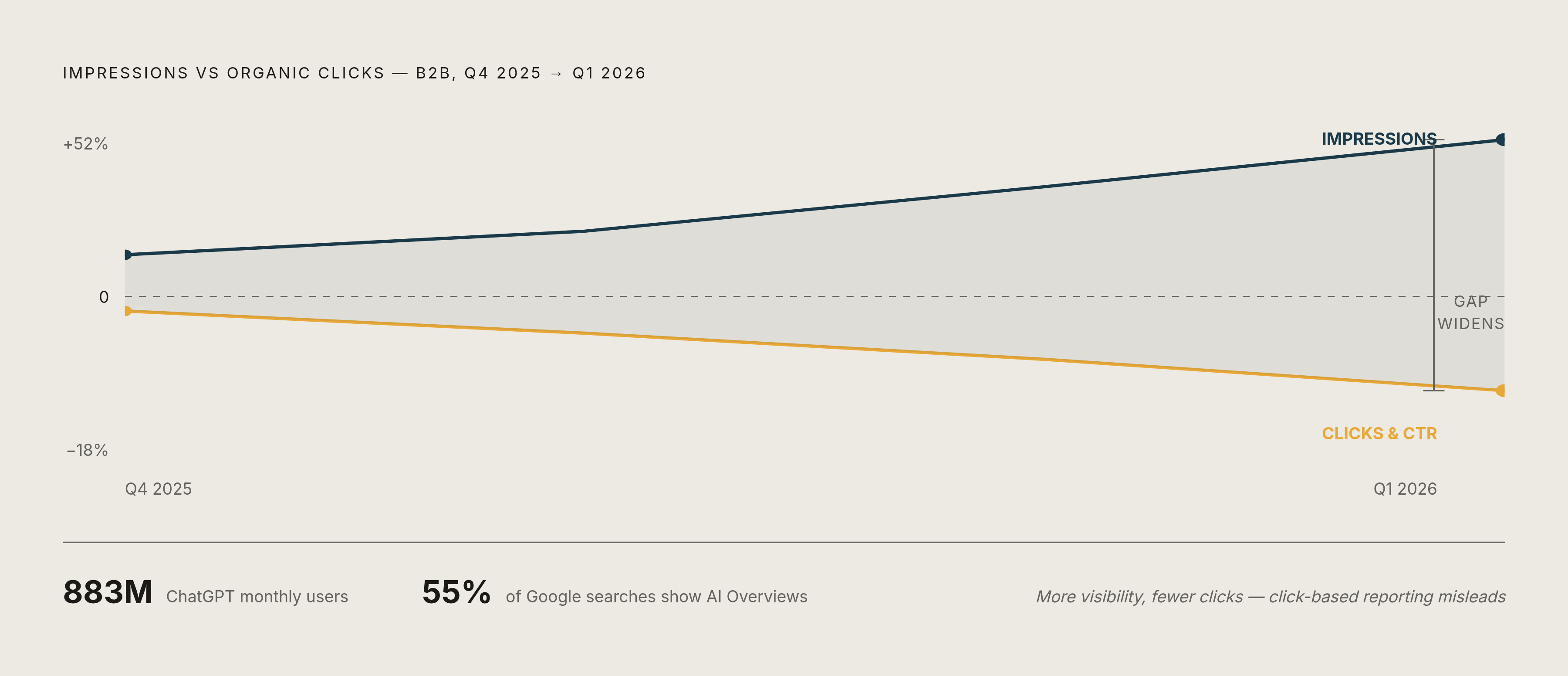
This is why SEO, AEO, and GEO, related as they are, can't be measured by the same yardstick. SEO still lives and dies on rankings and traffic, AEO on whether a snippet gets extracted, GEO on citation rate and share of model, three different games with three different scoreboards. Most of what actually shapes AI visibility doesn't happen on a brand's own website anyway. The large majority of brand mentions inside AI search answers trace back to third-party pages rather than owned domains, which means a platform that only crawls what a company controls is structurally blind to most of the terrain that determines citation. None of this settles the semantic argument some corners of the industry keep having, either. Google's own 2026 developer documentation is blunt that optimizing for generative AI search is still, at bottom, SEO, a fair counterpoint that any skeptical internal stakeholder is going to raise in a procurement meeting. Fine. Whatever you call the discipline, the reporting requirement doesn't change because a platform has to measure presence across an ecosystem it doesn't own, not just performance on pages it does. ChatGPT reaches 883 million monthly users, and Google AI Overviews appear in nearly 55% of all Google searches, a scale that makes AI visibility a primary channel, not an experiment. The Crocodile Mouth Effect describes how, across B2B websites from Q4 2025 to Q1 2026, impressions grew substantially year over year while organic clicks and CTR fell sharply, meaning traditional click-based reporting tells an increasingly misleading story about brand health.
The six core metrics a credible AEO platform must report
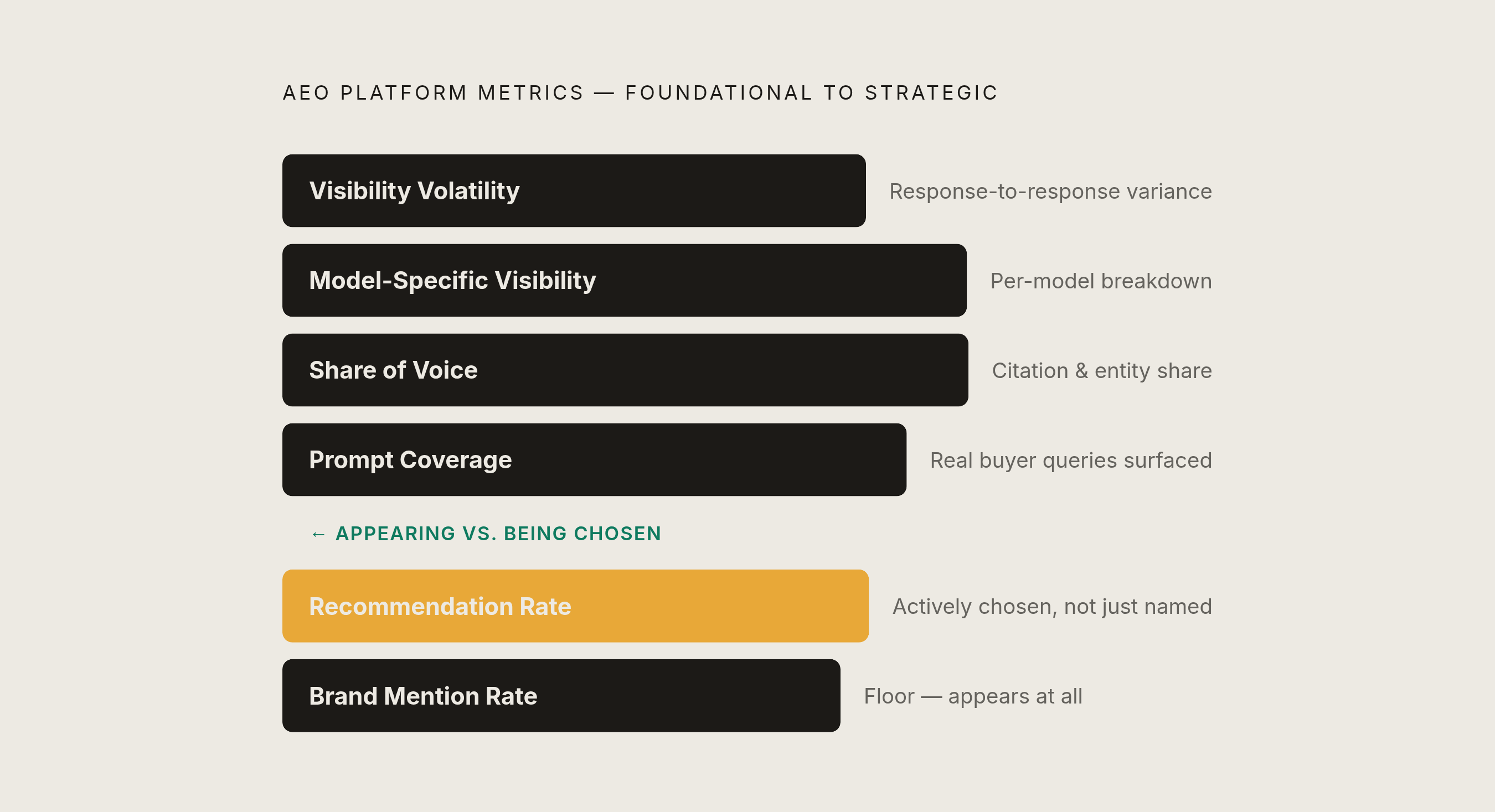
Six metrics make up what counts as a real AI visibility picture: Brand Mention Rate, Recommendation Rate, Prompt Coverage, Share of Voice, Model-Specific Visibility, and Visibility Volatility. An AI visibility score, when a platform reports one, should be a composite of all six, weighted by how often and how favorably a brand shows up, not a single number standing in for the whole picture. A platform that only shows one or two of these six is giving a partial picture, not simplifying anything for the buyer. It's giving them half a map and calling it the territory.
Brand Mention Rate is the floor: it appears in how often the brand is mentioned at all in AI-generated answers across a defined set of prompts, before anyone weighs whether that mention was flattering, neutral, or buried. Recommendation Rate sits a level above it, measuring how often the brand gets actively recommended rather than just name-checked, and that gap between appearing and being chosen is exactly the distinction that eventually has to tie back to pipeline. Prompt Coverage asks a more practical question: out of all the queries a real buyer might type, what share actually surfaces the brand at all? Gaps here point straight at content strategy, which makes this one of the more actionable metrics on the list.
Share of Voice is where procurement teams need to slow down, because it isn't one number, it's two. AI Share of Voice measures the percentage of total brand mentions that belong to a given brand across a defined prompt set, but there are two distinct ways to calculate it. Citation-based AI SOV divides a brand's citations by total citations and multiplies by 100, while entity-based AI SOV divides brand appearances as a recommended entity by the total entities listed in the answer set. Conflate the two, or report only one without saying which, and a buyer is looking at a number that sounds precise and means something different depending on which version the vendor happened to pull that quarter.
Model-Specific Visibility breaks all of the above out by individual LLM, ChatGPT, Perplexity, Gemini, Claude, Copilot, Grok, because a brand can dominate one model's answers and be nearly invisible in another's, a split that aggregate-only reporting simply papers over. And Visibility Volatility captures the variance of a brand's scores across consecutive responses to the same exact query; roughly 30% of brands that appear in one AI response appear again in the very next consecutive response to that same query, and a platform that takes only periodic snapshots will miss real signal. A platform sampling only once a month will miss that churn entirely. A five-point swing week to week is probably just noise, but a five-point swing that holds for three or four consecutive weeks is a real shift worth acting on. In B2B competitive context, a citation share between 5% and 15% is competitive, while 20% or above signals category leadership, per AuthorityTech's benchmarks.
Why prompt methodology determines whether the data is statistically meaningful
None of those six metrics mean anything if the underlying prompt set is thin. If a vendor shows a brand's performance on a handful of obviously branded queries and calls that proof of visibility, that's cherry-picking dressed up as evidence, not a measurement system.
Google's own documentation on how its AI systems work introduces something called query fan-out, where a generative model doesn't answer one query, it silently generates a cluster of related sub-queries and answers all of them at once. Prompt coverage has to map that entire semantic neighborhood around a topic, not just the one head query a marketer might type into a search box. A platform that only tests the obvious phrasing is missing most of the actual surface area where a brand could be cited or skipped.
A few direct questions belong in every vendor conversation at this stage. How are prompts selected in the first place, and how often are they refreshed as market language shifts? Are buyer-intent prompts kept separate from purely informational ones, since conflating the two muddies what the resulting score actually represents? And is the same prompt set run across every tracked model at the same time, so that Model-Specific Visibility numbers are actually comparable rather than measuring one model under different conditions than another? A vendor that can't answer these cleanly probably hasn't built the methodology to answer them at all. Discovered Labs' GEO metrics analysis shows testing five queries tells a team nothing meaningful, since AI responses vary based on personalization, timing, model version, and context, and teams need 50–100+ query variations to reach statistical confidence.
Hallucination monitoring as a non-negotiable reporting component
35% of brands report that AI hallucinations have already damaged their reputation, which puts accuracy monitoring squarely in the category of required reporting, not a nice-to-have bolted on later. The failure modes are specific. Invented statistics get attributed to a brand that never published them, citations get fabricated wholesale, complete with authors and studies that don't exist, and entity confusion mixes up founders, headquarters, or founding dates, often borrowed wholesale from a competitor's profile.
What makes this harder to manage in 2026 is a pattern some researchers are calling the Hallucination Paradox. The best models have pushed hallucination rates on simple tasks like document summarization down to as low as 0.7%, genuinely low, but the same reasoning-heavy models are drifting more on complex tasks, precisely because they spend more computation "thinking through" an answer and sometimes wander further from the source material in the process. More reasoning doesn't automatically mean more accuracy. Sometimes it means the opposite.
The stakes vary sharply by industry: in financial services, a hallucinated product or regulatory summary can slide straight into mis-selling territory, and in legal and professional services, fabricated case citations have already led to court sanctions and professional discipline. So a credible platform needs different success metrics for three distinct but layered disciplines: rankings and traffic for SEO, answer extraction and snippet capture for AEO, and citation rate and share of model for GEO. Retrieval-Augmented Generation is the leading technical fix here, forcing a model to build its answer from real retrieved sources rather than from its training data alone, and it cuts hallucination rates substantially. It doesn't eliminate the problem, though, and it doesn't force a model to stay strictly inside the evidence it retrieved, so a platform worth its contract should be able to show a client, concretely, how tightening entity integrity translates into fewer hallucinations downstream. Does the dashboard distinguish between a brand being cited wrong and a brand simply being left out, and does it show both in the same view?
Connecting AI visibility data to business outcomes: what pipeline attribution reporting requires
Everything above is diagnostic until it answers one question: does a rise in AI Share of Voice line up with a measurable change in pipeline, more traffic, more leads, more revenue that can be traced back to it? A platform that can't eventually answer that is a monitoring tool. It is not a growth platform, and boards tend to notice the difference fast.
There's a real proxy for this already in the data. Brands cited inside an AI Overview see a 35% higher organic click-through rate on those same queries compared with brands that go uncited, which says something important: getting named inside an AI answer doesn't just satisfy a buyer's question and end the session, it creates downstream intent to click even in a search environment that's supposedly moving toward zero clicks altogether. Citation rate, in other words, is a leading indicator, but on its own it isn't yet board-ready reporting. Getting there means tying it to traffic that specifically originates from AI-referred sessions, a channel that grew 527% year over year through mid-2025 and deserves its own line item rather than getting folded into generic referral traffic. It also means mapping share-of-model trend lines against where deals actually enter the pipeline, how fast they move, and whether they close, and tracking a content gap closure rate that shows whether fixing an identified gap in coverage actually moved the citation numbers afterward.
Cadence matters as much as the metrics themselves here. Given that a five-point swing has to hold for three or four consecutive weeks before it counts as a real signal, attribution reporting needs to run on that same rhythm, not get flattened into a quarterly business review that arrives long after the inflection point has already passed. One test that separates a serious vendor from a decorative one: ask for an actual example report showing a client moving from one AI SOV baseline to a meaningfully higher one, and ask the platform to say what content or entity work it attributes that movement to. A vendor that can produce that isn't selling a dashboard. A vendor that can't, is.
The technical reporting infrastructure that makes these standards achievable
The reporting standards above depend on specific infrastructure, and procurement teams should treat this section like a checklist rather than a pitch deck.
Multi-LLM tracking, run simultaneously across models rather than staggered or spot-checked, is table stakes: cross-platform visibility spanning multiple LLMs simultaneously is the only true measure of where a brand actually stands, and a platform tracking only one or two models is structurally incomplete. Entity consistency monitoring matters just as much, since AI models build their understanding of a brand from consistent entity signals across the web; when a company name appears in different variations across different sources, the model's entity graph fragments, and mentions fail to consolidate into a unified SOV signal, and the platform must detect and surface this fragmentation. A platform has to detect that fragmentation, not just report around it.
Because most brand mentions originate on third-party pages rather than a brand's own site, crawler scope has to reach well past owned domains, into editorial reviews, analyst commentary, community forums, and earned media generally. A platform that stops at the edge of a company's own domain is only ever seeing a fraction of what actually drives citations.
Structured data and schema signal auditing matters because LLMs rely on structured data more heavily than traditional crawlers, and a platform that cannot audit schema implementation and surface gaps is missing a primary lever for improving citation rates. And freshness weighting deserves a place on the list too: research looking at a large corpus of AI citations found that AI-surfaced URLs run 25.7% fresher on average than what shows up in traditional search results, which means a platform's reporting needs to account for how recency itself functions as a ranking factor inside these systems, not just an afterthought.
Sources
- GEO, AEO, and SEO in 2026: The enterprise guide to AI visibility - WRITER
- Answer Engine Optimization: Complete AEO Guide [2026] | Frase
- Google's Guide to Optimizing for Generative AI Features on Google Search | Google Search Central | Documentation | Google for Developers
- Ultimate Guide to LLM Tracking and Visibility Tools 2026
- AI Share of Voice: How to Measure LLM Brand Visibility
- Prevent AI hallucinations about your brand in 2026: Complete guide | by Anya Writes | Write A Catalyst | Medium