AI Brand Monitoring for Regional Banks and Financial Services Firms
Three publishers control what AI tells customers about your bank before they visit your website.
American consumers increasingly start their banking research inside ChatGPT, Claude, Gemini, and Perplexity. That shift puts an AI answer layer between a prospective customer and the financial product they're looking for, well before anyone visits a bank's website. The Banking AI Visibility Index 2026 looked at tens of thousands of prompts across five leading AI assistants between January and May 2026, and it mapped citation share across dozens of institutions; a benchmark like this exists now because the behavior has become that established. Whatever a prospective customer sees when they ask an AI assistant about a bank, a product, or a rate shapes which institutions make their shortlist, and it does so before they ever open a branch page or talk to a banker.
Who controls what AI answers say about banks
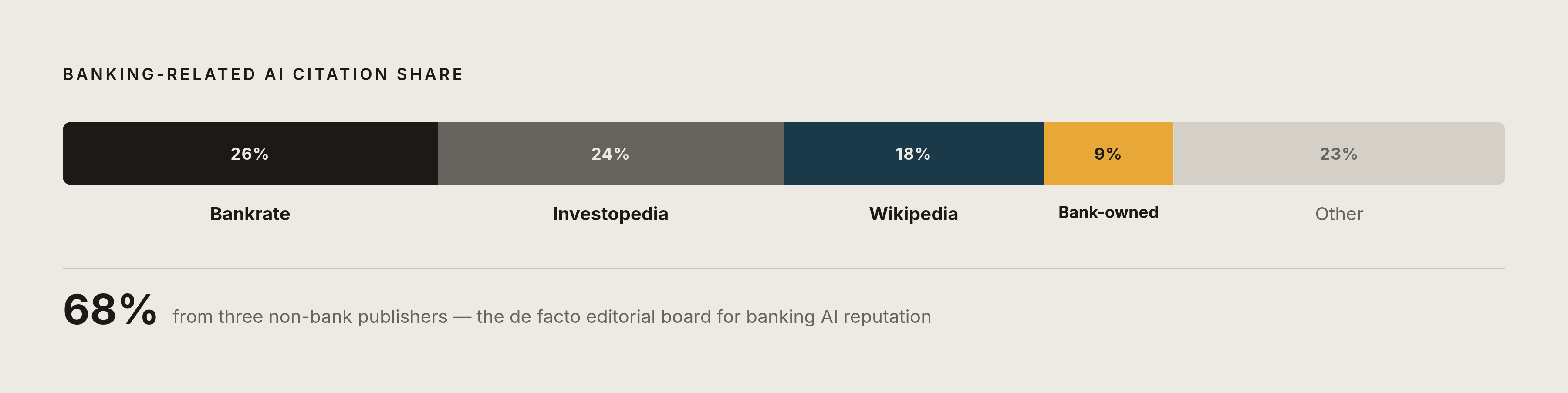
The Banking AI Visibility Index 2026 turned up a structural finding that explains most of what follows in this piece: three publishers, Bankrate, Investopedia, and Wikipedia, supply 68% of all banking-related AI citations, while bank-owned domains account for a small slice of the total. A bank would never let a competitor write the copy on its own branch signage. Yet that is functionally what's happening inside AI answers right now: publishers, not banks, are doing the describing. When Bankrate frames a bank's savings rate or Investopedia characterizes a bank's reputation, that framing is what gets repeated back to a prospective customer, and the bank has no seat at the table where that first impression gets written. This is a supply chain problem before it is a content problem. Three publishers have become the de facto editorial board for an entire industry's online reputation, and most banks have not yet noticed the handoff.
The citation gap between regional banks and the institutions outranking them
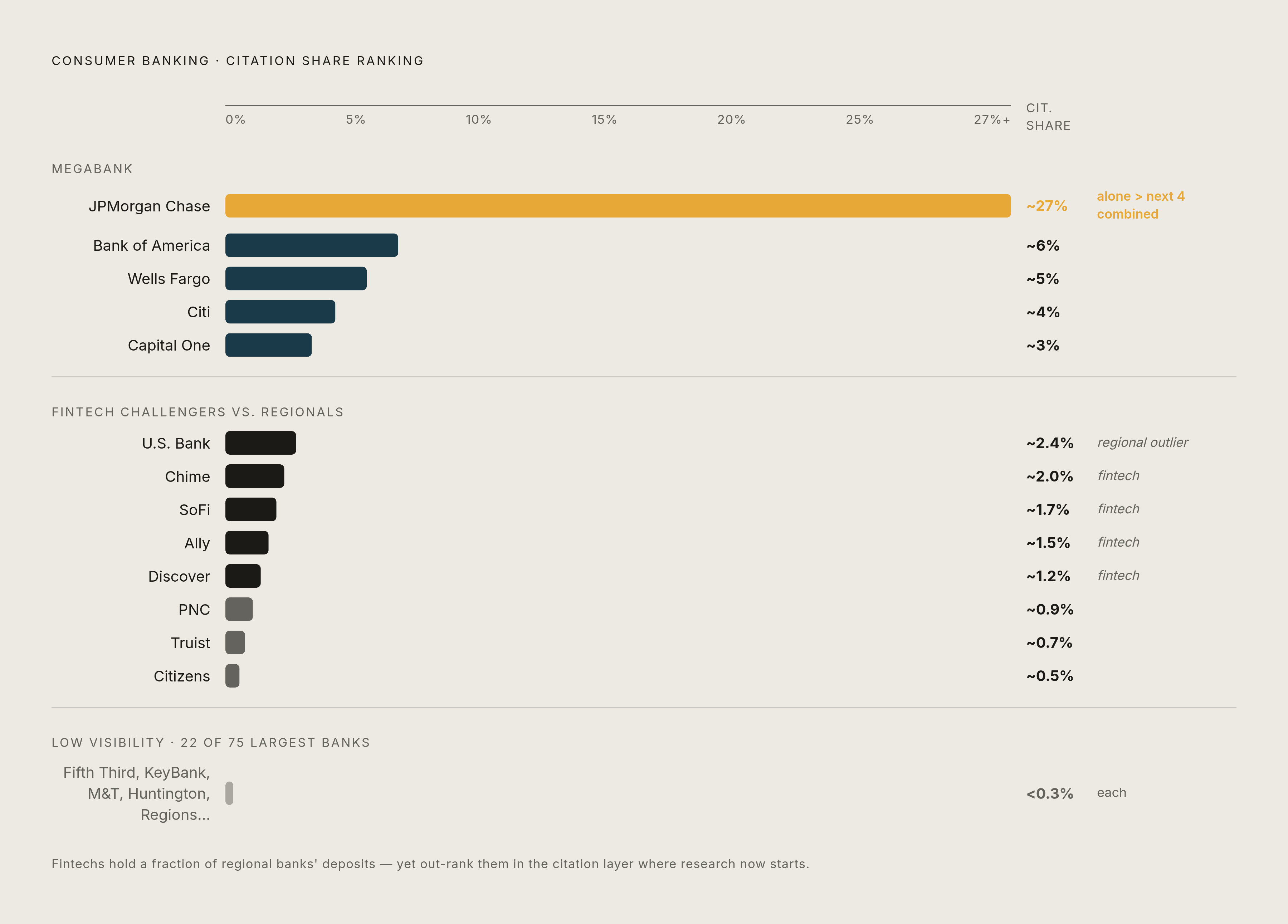
Scale matters at the top of the market. JPMorgan Chase captures more than a quarter of consumer banking Citation Share, more than Bank of America, Wells Fargo, Citi, and Capital One combined, which concentrates AI discoverability at the very top of the asset ladder. But scale is not the whole story, and the more damaging pattern for regional banks has nothing to do with balance sheet size. Fintech challengers, Chime, SoFi, Ally, and Discover, now out-cite regional banks like PNC, Truist, and Citizens, despite holding a fraction of their deposit base (U.S. Bank is the exception here, out-citing all four fintechs). These fintechs built digital-native content ecosystems years before the AI layer existed, and those ecosystems are now the infrastructure that AI assistants draw from when answering a customer's question. Among the 75 largest U.S. banks tracked in the index, 22 registered less than 0.3% Citation Share, a group that includes Fifth Third Bank, KeyBank, M&T Bank, Huntington, and Regions Bank. Those institutions are invisible in the layer where banking research increasingly starts. The Evident AI Index for Banks, now in its fifth edition as of October 2026, ranks AI maturity across 50 of the world's largest banks and places JPMorganChase, Capital One, and RBC as the top three, with regional institutions clustered toward the bottom. That ranking confirms the citation gap reflects a broader gap in AI capability across the industry, not simply a shortfall in how much content regional banks publish.
Why AI assistants disagree about the same bank
A bank's visibility also depends heavily on which AI assistant a customer happens to be using. The Banking AI Visibility Index 2026 found that ChatGPT and Gemini favor JPMorgan Chase, Perplexity over-indexes Capital One and surfaces fintechs more aggressively than the other platforms, Claude comes closest to balanced coverage across institutions, and Google AI Overviews show the most volatility of the five. A bank that looks well-represented on one engine can be nearly absent on another, and a regional bank that checks only one platform is working from a one-engine result. It may conclude its visibility is in reasonable shape while remaining invisible to every customer who happens to reach for a different assistant. Standard rank tracking, built for a search engine with a fixed set of positions, doesn't transfer to this environment because there is no fixed position to hold in a generative answer. The metric that matters is Citation Share: how often a brand gets named, recommended, or cited as a source across a defined set of prompts, tracked over time, against competitors, and across multiple models at once. Anything less than that cross-platform view produces a false sense of security.
What AI monitoring reveals that banks don't know
AI assistants were still surfacing the "Marcus" brand name in nearly a third of Goldman consumer banking responses more than three years after Goldman Sachs wound down its consumer retail operation, the Banking AI Visibility Index 2026 found. AI assistants encode reputational memory slowly, and they release it even more slowly. Correcting that kind of lingering reference required active intervention rather than simply waiting for the old brand to fade from the training data on its own. The same index found that First Republic, Silicon Valley Bank, and Signature Bank, all of which collapsed more than two years before the study, still appeared in 8% of safety-related AI responses as cautionary references. Reputational events get encoded for years after they happen, long past the point when a bank's own communications team considers the story closed. Hallucination compounds this risk in a banking context specifically. AI models can generate factually incorrect answers about interest rates, product terms, fee structures, or regulatory status, and a wrong answer about a CD rate or a loan term isn't a cosmetic error. It creates customer harm, compliance exposure, and reputational damage that a bank may not discover until a customer has already acted on the wrong information. Most banks track Net Promoter Score, brand awareness, and SEO position, and none of those three metrics capture what AI assistants are currently telling prospective customers about a bank's products, rates, or reputation. Closing that gap requires systematically querying AI platforms with the actual questions prospective customers ask and auditing what comes back.
AI brand monitoring for financial services firms
AI brand monitoring for a bank means prompting AI platforms, repeatedly and systematically, with the questions prospective customers actually ask: about checking accounts, home equity products, CD rates, business loans, financial advisors. It means auditing what each platform returns, which brand gets named, in what context, with what framing, and which sources the platform cites to back up its answer. Citation Share is the central output of that process, the share of relevant AI responses in which a given bank is named, recommended, or cited as a source, tracked over time, across multiple large language models, and measured against named competitors and fintech challengers. A properly run monitoring program also surfaces which third-party publishers are capturing citations a bank's own content should be earning, where AI responses contain factually wrong product or rate information, where a bank's name only shows up as a cautionary reference rather than a recommendation, and where competitors have gained or lost ground since the last measurement period. When third-party publishers dominate the citation layer this thoroughly, a bank loses editorial control over its own narrative inside AI answers, and you only see that loss through systematic monitoring across every major model a customer might use. AthenaHQ runs this kind of monitoring across eleven or more major LLMs, including ChatGPT, Perplexity, Google AI Overviews, Google AI Mode, Gemini, Claude, Copilot, Grok, DeepSeek, Meta AI, and Mistral, combining real-time brand sentiment intelligence with competitor share-of-voice comparison and citation source analysis. That combination gives a financial services marketing team one unified view of AI brand presence instead of a pile of separate, platform-by-platform snapshots that don't add up to a coherent picture.
The content architecture that determines whether a bank gets cited or ignored
AI assistants surface content written to directly answer the conversational questions customers type in: "What's the difference between a HELOC and a home equity loan?", "How do I improve my credit score to qualify for a loan?", "What should I look for in a business checking account?" A bank that publishes only product pages and static rate tables sits structurally outside the content AI assistants pull from, no matter how accurate that content is. Earning citation share is a matter of architecture, not volume. Three kinds of structured data form the technical foundation of that architecture: FinancialProduct Schema, which clarifies interest rate, maturity, and fees in a machine-readable format; Organization Schema, which presents a bank's official name, contact information, and regulatory status in a clear hierarchy; and Person Schema, which establishes the credentials of whoever wrote the content. These markup signals help an AI platform treat a bank's own domain as a source worth citing. Content that directly compares a bank's products to competing alternatives raises the odds of appearing in exactly the generative responses where a customer is deciding between options, so if banks avoid comparison content to look neutral, they end up absent from precisely the prompts that carry the highest purchase intent. Trust signals from outside a bank's own domain matter too: AI platforms weigh user-generated content on platforms like Reddit and Discord as credibility signals, so a bank's presence (or absence) in those community conversations affects its citation share alongside anything it publishes directly. None of this is a one-time project. Pages that go unmaintained lose citations at a disproportionate rate, and that compounds the pattern described above, where AI assistants keep repeating outdated information long after a bank has moved on.
How AI engines weigh expertise and trust signals in financial content
Financial content sits in the highest-scrutiny category AI platforms apply, the same tier as health and legal information, so AI assistants run a stricter credibility filter before they cite a bank's own page over an established publisher like Investopedia or Bankrate. The signals that filter looks for, Experience, Expertise, Authoritativeness, and Trustworthiness, have to appear in machine-readable form before generative AI will treat a piece of content as authoritative. Author credentials written into plain prose, a line at the bottom of an article noting someone's title, read as far less legible to an AI system than structured markup that explicitly names the author, their role, and their institutional affiliation. That difference in format, not in substance, explains a meaningful part of the citation gap documented across the index. Established financial publishers carry years of accumulated domain authority and structured author attribution that AI platforms already recognize. Regional bank content teams frequently produce material that is substantively stronger and more accurate on the specifics of their own products, yet that material isn't packaged in a format AI can process as authoritative, so the credit goes to the publisher repeating a simplified version of the same facts.
Building the business case for AI visibility investment inside a bank
Most bank AI ROI dashboards track model performance metrics, accuracy rates, inference latency, cost per query, rather than the operational and financial outcomes a CFO actually needs to see: origination cost per funded application, cost-to-serve per case, share-of-wallet growth per segment. The Banking AI Visibility Index 2026 frames the resulting gap this way: most banks have a CMO who can explain their Google rankings in detail and a CFO who has no idea what their Citation Share looks like inside ChatGPT. Closing that gap is the executive argument for putting AI search on the board's agenda alongside NPS, brand awareness, and organic traffic, rather than leaving it as a side project inside the marketing department. The case strengthens once conversion quality enters the picture. When buyers discover a financial institution through AI search, they show meaningfully higher purchase intent than those who arrive through traditional organic channels, so Citation Share works as a pipeline metric as much as a brand metric. Making that case to a board requires reporting infrastructure built for it. AthenaHQ's Enterprise plan includes board-ready reporting with Tableau, Power BI, and Looker integration, along with an executive dashboard that ties AI visibility to ROI tracking and competitive intelligence summaries, which gives a financial services marketing leader a way to present AI search as a measurable growth channel rather than an experimental line item that's hard to defend at budget time.
What regional banks do to close the AI visibility gap
South State Bank's Director of Capital Markets, Chris Nichols, is identified by that title on the bank's own correspondent division podcast and by S&P Global, a small but telling example of the kind of structured, consistently attributed author credential that AI platforms are built to recognize. Few regional institutions can point to that same consistency across their published content, and that gap in practice, more than any gap in product quality, is what separates banks managing their AI presence from banks that remain invisible to it. The operational discipline behind that consistency has a name: AI listening, the practice of periodically querying AI platforms with the questions a prospective customer would ask, auditing what comes back, and acting on what those responses reveal about citation gaps, factual errors, and competitive displacement. Monitoring alone doesn't close a gap. It has to feed a loop: monitoring shows which third-party publishers are capturing citations a bank's own content should be earning, which product descriptions AI is getting wrong, and which competitors have gained ground, and optimization then targets those specific findings with structured content, schema markup, and third-party citation building. Identifying which regional competitors are out-citing a given bank, and why, means analyzing citation position not on one AI platform but across the eight or more major models prospective customers actually use. Tools built for cross-platform AI visibility can map that competitive gap, and they show which content strategies are converting into citation share across the AI landscape where regional banks currently trail. A bank that looks reasonably visible on ChatGPT but nearly absent on Perplexity doesn't have a complete picture of its AI search standing, and only unified monitoring across multiple LLMs catches that kind of blind spot before a competitor or a publisher fills it first. The fintech content ecosystems dominating AI citations today took years to build, but the AI layer itself is still consolidating, not yet locked into a permanent shape. Banks that start establishing citation authority now, while the index is still forming, will be structurally harder to displace later than banks that wait for the pattern to settle. AthenaHQ was built for that operational practice specifically, giving financial services marketing teams cross-platform AI visibility tracking across eleven or more LLMs, content gap analysis, citation intelligence, and the Athena Citation Engine to act on what monitoring turns up, which is what makes AI brand monitoring a repeatable discipline rather than a one-off audit a bank runs once and forgets.