Building an In-House AEO Monitoring Stack From Scratch
AI answers now reward citations and content structure, not search rankings.

A marketer loads a rank tracker expecting to see where the brand stands and finds nothing useful about how that brand shows up in ChatGPT, Gemini, or Perplexity. That gap exists because the unit of success has changed from a ranking position on a results page to a citation inside an AI-generated answer, and no amount of tweaking the old tool closes it. Building a monitoring stack for this new environment means starting over on the instrumentation itself, not bolting a new report onto an old dashboard.
Why the instrumentation logic for AI search is different from SEO from the ground up
Rank trackers were built to measure a specific kind of output: position, impressions, click-through rate, all downstream of a ranked list of blue links. AI engines run on retrieval-augmented generation, a pipeline that moves from query interpretation to semantic retrieval to authority scoring to answer synthesis to citation attribution. Each of those stages is a place where a brand can win or lose visibility, and none of them is something a rank tracker was built to watch.
A brand can hold strong, stable organic rankings and still be functionally invisible in AI answers because citation selection depends on authority signals, how extractable the content is structurally, and how present the brand is across the wider ecosystem, not on rank position, which unsettles a lot of marketing teams the first time they see it. The AI engine isn't malfunctioning; it's a different scoring system working as designed, just on inputs the SEO stack was never built to track.
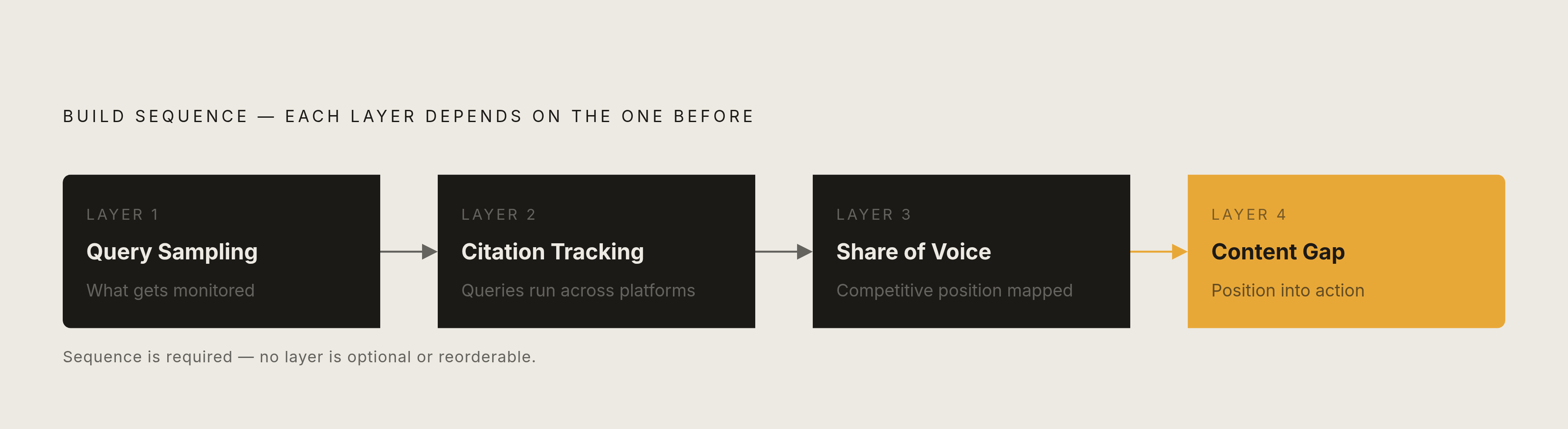
The shift in instrumentation that follows from this is direct: the monitoring layer needs to track citations, mentions, sentiment, and accuracy, and set aside rankings, impressions, and CTR as the primary measure of success. Four distinct capabilities make up that stack, and they need to go in order: a query sampling layer that defines what gets monitored, a citation tracking layer that runs those queries across platforms, a share-of-voice layer that turns the raw data into a competitive position, and a content gap layer that turns the position into action. Each layer depends on the one before it. Sequence matters as much as the tools themselves.
How fragmented the AI citation landscape is before you build anything
Before any tool gets selected, the team needs a clear picture of what it's actually measuring across, because the AI search landscape is no longer a single environment. Citation behavior differs so much from one platform to the next that watching only one LLM gives a badly incomplete picture of where a brand stands. Platform share has moved fast: ChatGPT's share of B2B AI referrals has dropped substantially, Claude has grown from a negligible share to nearly a fifth of referrals, Gemini has quadrupled, and Perplexity has more than doubled. A field that functioned, in effect, as a single-platform environment not long ago now has four platforms competing for the same buyer attention, each behaving by its own rules.
Those rules diverge in ways that change what gets measured and how. Perplexity does the opposite: it systematizes clickable links and produces far more outbound links than brand name mentions, a different measurement problem that calls for watching URLs rather than counting name-drops. Claude carries a lower hallucination rate than some competitors but cites sources less traceably than Perplexity, a distinction that matters most in health, finance, and legal content where accuracy carries legal and reputational weight. Gemini sits inside Google's search results twice over, powering both AI Overviews and AI Mode, which gives it the largest combined SEO and GEO surface of any platform even though its citation policy is less transparent than its competitors'.
The overlap between these systems is thin enough to make single-platform optimization a bad bet. Only a tiny fraction of citations overlap between AI Overviews and AI Mode, and the overlap between ChatGPT and Perplexity citations is similarly minimal. Work that wins citations on one platform does not carry over to the next. That forces platform-specific strategy: ChatGPT tends to reward authority and clarity, Perplexity rewards source-backed data, Gemini responds to schema markup and topical depth, Claude rewards structured long-form expertise, and AI Overviews favor summaries that can be lifted and extracted concisely. An enterprise platform guide covering this landscape in 2026 treats multi-LLM coverage as a baseline requirement for serious monitoring, not an advanced feature, and tools that watch only one or two engines fail that test before they do anything else. Before evaluating any tool, the team needs to map which platforms its buyers actually use for the category's core questions. That map sets the minimum coverage the entire stack has to deliver.
Building the query sampling layer first, because you cannot monitor what you have not defined
The most common mistake teams make early on is tracking the wrong prompts, feeding the system brand-name searches that say nothing about how buyers actually run into the category inside AI search. AI search behavior runs on questions. Buyers put the same evaluation, comparison, and recommendation questions into ChatGPT and Perplexity that they used to type into Google, and brand-name lookups make up a small share of that real traffic. A HubSpot survey found that buyers who used AI search were 36% more likely to purchase, and HubSpot's State of AEO 2026 report describes AI search as the strongest single predictor of purchase intent, with buyers forming what the report calls "silent shortlists" in AI conversations well before they ever land on a brand's website. The prompt set a team builds has to reflect that pre-purchase behavior, or it ends up measuring something buyers barely do.
Category-level queries, phrased something like "What is the best [category] tool for [use case]?", reveal which brands AI surfaces when a buyer is still open to any option. Comparison queries, such as "[Brand A] vs [Brand B]" or "[category] alternatives," show where a brand stands against named competitors inside an AI answer. Intent-specific queries, framed as "How do I [solve specific problem]?", show which sources AI treats as the experts, independent of how well-known the brand already is. Running all three tiers together gives a team a far more honest read of AI visibility than any single tier would on its own.
The size of that prompt set matters almost as much as its structure. Whatever the size, the same prompt set has to run consistently across every platform the team committed to tracking in the previous stage, because inconsistent platform coverage is the second most common way early monitoring efforts fail and produce numbers that can't be compared to each other. Running that prompt set manually across the target platforms and recording which brands come up and which sources get cited is worth doing before any tool gets configured. That manual pass becomes the baseline the rest of the stack measures against, and it's the first real look at the competitive field the monitoring effort is about to formalize. The query set should also be treated as something that changes over time, since buyer language and category terminology shift, and a prompt set built once and left alone will drift out of sync with how people actually ask.
What multi-LLM citation tracking tools measure and where each falls short
With a defined prompt set in hand, the next question is which tool runs it at scale, and no single tool on the market closes every gap in that problem. The gaps in a given tool matter as much as the features advertised on its homepage. Four measurement objects sit at the center of what any citation tracking tool needs to cover: how often the brand name shows up across tracked prompts, how often specific owned URLs get linked or credited as sources, a separate and harder measurement than counting mentions, whether the AI frames the brand positively, neutrally, or negatively in context, and whether the AI describes the brand's products, pricing, and positioning correctly.
Platform coverage is the first thing to check in any tool evaluation. A tool that tracks only two or three platforms will produce an incomplete read of the landscape given how fragmented citation behavior already is across engines. An enterprise platform comparison from 2026 names four vendors commonly encountered in enterprise sales cycles for this category, with two of them carrying SOC 2 Type II certification, SSO, and role-based access control, while a third lacks role-based permissions and a fourth's SOC 2 audit was still in progress as of early 2026. Those security and access differences matter more for larger organizations running monitoring across multiple teams than for a solo marketer running a handful of prompts.
Free and native tools provide a starting floor to use before committing budget anywhere else. One toolkit tracks brand visibility across ChatGPT, Google AI Overviews, Google AI Mode, Gemini, Perplexity, and other platforms for around €99 per month per domain, giving a sense of where pricing sits for a multi-platform option aimed at a single domain.
The key gap to probe in any tool evaluation is whether it distinguishes brand mention share, position-weighted share, and URL citation share from each other, or whether it folds them into a single, undifferentiated visibility score. For teams already running marketing operations inside a broader platform, an AEO capability built into an existing marketing suite's professional and enterprise tiers helps map user questions, structure content for quick answers, add schema markup, and track brand visibility over time. That kind of built-in option won't match a dedicated vendor on platform breadth, but it lowers the cost of getting started for a team already working inside that ecosystem.
Measuring Share of Voice Across LLMs Once the Tracking Layer Is Running
Citation tracking data on its own tells a team what happened. Share of voice across LLMs is what turns that data into a competitive position a marketing leader can act on and a CFO can question with specific numbers. A 2026 guide to this space introduces the term "share of model," credited to Jack Smyth and Tom Roach, to describe how often a brand turns up in AI-generated answers relative to its competitors across a defined prompt set. The term matters because it signals a real difference from the paid media version of share of voice: share of model is earned, reflecting the AI's own assessment of a brand's authority and relevance rather than how much that brand spent to get there.
A mature stack should track three distinct forms of this metric rather than blend them into one number. Mention-based share of voice measures the raw frequency with which a brand's name shows up across every tracked prompt. Position-weighted share of voice accounts for where in an answer the brand gets mentioned, since a first mention, a recommendation, and a buried caveat carry different commercial weight. Citation-based share of voice tracks how often owned URLs specifically get credited as sources, a number distinct from and usually smaller than raw mention share.
Benchmarks from a 2026 AEO guide give a sense of how hard consistent visibility actually is to hold onto: only a small fraction of studied brands appeared consistently across ChatGPT, Gemini, Google AI Mode, and Google AI Overviews in every month measured. None of these numbers mean much without a competitor set to measure against, since share of voice baselined against nothing is just a number sitting by itself. It needs to be measured against the same competitor set defined back in the query sampling stage to say anything about actual market position.
Cadence matters here too. Share of model moves as LLMs get updated, as competitors publish new content, and as brand signals shift elsewhere online, so weekly measurement is the minimum cadence for a signal a team can actually act on, with monthly rollups suited to board-level reporting. Most brands still cannot connect their AI search performance to pipeline in a way that holds up under scrutiny, and the share-of-voice layer exists to close that gap, bridging raw monitoring activity and a business outcome a leadership team can weigh against other investments.
Adding the content gap analysis layer to find where AI is citing competitors instead of you
Content gap analysis in this context has nothing to do with keyword research. It's a systematic audit of which sources AI engines are citing in a brand's place and what explains why those sources are winning the citation instead. The same prompt set already running in the citation tracking layer is the starting point: for every prompt where a competitor gets cited and the brand doesn't, the cited URLs need to get pulled and examined for what they're doing that the brand's own content isn't.
That examination shows that a 2026 GEO guide cites an analysis of over a billion citations showing that roughly 85% of brand mentions in AI search come from third-party pages rather than brand-owned sites. Brands get cited through someone else's domain far more often than through their own. That means the gap a brand is chasing is frequently not a gap in its own content at all, but a gap in earned presence, since industry publications, analyst reports, consumer reviews, and trade press are the surfaces AI engines read first when building an answer.
For the content a brand does own, a few diagnostic questions separate pages that get cited from pages that don't. Does it include statistics and citations that an AI engine can lift out as evidence? The Princeton GEO study found that adding statistics to a page boosts its AI visibility, and adding citations and quotations boosts it further still. Clean formatting correlates with meaningfully higher citation rates than poorly structured pages carry, though schema markup by itself does not measurably raise citation rates on its own. Has the page been updated recently, since AI engines favor fresher material and tend to pass over outdated statistics, discontinued products, and stale examples?
For the earned-presence side of the gap, the questions run differently. And where the brand isn't mentioned at all, what would a realistic PR effort or content partnership look like to build a presence there? Answering those questions turns a list of citation gaps into a working brief, the kind a content or communications team can actually execute against rather than a report that simply confirms a competitor is winning.