AEO Budget Line Item vs. Paid Search Budget Comparison for Finance Teams
Finance teams need a separate AEO budget line with its own ROI metrics.
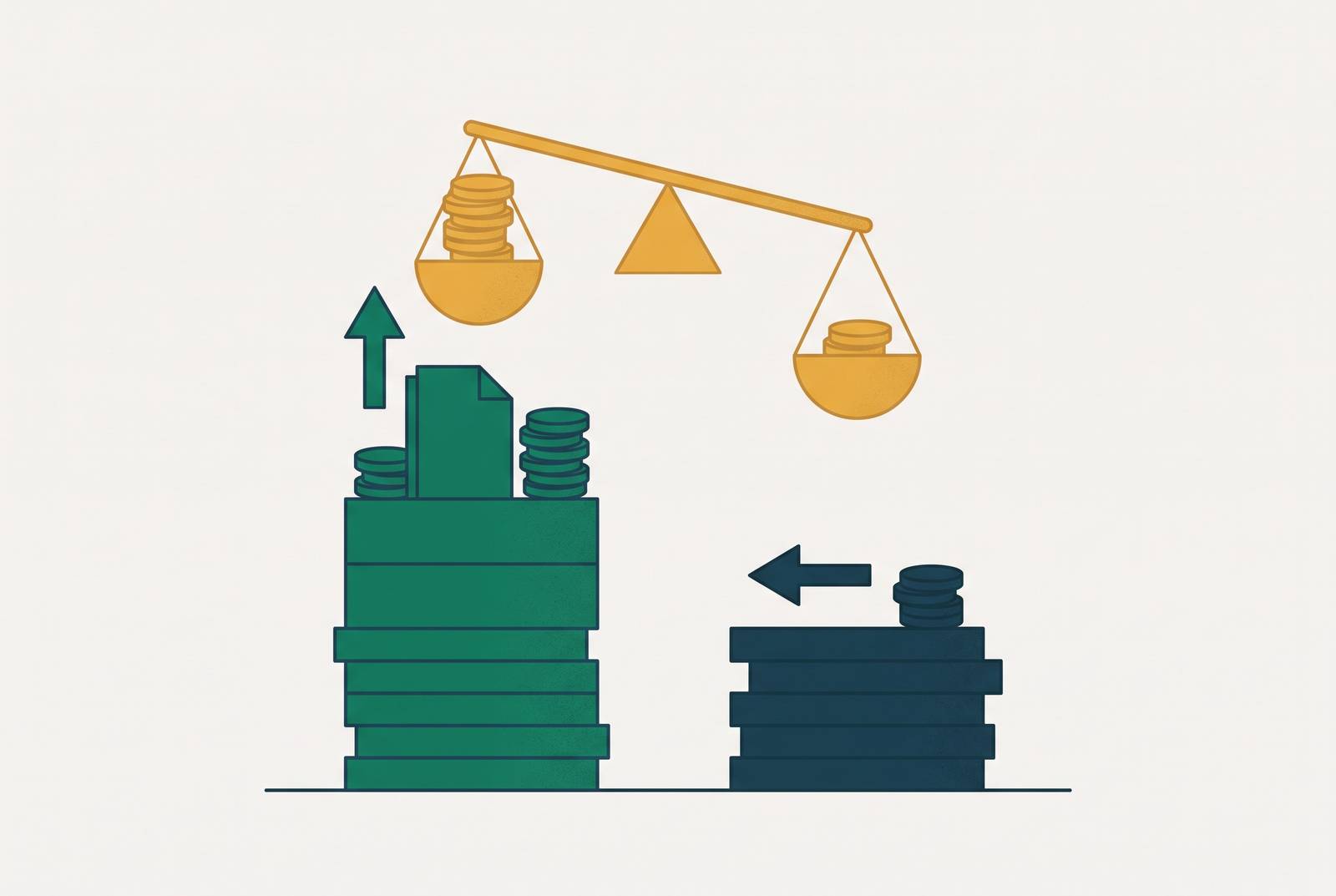
ROI reporting for AI search optimization that is ready for the board needs a separate AEO budget line, tracked through citation share by engine, AI-referred conversion rates, and the pipeline from buyers who report AI discovery. Paid search brings in demand in the near term, while AEO pays for citation authority that grows over months. The defensible finance case is expansion with defined review dates while preserving paid search funding.
Why finance teams need a different framework for AEO than the one they already use for paid search
An AEO request reaches the CFO meeting without a CPC column, and the decision gets tabled. Paid search comes with standardized inputs, including cost-per-click, impression share, conversion rate, and ROAS. Finance can evaluate those inputs quickly because the channel supplies its own reporting infrastructure. AEO has no built-in scorecard like this, so the request can look harder to hold to account before finance weighs its costs and returns.
That reporting gap reflects a different operating model subject to the same financial scrutiny. ChatGPT does not pass referrer data, citation share has no universal equivalent to impression share, and conversion signals can arrive weeks or months after a citation. Using the paid search template can therefore steer money toward what is easiest to count at the expense of what deserves funding. Finance needs a framework that makes earned authority measurable without pretending it behaves like an auction.
How generative AI has already moved into the discovery layer finance teams thought belonged to paid search
The reason to resolve this mismatch now is that AI already shapes research and comparison. Those are the same stages where paid search has historically captured high-intent, high-CPC queries. Similarweb's Director of SEO & AI Search observes that more than half of searches are projected to go through AI assistants by 2030 and that zero-click searches in the US have already surpassed the majority of queries. The forecast points to more growth, but budget decisions already have to account for a split in the discovery layer.
That split also exists within AI search itself. Google AI Overviews, Bing Copilot, Perplexity AI, and ChatGPT Search are distinct citation environments with different ranking signals. Optimizing for only one leaves the other three outside the program's coverage, rather than providing a representative view of AI visibility. Cross-platform measurement options, including Athenahq, address this fragmentation by monitoring presence across eight or more major LLMs, although coverage and attribution depth vary by platform and plan. The implication is broader discovery coverage alongside paid search.
The structural reason AEO and paid search do different jobs and should not share a budget line
Paid search harvests existing demand and can deliver impression share rapidly with clean attribution. AEO builds citation authority over months and can influence buyers who never click. Combining them under one budget resembles using “social media” to cover both organic community management and paid Facebook ads. The shared surface does not make the costs, time horizons, or evidence of performance interchangeable. Separate budget lines preserve those distinctions when finance reviews results.
A further split exists between tactics within the broader AI search program. AEO schema and direct-answer formatting can produce measurable snippet wins within weeks, while GEO authority depends on third-party mention density and model training refresh cycles over a longer horizon. These tactics need distinct budget lines so that an early review can distinguish working infrastructure from authority investment that has not matured. Otherwise, the whole program becomes vulnerable to cancellation because finance cannot tell which spend produced which result.
The missing native reporting layer also creates a need for dedicated measurement. Athenahq tracks citation share, AI-referred revenue attribution, and cross-model visibility in a unified command center across ChatGPT, Perplexity, Gemini, and eight or more other LLMs. That infrastructure gives finance an alternative to forcing AEO into paid search's reporting template. It does not make the underlying attribution as clean as a paid auction.
Why framing AEO as a reallocation from paid search is the fastest way to lose the budget conversation
If you receive an AEO proposal framed as moving money out of paid search, the proposal asks you to judge two decisions at once. You must judge a channel that is new to you while deciding whether to cut funds from one already in use. The framing can make past spending sound mistaken and invite a wait-and-see response. It also obscures the strongest argument for AEO, which is access to a parallel discovery channel.
The more defensible request preserves paid search's job and explains what the additional investment buys. PMG recommends piloting GEO at 1.5 to 2x the current search budget through additional spending. That recommendation is an expansion model whose spending level requires evaluation for each business. For finance, the distinction matters because the proposal can be judged on incremental pipeline and a defined learning period. AEO then has to earn its budget without first claiming that paid search has failed.
The conversion economics that make AEO defensible in the language finance teams already speak
AI-referred conversion rate is the bridge between visibility in a new channel and familiar acquisition economics. It connects a measurable visit to a business outcome, keeping citations separate from revenue. Published AI referral conversion rates are often several times higher than average organic conversion rates. That points to the channel’s potential as a revenue source, but the comparison is with organic search and leaves AEO’s performance against paid search unproven.
A higher conversion rate can support a lower cost-per-acquisition, but only when referral volume and total spend also support the calculation. Equivalent or higher spending does not automatically produce a lower acquisition cost merely because a larger share of visitors converts. Finance therefore needs to see both the measured conversion rate and the pipeline those visitors create. A smaller AEO line can still contribute meaningfully when investment maps to extractable money pages and citation measurement.
Restructuring existing content with schema markup and conversational Q&A formatting can cost substantially less per article cluster than equivalent paid-search impression volume on informational queries. That comparison favors AEO for brands that can wait six months or longer over those that need lead volume right away. GA4 AI-referred sessions, post-demo discovery surveys, and CRM source tagging provide a conservative, directional attribution base. The missing click-level record remains a limitation, but it does not prevent a defensible revenue estimate.
What metrics should finance teams bring to the board to justify an AEO budget
The main dashboard measure is citation share of voice, or AI SOV, which is brand citations divided by total category citations. It is a structural parallel to impression share, with limits to its equivalence. Reporting needs to show that share separately for each AI engine because a brand's position on Perplexity can differ meaningfully from its position on ChatGPT. A figure from one engine cannot show the brand's presence across platforms. Nor should an early program be judged against a category leader without acknowledging that new entrants typically remain well below established positions for the first two to three quarters.
A report for the board links that visibility measure to two more signals: buyers who self-report AI discovery and the pipeline those buyers create. AI-referred sessions and conversion rates provide the observable traffic component, while surveys and CRM source tagging capture discovery that lacks a clean click trail. When the three signals move together, they give attribution more weight than citation growth alone does. The report should distinguish the signals rather than collapse them into a claim of paid-search-style precision.
Gumlet provides a practical example of this model. DerivateX implemented citation tracking, direct traffic pattern analysis, post-demo discovery surveys, and CRM-level source attribution for the SaaS company. That four-component approach produced a reportable share of inbound revenue attributable to AI discovery. The useful proof is the connection between citation measurement and a revenue outcome, rather than visibility presented as a return by itself.
How to size the AEO budget line relative to existing paid search spend
PMG's recommendation to pilot GEO at 1.5 to 2x the current search budget is an aggressive expansion reference point. It reflects the compounding nature of citation authority rather than a claim that AEO and paid search have equivalent unit economics. Because the reference is current search budget, it should not be relabeled as a paid-search-only multiplier. Finance needs to be clear about the denominator before it uses any such range in its own plan.
Business size also changes what a useful comparison looks like. Similarweb's 2026 AI search budget guide distinguishes small-business, mid-size, and enterprise SEO baselines, with AI search optimization adding a category above those existing investments. Those tiers should remain separate rather than being blended into a universal starting percentage. Large-brand programs can include tools and PR, while operator-led engagements require a meaningful retainer and a multi-month minimum. A platform subscription alone therefore does not describe the full program cost.
A three-month pilot with set citation share targets and a date to review pipeline signals gives the program a clear starting limit. It gives finance a concrete approval period without implying that the full return will arrive within it. The initial ask can be expressed relative to existing search spend, with the chosen comparison tied to the program's scope and business tier. The review then checks progress against named signals, with a set date for testing the promise of AI visibility.
The specific content and technical investments the AEO budget funds, and why each is a one-time or recurring cost
The largely one-time layer includes schema markup, JSON-LD implementation, clean crawler access, and technical prerequisites that keep pages eligible. The specified access work includes explicitly allowing GPTBot, ClaudeBot, PerplexityBot, and Google-Extended in robots.txt. Core Web Vitals is also part of this technical work. These items build infrastructure that still needs upkeep from time to time, without committing the business to producing content indefinitely. That distinction gives finance a clearer basis for classifying costs than a single undifferentiated optimization fee.
Content extraction work establishes another foundation. Answer-first formatting, FAQ blocks, comparison pages, and clear pricing make it easier for AI models to extract content from money pages without generating hallucinated claims. Initial restructuring can be scoped as a discrete project, but its useful life depends on updates. Pages that go a long time without updates have measurably lower AI citation rates. Content production is therefore not the end of the cost model.
Recurring investment covers entity authority and measurement as well as freshness. Review platform presence, earned media, Reddit and LinkedIn presence, and consistent brand language help AI engines resolve who the brand is. Weekly citation checks across ChatGPT, Perplexity, Gemini, Copilot, and Claude sit beside GA4 AI referral attribution and monthly refresh cycles on bottom-of-funnel pages. These activities need their own ongoing operating budgets, kept separate from the launch cost. Separating AEO and GEO tactic costs also makes their different timelines visible, while enterprise measurement platforms such as Athenahq can help isolate attribution signals for review.
The ROI timeline and the honest risks finance teams should build into the model
Perplexity citations can appear in days to weeks, broader ChatGPT movement can take weeks to a couple of months, and clearer pipeline signals can emerge by months two to three when money pages and prompts are instrumented. Authoritas Q1 2026 sprint data showed a measurable increase in AI Overview inclusion within eight weeks for pages redesigned with structured-data-first principles. These are useful short-cycle proof points, with revenue timing still uncertain for individual programs.
The three-month pilot therefore tests the direction of returns while the full compounding return requires more time. AEO will not rescue a Q3 pipeline shortfall, and paid search remains the appropriate instrument when qualified leads are needed in the near term. Finance should build delayed conversion signals, incomplete attribution, and engine-level divergence into the model. Acknowledging those limits makes the approval case more credible because it separates what can be demonstrated within 90 days from what requires subsequent quarters.
The reason to proceed despite that longer horizon is the cost of arriving late. AI engines preferentially reinforce existing citation authority, so an established position can compound while a new entrant is still building recognition. The resulting gap becomes progressively more expensive to close. A separate, measured AEO budget lets finance fund that longer-term position without sacrificing the channel responsible for immediate demand. The window is finite because waiting does not hold the competitive starting point still.