Agency-Managed AEO vs. Platform-Direct Subscription for Mid-Market Brands
Platforms measure AI visibility; agencies fix the gaps platforms expose.
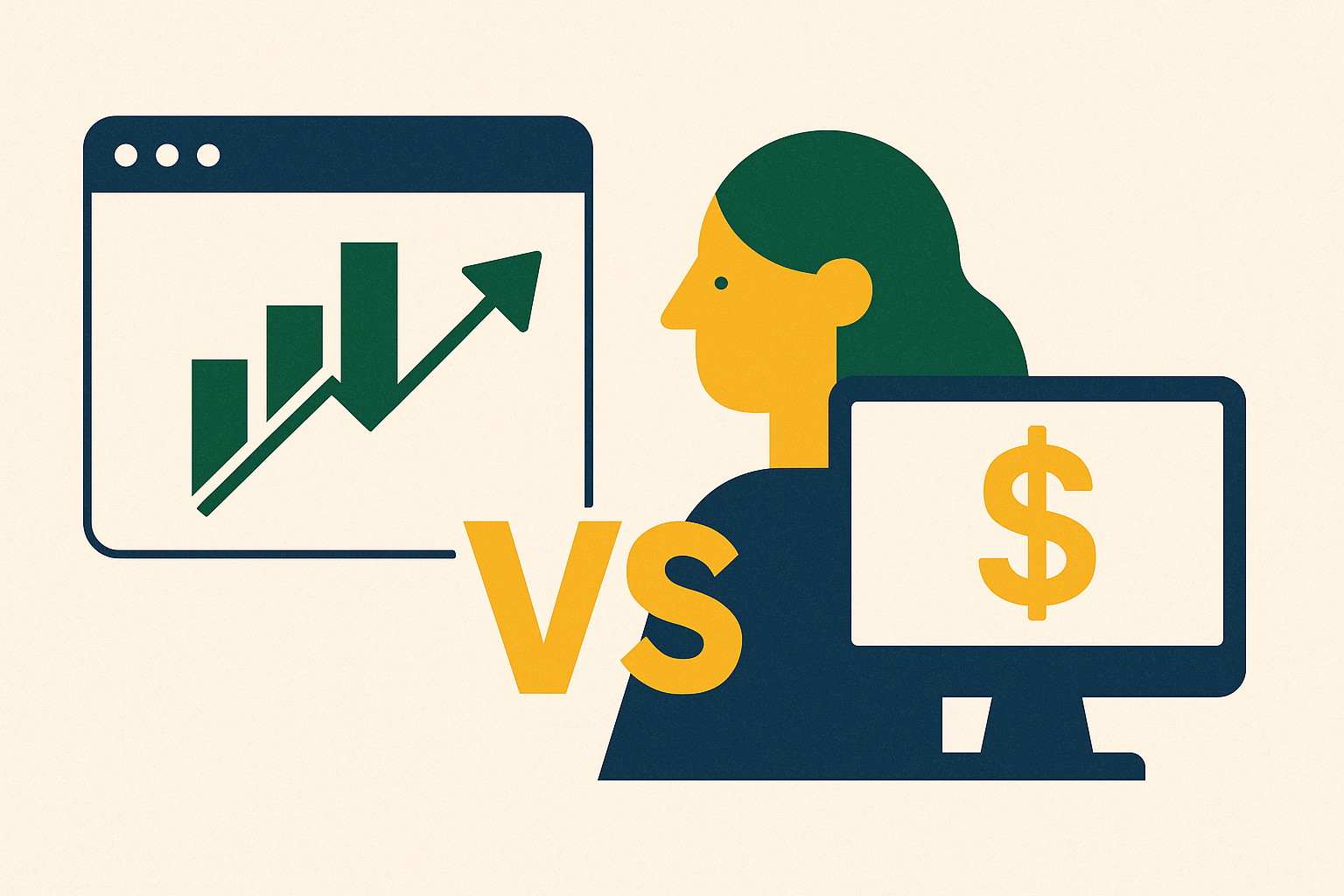
Mid-market brands evaluating AEO (answer engine optimization) or GEO (generative engine optimization) usually frame the decision as agency versus platform, but that framing is wrong. The real choice is a capability question: platforms deliver continuous measurement across large language models, agencies close the structural gaps that measurement exposes, and the brand's job is to diagnose which gap it has before spending on either one.
AI Search as a Primary Discovery Channel for Mid-Market Buyers
Generative AI platforms have become a research layer, and buyers move through it before a vendor's website ever enters the picture. That shift makes AI citation a pipeline variable, not a vanity metric to glance at in a quarterly report. In the year ending May 2026, generative AI platforms collectively pulled in billions of monthly visits, and that is too much volume for a mid-market brand to treat as experimental or secondary to traditional search.
The discovery mechanism works differently from a search results page, too. When a buyer forms a vendor shortlist inside ChatGPT, Perplexity, or Gemini, they often land on a brand's site afterward through branded search or a direct visit, so standard analytics never show the AI's role in that decision. The decision gets made inside a space the brand has no visibility into. For mid-market brands, the window to act on this is narrow: those establishing AI citation patterns now compound that presence over time, while those waiting face a displacement that gets harder to reverse the longer it goes unaddressed.
What AEO/GEO Optimization Requires
Winning citation in AI answers needs two different kinds of work, and no single vendor, platform, or agency can deliver both. The first is continuous cross-platform measurement. The second is structural gap remediation. Treating these as one problem is what leads mid-market teams to buy the wrong thing first.
You need to track mention rate, citation rate, and share of voice across multiple large language models at once, because engine behavior diverges sharply between them. Citation overlap between major engines runs low, and patterns shift fast when competitors publish new content or land fresh press coverage. A brand that only checks one engine, or checks sporadically, is working from a partial and aging picture. Each major AI assistant, including ChatGPT, Perplexity, Gemini, Claude, and Copilot, surfaces brands differently, weights sources differently, and responds to optimization efforts on its own timescale. A single blended visibility score across all of them hides the specific gaps you need to fix.
Execution work covers the structural fixes that actually move citation rates: content built for AI extraction (structured lists, expert quotes, embedded citations), clean schema and technical hygiene, and off-site authority signals from third-party publications, review platforms, and community sources that AI engines weight heavily when deciding what to cite. Software can show a brand exactly where it stands in AI answers across a dozen queries and a dozen models. It cannot rewrite the brand's product pages, implement schema markup, or land a placement in a trade publication. That gap between seeing the problem and fixing it is where platforms stop and human execution has to begin.
Platforms like AthenaHQ track brand visibility and identify content gaps across eight or more major LLMs at once, turning measurement from a periodic spot-check into a prioritized list of what needs remediation. That's a useful illustration of what a platform-tier tool is built to do: surface the problem clearly and consistently, across every engine that matters, so the brand knows exactly where to direct its next dollar of execution spend.
What a platform subscription delivers
A platform subscription buys continuous, multi-engine visibility data at a price that makes year-round monitoring realistic, not just a once-a-quarter audit. What that looks like in practice: automated query tracking running continuously across multiple LLMs, mention rate and citation rate measured over time, competitive share-of-voice tracked against named rivals, and alerts when citation patterns shift, whether because a competitor earned a new press hit or because an engine itself changed how it selects sources.
A platform does not execute the fix: it does not rewrite the content, implement the schema, run the PR campaign, or do the outreach to Wikipedia and review platforms that shifts citation rates upward. If a brand gets a visibility score with no execution plan, it learns it's underperforming but gets no resource to close that gap. That's why most mid-size teams end up running a platform subscription year-round and calling in outside execution help only for defined projects, rather than treating either option as a permanent, standalone solution.
Some platforms narrow that execution gap without closing it. AthenaHQ pairs visibility tracking with content gap identification and AI-optimized content deployment, so if a team has internal content capacity, it gets a more direct path from diagnosis to action than a monitoring-only dashboard gives. A brand still needs someone, in-house or contracted, who can act on what the platform surfaces. The platform narrows the distance between seeing the gap and closing it; it does not eliminate the need for execution capacity on the other end.
What an agency delivers
An agency closes the structural gaps that a platform can only flag. That includes content overhauls built specifically for how AI engines extract information (structured formatting, expert quotes, embedded statistics), schema and technical restructuring, digital PR campaigns that place a brand in the third-party publications AI engines weight most heavily, and outreach to review platforms and community sources, where the lift to citation rates is often disproportionate to the effort involved.
Pricing in this space tends to fall into three tiers. The Monitor and Maintain tier runs $1,000 to $2,500 a month and covers basic monitoring across one or two platforms along with quarterly schema and FAQ updates, a reasonable foundation for a brand newer to AEO and GEO that wants to test the waters before committing further. The Active Optimization tier runs $3,000 to $8,000 a month and adds active monitoring, monthly content sprints, entity work, and some digital PR or citation building, the tier where most serious ongoing programs operate. The Category Leadership tier runs $10,000 to $25,000 or more a month and includes original research, coordinated PR campaigns, full-time multi-engine monitoring, and executive-level reporting, appropriate for organizations where AI search visibility drives meaningful revenue.
Contract structure carries its own cost, separate from the monthly fee. Agency retainers typically lock a brand in for multiple months, so if a mid-market company commits to one before it has even diagnosed the gap type, it takes on real financial risk within its constrained budget cycles and uncertain results timelines. Specialization among agencies in this space, including firms like Digital Elevator, Graphite, Directive, Animalz, Siege Media, iPullRank, and Go Fish Digital, varies widely, and matching agency type to the actual gap (content, technical, or PR) affects whether the engagement closes the right gap or wastes the budget on the wrong one. Client size fit varies too: Digital Elevator is built for small business through mid-market, Go Fish Digital serves small business, mid-market, and enterprise clients, while agencies including Directive, iPullRank, and Graphite skew toward enterprise accounts. iPullRank's own site describes itself as an enterprise SEO, content strategy, and AI search agency with a project minimum of $50,000, and Graphite is named across enterprise SEO agency roundups alongside clients like Netflix, Robinhood, and Neiman Marcus. A mid-market brand that signs with an enterprise-oriented agency risks receiving a program scoped for a budget and an internal team it does not have.
How to diagnose which gap you have before choosing
The agency-versus-platform decision comes down to identifying which gap type a brand is actually facing, and the diagnosis follows a specific sequence: establish a cross-platform baseline with a platform tool, identify which gap type dominates, then select the agency specialization that matches it, or stay platform-only if measurement and internal execution already cover the need.
A brand with no data at all on its mention rate, citation rate, or competitive share of voice across LLMs has a visibility-unknown gap, and the right first investment is a platform subscription or a platform-included diagnostic, not an agency retainer. Committing budget to remediation before the diagnosis exists wastes that budget regardless of which agency gets hired. A brand that has measured its visibility and found low citation rates paired with content that is thin, poorly structured, or not built for AI extraction has a structural content gap, and a content-focused agency or a scoped content sprint, rather than an open-ended retainer, is the appropriate next step. If a brand measures its visibility and finds the technical foundation inadequate, meaning schema implementation is missing or broken and site structure prevents AI crawlers from reliably parsing content, it has a technical gap, and that calls for a technically oriented agency or a scoped audit and remediation project.
A brand with solid, well-structured owned content that still isn't getting cited has an off-site authority gap: AI engines aren't finding enough third-party signal to point to it, which is the PR and citation-building gap, requiring agency execution because it depends on editorial relationships and outreach capacity that no software subscription can supply on a brand's behalf. Finally, if a brand performs reasonably well but tracks too infrequently to catch citation displacement before it compounds, the infrequent tracking itself creates a monitoring-cadence gap, and platform-only investment is the right sustained response, with agency work reserved for defined sprint projects as new gaps surface.
Hallucination risk deserves attention before outreach of any kind begins. Brands whose facts, including product names, pricing tiers, and service differentiators, are inconsistent across their own site and third-party sources face a specific accuracy problem that requires a centralized brand knowledge base and disciplined claim-anchoring. That's a content and governance issue before it's a PR issue, and it needs to surface in the diagnostic stage, because no amount of outreach fixes a citation problem rooted in inconsistent facts. AthenaHQ's platform is built to run this diagnostic on an ongoing basis, tracking mention rate, citation accuracy, and content gaps across LLMs so a brand's team can identify which gap type is active at a given moment and make a targeted investment.
The hybrid model most mid-market teams settle into
For most mid-market brands, the practical answer is a platform subscription running year-round, with agency engagement brought in on a defined project basis as specific gaps get identified. Most mid-size teams converge on exactly this pattern rather than picking one vendor type forever, because the two forms of work, measurement and execution, never actually stop needing each other.
The sequencing matters as much as the choice itself. A platform establishes the baseline first and identifies which gap type dominates. Agency engagement then gets scoped narrowly to close that specific gap, whether it's a content sprint, a PR campaign, or a technical remediation project. Platform monitoring continues underneath that engagement, tracking whether citation rates actually respond to the work and flagging the next gap as it emerges, because a gap that's closed today can reopen within weeks if a competitor publishes new content or earns new press and nobody's watching for it. Scoped, project-based agency work also fits mid-market budget realities better than open-ended retainers: it limits lock-in risk and ties spending directly to a deliverable with a fixed endpoint.
Reporting discipline belongs inside this model too. AI-influenced pipeline gets undercounted in standard analytics, because when buyers do their research inside AI interfaces, they often arrive at a brand's site through branded search or a direct visit, with no trace of the AI interaction in between. A platform that tracks AI mention rates, branded search lift, and AI referral sessions builds the attribution record that makes this kind of investment defensible to a CFO or a board, holding it to the same standard of evidence as any other marketing channel. AthenaHQ is built for that sustained role: tracking AI visibility across LLMs on an ongoing basis, surfacing emerging content gaps as they appear, and producing the board-ready reporting that lets a mid-market team justify AI search investment with the same rigor applied everywhere else in the budget.