Content Structure Audits That Expose AI Citation Gaps Behind Strong SERP Positions
Structural fixes to your top-ranking pages can recover citations AI systems skip over.
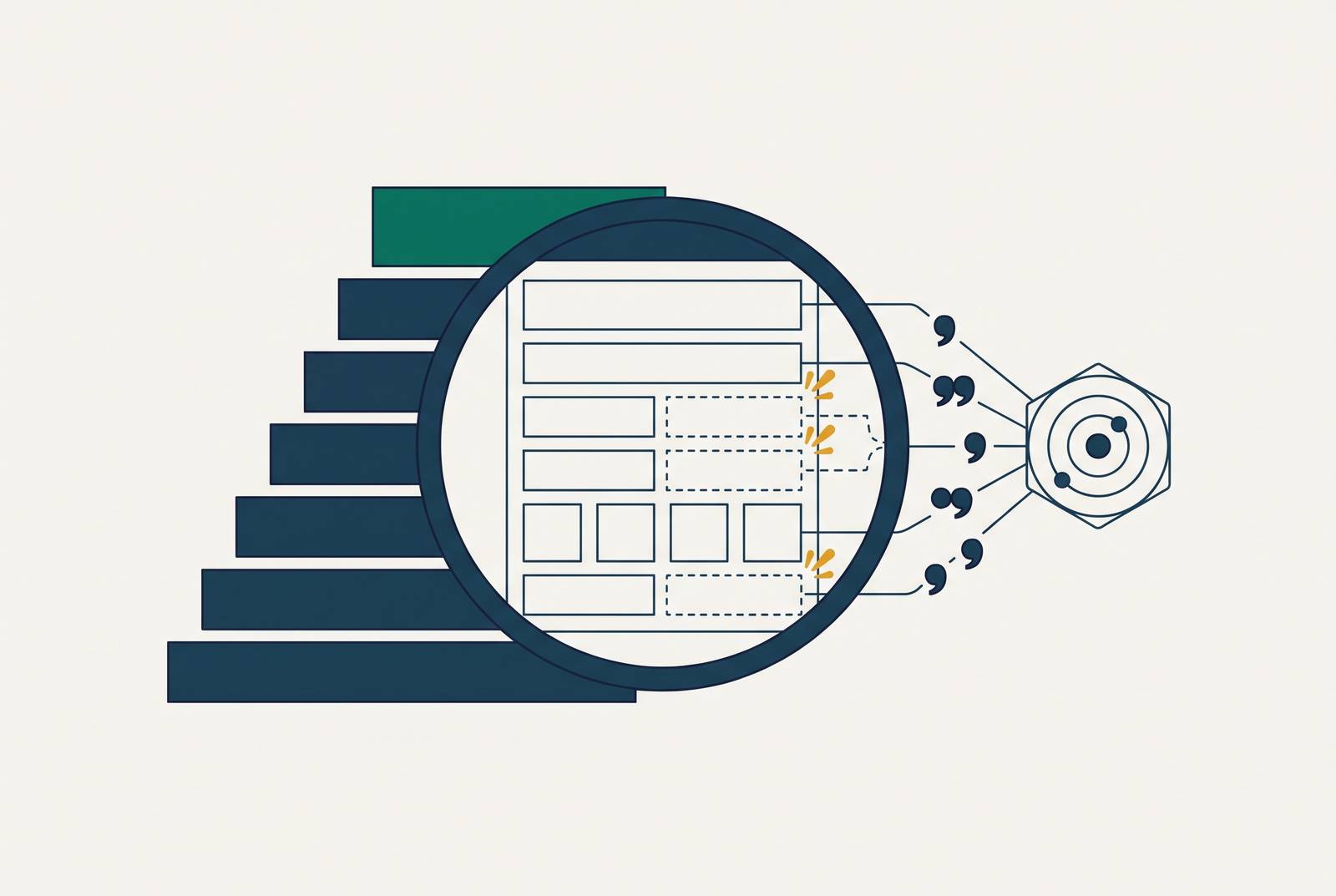
AI citation gap analysis identifies why content that ranks well in Google is skipped in AI-generated answers. A content structure audit tests answer placement, heading hierarchy, evidence, schema and entity clarity, then connects those findings to citation patterns. Restructuring around those signals addresses a gap that ranking dashboards cannot diagnose, because search visibility does not establish whether an AI system can retrieve, interpret and use a page.
Why a strong SERP position no longer guarantees AI visibility
A marketer sees strong rankings and assumes visibility is secure, then discovers that a competitor appears in ChatGPT for every relevant query tested. The ranking dashboard still looks healthy. Yet the answers that shape buyer shortlists point to other brands, leaving a gap in the business they can win even when rankings look strong. A page can dominate organic search and remain absent from AI answers, while a page outside the top ten earns a citation.
The difference begins with what each system selects. Search position describes where a page appears among ranked results, while AI citation depends on whether a source is retrieved and used in an answer. Traditional audits assess keyword density, backlinks, page speed and indexation. Those checks remain distinct from the structural questions involved in citation selection, so a satisfactory audit does not establish citation readiness.
Competition for citations is also becoming more concentrated. Google AI Mode reduced the number of unique URLs cited per response by 59% between late April and the end of May 2026. Fewer sources leave less room for structurally weak pages. For marketing teams, the practical problem is therefore not simply a new place to track rankings, but a different selection process that can exclude otherwise successful content.
How AI retrieval logic differs from the ranking signals SEO audits measure
The research paper arXiv:2604.25707 distinguishes citation selection, when a platform triggers search and chooses sources, from citation absorption, when a cited page contributes language, evidence, structure or factual support to the answer. A citation is not proof of influence. A brand can appear in the source list without its content shaping the response.
That distinction shifts the audit’s focus from whether a page performs well in search to where it fails in retrieval. An intent mismatch requires a different correction from thin entity coverage or missing structured data. Traffic decline and impression loss cannot distinguish those failures. Treating them as interchangeable symptoms can therefore produce edits that leave the underlying citation gap untouched.
The GEO-16 paper uses banded pillar scores to assess the quality of what is on a page. It identifies Metadata & Freshness, Semantic HTML and Structured Data as the pillars with the strongest associations with citation. They support examining page structure directly rather than using organic position as a substitute for retrieval readiness.
Content gap analysis consequently has two dimensions. The familiar one identifies keywords for which competitors rank and the brand does not. The second identifies information, structural and entity gaps that lead AI systems to choose a competitor’s source. A citation architecture audit addresses that second dimension while preserving the distinction between being selected and actually informing the answer.
The five structural layers a citation architecture audit evaluates
A citation architecture audit evaluates five layers in sequence, beginning with the answer itself and ending with the identity of the source. Each layer tests a different failure mode. The order moves from what an AI system can extract on the page to whether it can confidently associate the brand with the question. Freshness needs to be checked across all five layers.
The first layer is answer-first positioning, or macro-structure. Its audit question is whether every major section opens with a direct answer to the question its heading implies. The first two to three sentences after each H2 should stand alone as an answer. When the conclusion appears only after background or narrative, the page fails this basic extraction test even if a reader could eventually find it. The restructuring task is to bring the answer forward without stripping away the evidence that supports it.
The second layer is heading hierarchy and parseability. Its question is whether every H2 and H3 provides a clear, standalone topic signal for the material beneath it. Creative headings can hide an answer that would otherwise meet the reader’s needs. A strict, logical hierarchy makes the relationship between the main topic and its supporting questions explicit, whereas decorative or inconsistent headings make that relationship harder to interpret.
The third layer is format and evidence density. Its question is whether a page offers extractable content units or relies entirely on narrative paragraphs. Definitions near the top, structured comparison tables, statistics with sources and FAQ blocks with 40–80 word answers give a system separate units it can extract. The page also needs more than format, because original data, expert attribution and sourced comparisons add to what is already widely agreed. A citation-readiness rubric should score definitions, tables, FAQs, schema, source quality and answer completeness, with the strongest citation opportunities updated first.
The fourth layer is schema and structured data. Its question is whether pages use relevant schema.org types, including Article, FAQPage and Organization, with recommended properties populated. Google’s guidance states that structured data is not required for generative AI search and that no special schema.org markup is needed. The audit still needs to focus on content quality, topical authority, original data and well-structured Q&A.
This layer also covers access and extractable content. The access check should examine robots.txt permissions for ChatGPT-User, PerplexityBot, ClaudeBot, GPTBot and OAI-SearchBot, as well as the Google-Extended control token. Google’s crawler documentation distinguishes Google-Extended from a separate HTTP user agent. The audit should also assess the content-to-chrome ratio, which compares useful content with navigation, sidebars and other interface elements. Excess chrome weakens extractability even when the substantive answer is present.
The fifth layer is entity clarity and resolution. Its question is whether the brand’s name, description and positioning agree across its website, LinkedIn, Crunchbase, G2, Wikipedia and press coverage. Recognition depends on a coherent identity. The audit should examine disambiguation across knowledge graphs, Wikipedia, Wikidata and structured data, then assess entity chain depth, or the related concepts that connect back to the brand through intermediate nodes.
Specialist and regional brands can fail at Stage-1 discoverability because systems do not confidently associate them with the queries being answered, with an entity-resolution defect still requiring confirmation. Inconsistent external descriptions are one possible structural weakness to investigate. Across this and the earlier layers, the audit should also flag high-value pages whose update dates are old, examples are out of date or sourcing is weak, because stale content can lose citations it has already earned.
How to prioritize which pages the audit addresses first
The first priorities are commercially important pages that rank on page one or two but receive no AI citations. These pages expose the disconnect most clearly. To build that queue, teams should start with the services, products and educational topics that bring in qualified demand. The spreadsheet should connect each priority topic to its relevant page and the five-layer diagnosis.
The next step is to test priority queries manually across ChatGPT, Perplexity, Claude, Gemini and Google AI Overviews. Branded, category, comparison and high-intent queries reveal different citation behavior, so the query types should remain distinguishable in the findings. Teams should look at competitor-only citations right away within those topics that matter to the business. They identify an existing answer opportunity in which another source is being selected and the brand is not.
After the high-ranking uncited pages, the next priority is informational content answering common buyer questions, especially evaluation-stage questions used to form vendor shortlists. Next come comparison pages without structured tables or clear decision criteria, along with product or category pages that lack FAQs, proof points or buying guidance. Older posts with strong traffic should also be flagged when outdated examples or thin sourcing put their usefulness at risk.
High rankings alone should not determine the order, because a page can rank for a topic with little connection to qualified demand. Conversely, a relevant competitor citation gives the team a concrete source to examine against the five layers.
Why citation context and share of voice matter more than whether a brand appears at all
Brand Mention Rate measures whether a brand appears anywhere in an AI answer, while Recommendation Rate measures whether the answer actively suggests it as a solution. The distinction is commercially significant. Frequent mentions can coexist with weak recommendations, leaving a brand visible but rarely positioned as a preferred choice.
A context audit should record whether the brand is recommended, listed as an alternative, mentioned in passing or omitted. It should also capture positive, neutral and qualified framing. These categories expose positioning gaps that a binary citation count conceals. A primary recommendation can exert more influence on a buyer’s shortlist than several buried mentions, while qualified descriptions can point toward content or reputation weaknesses.
Share of voice adds the competitive dimension by showing the brand’s presence relative to other brands across the tested query set. That comparison needs a separate view for each engine. Citation overlap between ChatGPT and Perplexity is limited, so strong performance on one does not establish visibility on the other. Combining them into a single score can hide precisely the gap the audit is meant to explain.
Source preferences help interpret those differences. ChatGPT draws heavily from Wikipedia, Perplexity from Reddit and community sources, and Google AI Overviews from YouTube and Reddit. The same on-page change may therefore leave different external-source weaknesses unresolved. Teams should also track errors in pricing, features and positioning, because fixing hallucinations can take clearer entity signals, better schema and mentions from more authoritative sources elsewhere as well as edits to the content.
The business case: what AI citation gaps actually cost, and how to report it
AI citation gaps can affect pipeline before any website visit occurs. A prospect can ask ChatGPT which vendors to evaluate, form an opinion and build a shortlist without clicking a source. That influence leaves no visit to attribute. GA4, HubSpot and Salesforce cannot record that unseen research just because the brand later wins or loses the opportunity.
This dark funnel limits what traffic reporting can establish. AI-sourced visitors can be commercially valuable, but referral counts capture only the portion of influence that produces a measurable visit. Missing analytics data is a reason to combine observed citation gaps with proxy signals.
Executive reporting should combine AI brand mention share growth, correlated branded search volume lift tied to content publishing cadence, and self-reported attribution at demos or form-fills. Each signal captures a different part of discovery. Together, they provide a more useful account than citation totals alone, while still requiring care about attribution. A correlation between publishing and branded search should not be presented as independently proven incremental revenue.
The calculation should use the gross profit from incrementally attributed AI revenue, which requires more than the revenue figure alone. AI Search ROI (%) = (Gross Profit from Incrementally Attributed AI Revenue − Total Program Cost) ÷ Total Program Cost × 100. The formula is brief by design. Its usefulness depends on the attribution discipline behind the inputs, particularly where discovery happens without a click.
Reports should allow a 30-to-90-day planning window for citation gains to have an effect on pipeline that teams can measure in retrieval-based systems, while training-based systems without live web access can take 3–18 months. Gemini’s 2026 upgrade replaced 42% of the domains it had previously cited in a single release, showing how model changes can undo a place earned through one successful round of edits.
Deep entity chains, external mentions that agree and content that is kept up to date make the source stronger beyond any one citation slot. Leading brands by citation share capture the large majority of AI recommendations, and consistent citation can reinforce their perceived authority. Investing in citation architecture therefore builds a position that can accumulate strength, even when the next model update changes which pages appear.