Measuring Pipeline Attribution From AI Search Citations
Three measurement layers connect AI citations to closed revenue.

Board-ready ROI reporting for AI search optimization needs three layers that work together, citation-to-intent mapping, traffic isolation with identity-graph stitching, and self-reported re-attribution in the CRM. Together, they connect AI visibility to observable visits and closed revenue. No single layer captures the full journey, so defensible reporting presents their combined evidence rather than treating citation growth as proof of return.
Why AI search citations resist standard attribution
The head of marketing can show the CFO that AI citations are rising, but cannot answer what closed because of them. The dashboard records visibility without a revenue connection. This is not simply a missing tracking parameter. AI search influences buyers at the recommendation stage, before they visit a website, so the event that introduces the brand can sit outside the web analytics record entirely.
A buyer who discovers a brand through ChatGPT and then navigates directly to its website registers in GA4 as direct traffic, indistinguishable from a bookmark or a Slack link. No referrer identifies the original recommendation. UTM parameters cannot be retroactively attached to that discovery, and a mention does not necessarily produce a click. Measuring this takes several kinds of evidence, and a fix to one analytics tool alone will fall short.
Why the dark funnel makes AI-assisted revenue systematically invisible
On day one, a buyer discovers a brand in an AI response. On day seven, the buyer comes back through branded search. On day fourteen, the buyer converts, and analytics credits Brand Search for a journey it did not start. The return channel inherits the acquisition credit.
That sequence can extend across months and multiple devices, separating discovery from conversion even further. Direct and Brand Search then get credit that belongs partly to AI discovery. The resulting understatement is systematic rather than random, because the same kinds of return visits repeatedly become the visible endpoints. More complete attribution redistributes credit for existing revenue.
A rise in share of voice in decision-stage prompts can point to pipeline growth weeks ahead, before those opportunities show up. Because discovery, return visits and conversion are separated across touches and days, no single technique can trace the entire path.
Layer one — citation-to-intent mapping as the leading indicator
The earliest measurable event is the brand’s appearance in an AI answer to a relevant buyer prompt. The prompt is the unit of measurement. Citation-to-intent mapping organizes those appearances by the stage of consideration they serve, distinguishing broad discovery from questions asked closer to a decision. Without that structure, raw mention counts mix commercially different signals and make movement difficult to interpret.
Structured prompt sets should mirror actual buyer questions across ChatGPT, Perplexity, Gemini and Claude. AI Share of Voice measures the percentage of times a brand appears in a model’s responses for a defined set of strategic prompts. Platform differences must remain visible in the results. The same brand can have very different shares across platforms for the same query set, so an aggregate alone can conceal where visibility is improving or weakening.
Citation source mapping adds the next level of explanation by identifying the exact pages, threads and review profiles models use when recommending a brand or its competitors. This connects changes in visibility to the sources behind them. Weekly tracking is the operational minimum because a single snapshot is unreliable. Read by intent stage and platform, the resulting trend becomes a leading indicator of pipeline rather than a count of mentions presented as an outcome.
Layer two — traffic isolation and the direct-traffic anomaly signal
The next layer tests whether citation gains are followed by observable changes in website traffic. It starts with the visits that retain attribution. Perplexity passes referrer data on roughly a third of visits, while the remaining traffic is fragmented across referral and direct classifications. A GA4 custom channel group should separate identifiable AI-referred sessions from other traffic, establishing a visible baseline that the default setup does not provide.
To measure the share that is harder to see, teams should set a ninety-day direct traffic baseline before they launch a GEO program. They can then flag statistically significant lifts that follow citation gains and examine branded search lift over the same period. The sequence supplies the connection to layer one. A direct traffic increase has more interpretive value when it follows increased visibility on relevant prompts than when it is considered without upstream context.
Identity-graph stitching fills another gap in this behavioral layer by linking the parts of a journey that take place on different devices. SegmentStream’s approach combines an identity graph with first-click attribution and self-reported re-attribution, preserving credit for the upstream introduction. Stitching helps connect the observable parts of a journey, while direct traffic anomalies provide indirect evidence of influence where the original referrer is absent.
These signals support an attribution argument. A lift after citation gains is useful evidence, but it is not equivalent to a recorded AI referral. The distinction belongs in the reporting model. Even a well-configured traffic isolation layer misses a large share of AI-influenced visits, which makes buyer-reported discovery indispensable.
Layer three — self-reported re-attribution and CRM-level source tagging
Self-reported discovery supplies information that a referrer header cannot recover. A question at demo booking or signup should offer ChatGPT, Perplexity and AI assistant as explicit answer options, rather than collapsing discovery into a generic “AI tool” category. Platform names preserve distinctions relevant to content strategy. To serve as attribution evidence, the response must feed directly into the CRM and remain attached to the contact through pipeline and closed revenue.
Gumlet provides a concrete example of this connection. The company previously had no way to measure AI search contribution, then implemented citation tracking across every AI platform, direct traffic pattern analysis, post-demo discovery surveys and CRM-level source attribution. Through the combined measurement program linking surveys to sales records, Gumlet determined that approximately 20% of inbound revenue was attributable to AI discovery.
CRM source tags should cover both AI-referred and survey-attributed contacts and keep enough detail to trace reported revenue to a contact, a session and a touchpoint. That traceability makes re-attribution usable by finance. When a buyer reports first discovering the brand through ChatGPT, revenue reporting can credit that introduction by redistributing credit previously assigned to Direct or Brand Search.
SegmentStream’s customer data shows that first-click plus self-reported re-attribution recovers 8× as much AI search contribution as last-click. Most of that difference comes from Direct and Brand Search.
Connecting the three layers into a single attribution model a CFO can read
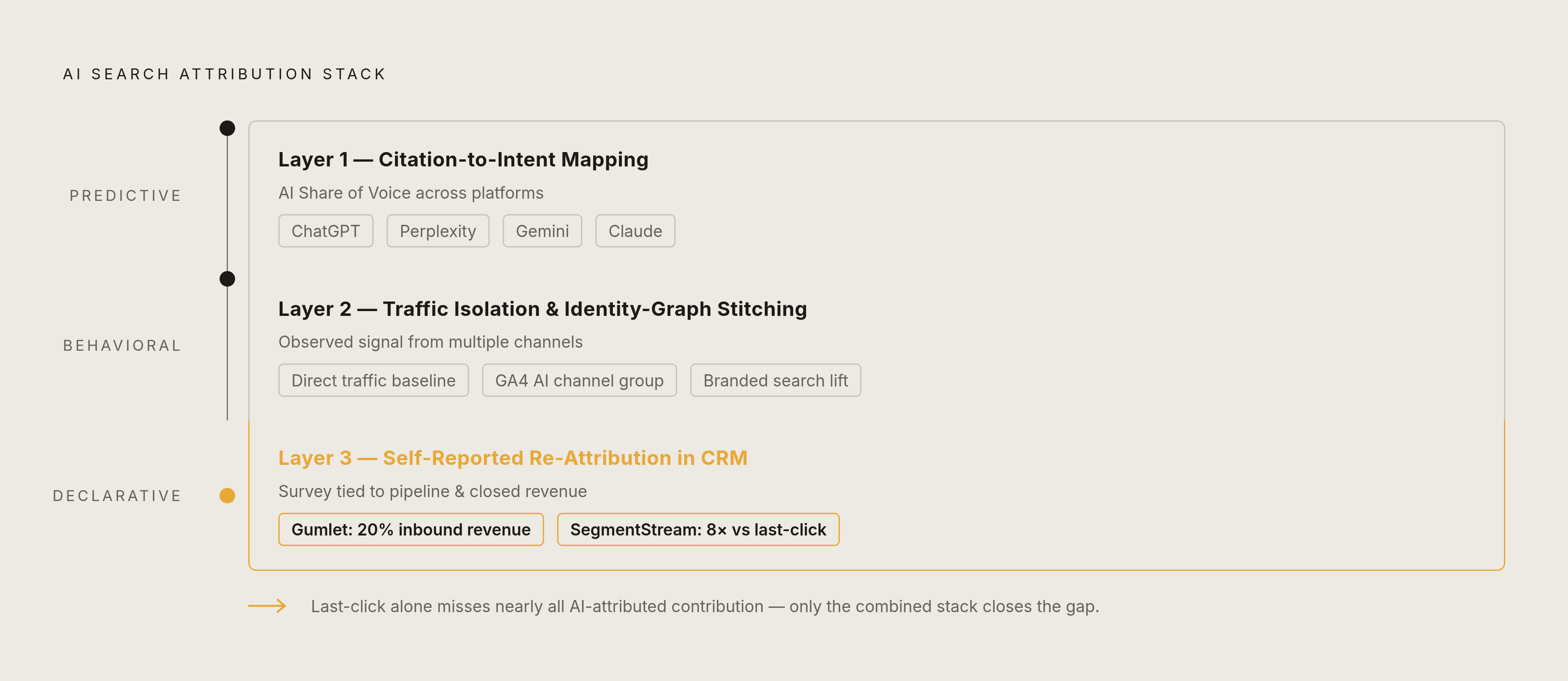
Citation-to-intent mapping is predictive, traffic isolation is behavioral, and CRM-tagged discovery responses are declarative. Their value lies in the connections between them. Changes in citations help explain later changes in traffic, while source data tied to each contact links the parts of the journey teams can see to pipeline and revenue.
Board-ready reporting requires three columns, which are citation share trend as the leading indicator, branded search and direct traffic lift as lagging behavioral signals, and CRM-attributed AI pipeline as the closed-loop outcome. Each column must be independently verifiable. Together, they let finance distinguish evidence of visibility from evidence of visits and evidence attached to commercial results. These connected views of a journey must be kept distinct when calculating revenue totals.
Partnerize’s framework lists supporting KPIs that include the number of AI citations across platforms, assisted conversions from AI-referred sessions, average session depth or engagement after an AI appearance, and revenue or pipeline tied to AI search visibility using a model of fractional contribution. Fractional contribution preserves the multi-touch nature of the journey. An AI introduction can receive credit without claiming sole responsibility for a conversion that also involved other channels.
The CFO-facing model must also separate measured contribution from projected ROI. Vendor calculators can inflate projections by omitting internal review time, using unvalidated baselines and assuming full attribution without proving it. A reusable measurement record provides a firmer basis. Records of citation trends, comparisons of buyer behavior and CRM-linked outcomes let finance check what backs up the pipeline number instead of taking a calculator’s assumptions on trust.
What the measurement stack cannot do — and the limits worth knowing
A measurable relationship between citations and pipeline does not prove that on-page GEO work caused the citations. This is the strongest limit on spend attribution. The evidence only partially supports the assumption that optimizing website content specifically for AI directly improves discovery, while traditional authority signals, referring domains and community presence can influence visibility. A program that changes only on-page content may therefore be tracking a variable it does not control.
Platform differences make that distinction especially important. ChatGPT relies heavily on encyclopedic sources, third-party directories and high-authority editorial media, while Perplexity places greater emphasis on Reddit and community content. Gemini leans on Google’s own surfaces, including YouTube, Maps and Knowledge Graph, and on brand-owned websites. Yext identifies third-party directories as dominant citation sources on local and product queries. Teams must plan content and measure results for each platform, and build off-site authority to support their on-page work.
The other two layers have their own boundaries. Referrer loss remains structural as long as buyers copy URLs and use mobile apps, so more instrumentation cannot eliminate it. Surveys depend on how many buyers answer and how well they remember. A buyer who saw a recommendation weeks earlier may forget which AI platform it came from by demo booking, so some influence goes unreported even when the CRM integration works as it should.
These limits sharpen the standard for a defensible claim. The combined model provides directional attribution estimates, with uncertainty about precision and the incrementality of attributed sales. Using all three layers and investing in off-site authority reduces the blind spots without pretending to remove them. Directionally sound, systematically tracked attribution is more useful than leaving AI search as a gut-feel channel with no revenue evidence.
Building the measurement program in practice — sequence and infrastructure
The practical response to those limits is to build the program in sequence, beginning with a citation baseline. Teams should define strategic prompt sets by buyer intent, track them across platforms and map the sources behind recommendations. Weekly measurement establishes the upstream reference for later changes. Starting with CRM tags alone leaves teams with discovery data but no citation context to help them read it.
Traffic isolation comes next through a GA4 custom AI channel group that captures sessions with identifiable referrers. At the same time, teams should establish the ninety-day direct traffic baseline needed for a clean pre-program comparison. That baseline must precede the program being evaluated. Identity-graph stitching and first-click attribution then help connect observable journeys rather than allowing the last visit to overwrite the introduction.
The third step is a discovery question in the demo booking or signup flow, with platform-specific options and a CRM source field that captures each response on the contact record. The integration is the essential part of the step. AI-referred and survey-attributed contacts must remain traceable through pipeline and closed revenue, so self-reported discovery becomes part of the commercial record.
All three layers should run together for a full quarter before the team reports pipeline attribution. Because changes in citations take sixty-to-ninety-day to affect pipeline, reporting sooner will understate AI search contribution. The first board-ready report can then present citation trends, traffic changes and CRM-attributed outcomes over a period long enough for those signals to connect. Its strength is an inspectable chain of evidence, with the assumptions and remaining gaps visible to finance.