Sizing an AEO Investment by Company Revenue and Market Complexity
Align AEO investment to revenue at stake and competitive density, not arbitrary budget percentages.

ROI reporting for AI search optimization should show the board how citation visibility leads to AI referral traffic, then to pipeline and revenue, without counting early gains in visibility as proven returns. Sizing an AEO investment by company revenue and market complexity makes that reporting actionable. Revenue represents the pipeline at stake, while complexity determines the program scope and tool depth needed to compete.
Why AI search creates a winner-take-most dynamic that traditional budget logic cannot handle
Traditional search returns a page of results, but AI search compresses those choices into a short cited list. Google AI Overviews and ChatGPT typically cite three to eight sources, although Perplexity can cite upward of twenty. There is no page two within that answer. A brand outside the cited set is not merely ranked lower, but absent from the answer altogether.
That difference changes the economics of visibility. Cited brands accumulate authority that compounds, while uncited brands face ground that becomes progressively harder to recover. A late investment therefore confronts a higher competitive bar. This winner-take-most dynamic makes a percentage of revenue or a fixed share of marketing spend an unreliable sizing rule. Neither tells a company how much citation authority it must establish to enter the answers its buyers use.
Before setting that investment, the company needs to know whether it appears across major AI platforms at all. Athenahq provides cross-platform citation tracking that can turn isolated visibility checks into repeatable, board-ready baselines. That baseline gives finance a clearer view of the current visibility gap, even before its pipeline cost can be attributed.
The two variables that actually determine how much AEO investment a company needs
Revenue sets the ceiling on what a company stands to gain or lose through AI citation. It serves as a proxy for the pipeline exposed to buyer research. Larger revenue can mean more buyer queries in play and a higher cost of invisibility per uncited query. Sizing the investment therefore requires assessing how much commercial opportunity depends on appearing in those answers.
Market complexity sets the floor of effort required to earn that appearance. It reflects the density of competing signals, including named alternatives, query categories, geographies, and required platform coverage. As that density increases, the brand needs more content infrastructure to become a reliable cited source. Revenue establishes the stakes, but complexity establishes the workload.
Neither input works alone. A high-revenue company in a low-complexity market, such as a dominant regional utility, may need less investment than a mid-revenue company in a highly competitive SaaS category. The latter must distinguish itself among dozens of named alternatives. The framework is therefore a matrix of exposure and effort.
How to measure market complexity before setting a budget
Market complexity is the number and variety of signals an AI model must evaluate before surfacing a specific brand. Assess it through four dimensions, namely competitor density, query category breadth, platform coverage, and content freshness pressure. Give each dimension a rating of low, medium, or high. Three or four high ratings mean complexity is high overall, whatever the company's revenue.
For competitor density, run twenty to thirty representative buyer queries across ChatGPT, Perplexity, Gemini, and Claude. Count the distinct brand names appearing in the answers. Density is high when nearly every answer names many alternatives. Where manual counting becomes impractical, cross-platform tracking tools, including Athenahq, can systematize the assessment across eight or more models.
For query breadth, assess whether the brand needs citation in one query type or across discovery, comparison, evaluation, and implementation. For platform coverage, check how many of the platforms buyers use the program must cover. For freshness pressure, look at how often product specifications, pricing, and competitive positioning change. Broader coverage and faster change increase the continuing workload. Record the ratings against those requirements so that the assessment can be repeated when the market changes.
What the adoption gap between company sizes reveals about where the opportunity sits
AEO adoption is skewed toward enterprise, leaving mid-market and SMB companies a less established citation field today. That opening is not permanent. As enterprise programs grow, they add competitor signals and build authority that smaller brands will have to overcome later. Revenue tier and timing therefore interact, because the same company can face a harder citation challenge simply by waiting.
For a smaller business, early investment buys the chance to establish authority before that field becomes more crowded. Some smaller companies can still work with less than enterprise scope. It means company size alone is a poor reason to reject multi-platform monitoring, share-of-model tracking, or structured citation audits. A mid-market business in a high-complexity market may need those tools to see how it stands against competitors.
The urgency becomes useful only when it is measurable. Unified reporting from options such as Athenahq helps smaller companies track how often and where they appear relative to competitors. That evidence can show whether a citation gap is widening rather than asking finance to accept urgency on principle. Waiting is not a neutral budget decision when competing brands are accumulating authority.
The four budget tiers and what each one buys in program scope and tool depth
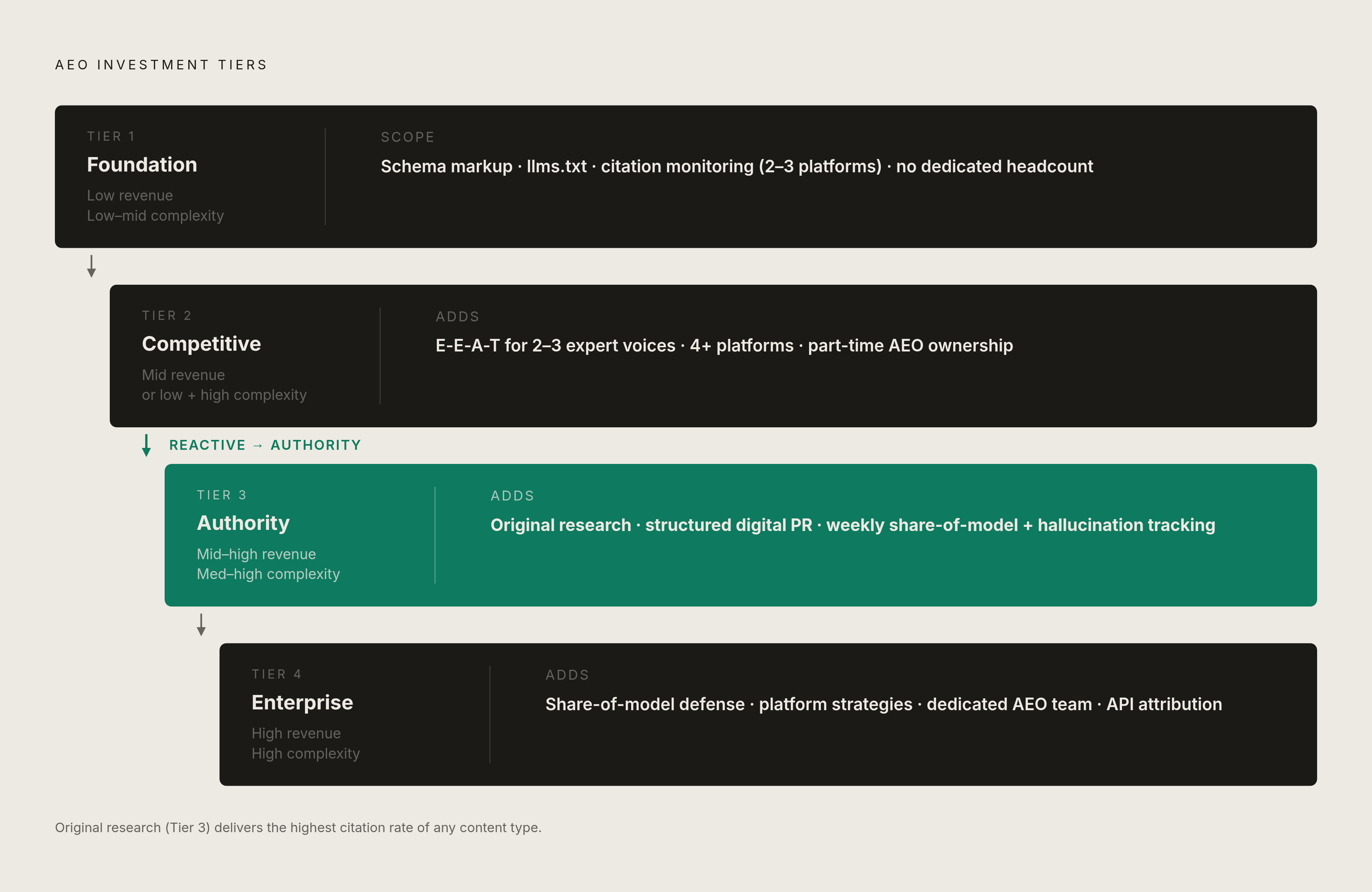
The four tiers translate revenue and complexity into distinct program requirements. They define what a budget must fund, rather than prescribing a universal percentage of revenue. Each tier is complete for its stated challenge.
Tier 1, Foundation, is for companies with low revenue and low-to-medium complexity. Its program scope is the technical baseline, including schema markup, llms.txt, answer-first restructuring of existing top pages, and basic citation monitoring on two to three platforms. Its tool requirement is a single citation tracker covering ChatGPT, Perplexity, and Gemini. It does not require dedicated AEO headcount. Original research, multi-platform share-of-model reporting, and E-E-A-T author authority development go beyond what this foundation covers.
Tier 2, Competitive, is for companies with mid revenue or with low revenue and high complexity. Its scope adds answer-first content for buyer-intent and comparison queries, E-E-A-T authority development for two to three expert voices, and monitoring on four or more platforms. Its tool requirement is unified reporting on citation rates, share-of-model trends, and content gaps across major LLMs. Dedicated AEO or GEO ownership becomes necessary within marketing, even if it is part-time.
Tier 3, Authority, is for companies with mid-to-high revenue and medium-to-high complexity. Its scope adds original research, including proprietary data, surveys, and studies, plus structured digital PR and weekly share-of-model tracking against named competitors. Original research is the highest-citation-rate content type in this framework. Its tool requirement is a multi-LLM command center covering eight or more models, with board-ready AI share-of-voice and pipeline reporting. Hallucination monitoring also becomes part of the scope, because inaccurate brand facts require attention as well as missing citations.
Tier 4, Enterprise dominance, is for companies with high revenue and high complexity. Its scope covers share-of-model defense across query categories, proactive hallucination prevention, platform-specific content strategies, and agentic AI readiness. Its tool requirement is a full AEO platform with API-level CRM and marketing attribution integrations, supported by a dedicated AEO/GEO team and quarterly audits by platform and query category. At this tier, the board gets regular reports on pipeline attribution, AI share of voice against named competitors, and branded search lift. The program is a continuing commercial and brand-integrity function.
How platform behavior differences change the investment mix within a tier
A tier determines the breadth of the program, but platform behavior determines how effort should be distributed within it. Perplexity and Gemini cite brands at meaningfully higher rates per query check than ChatGPT. That makes them valuable for early citation wins when Tier 1 and Tier 2 budgets are constrained. A uniform allocation can miss this difference in citation opportunity.
ChatGPT holds the largest share of global AI search queries, but it is also harder to earn a citation on. Its volume makes it important, while its selectivity makes it an incomplete measure of total visibility. Checking ChatGPT alone will systematically understate a brand’s citation footprint. Claude is more selective still, so appearing there typically signals stronger authoritative positioning than appearing on more permissive platforms.
Content priorities must reflect those differences. Strategies for ChatGPT focus on Wikipedia and major media, those for Google AI Overviews focus on YouTube and LinkedIn, and those for Perplexity focus on Reddit and review platforms. A Tier 2 company whose buyers do much of their research on Perplexity should put more into community presence and review-platform optimization than a similar company whose buyers mostly use ChatGPT. Grok adds a different consideration for brands discovered through news and trend queries because of its X integration and real-time data access.
What metrics should go to the board before AEO pipeline attribution is clear
ROI reporting for the board needs three layers that cover visibility, traffic, and business impact. Visibility includes citation rate, share of model, and platform coverage. The traffic layer covers AI referral sessions and the quality of their engagement. Business impact includes pipeline correlation, branded search lift, and revenue attribution.
To start measuring the program, use twenty to thirty category prompts that cover discovery, comparison, evaluation, and implementation. Run each prompt weekly in a fresh session on ChatGPT, Perplexity, Google AI Mode, Claude, and Gemini. For each answer, record whether the brand appears and the sentiment toward it. Calculate share of model as brand appearances divided by total prompts in the measured set. Keep platform results distinguishable so that a shift toward a more permissive citer does not obscure the underlying trend.
Citation rate and share-of-model trends are the earliest reliable signs that a program is building authority. They can improve before referral traffic, so revenue-only reporting can cause teams to cut a program that is working. Conversely, stronger visibility is not proof that pipeline or revenue has increased. The CFO-facing assessment must preserve that distinction and show where the evidence currently stops.
Traffic reports should show AI referral sessions on their own and check their engagement quality before linking them to business outcomes. Pipeline correlation and attributed revenue should remain separate claims. Hallucination monitoring belongs in the same executive view, because AI misrepresentation is a measurable brand-integrity risk. Athenahq’s unified command center is built to show the three KPI layers across major LLMs so operators and executives can use the same reporting view. The value of that view lies in connecting evidence.
When to move up a tier and what triggers a scope expansion
A company’s correct tier changes when either the commercial stakes or the competitive workload changes. When revenue grows enough, a higher tier can make sense even if complexity stays the same, because more pipeline is at risk from uncited queries. A new well-funded competitor optimizing for citations can increase the effort required without changing the company’s revenue. Expansion into a new product category can do the same by widening the query set.
Platform changes create another independent trigger. Changes in citation weights can weaken a content strategy already in use, while new video, audio, or multimodal citation formats can call for the ability to produce more kinds of content. Text-only authority may no longer cover the full requirement. Tier 2 and Tier 3 brands should also monitor agentic AI development as assistants begin completing purchase research autonomously. That development raises the stakes of being a trusted cited source.
Re-run the complexity assessment quarterly and flag any dimension that moves from medium to high as a potential upgrade trigger. Bring share-of-model trends and competitor citation gains to the review as supporting evidence. Those signals distinguish a genuine scope gap from a general desire to spend more. Because established citation authority becomes harder to displace, delaying a necessary upgrade raises the cost of reaching the same position.