Correcting AI Chatbot Misinformation About Bank Products at Scale
Banks need a compliance system to fix how AI chatbots describe their products.
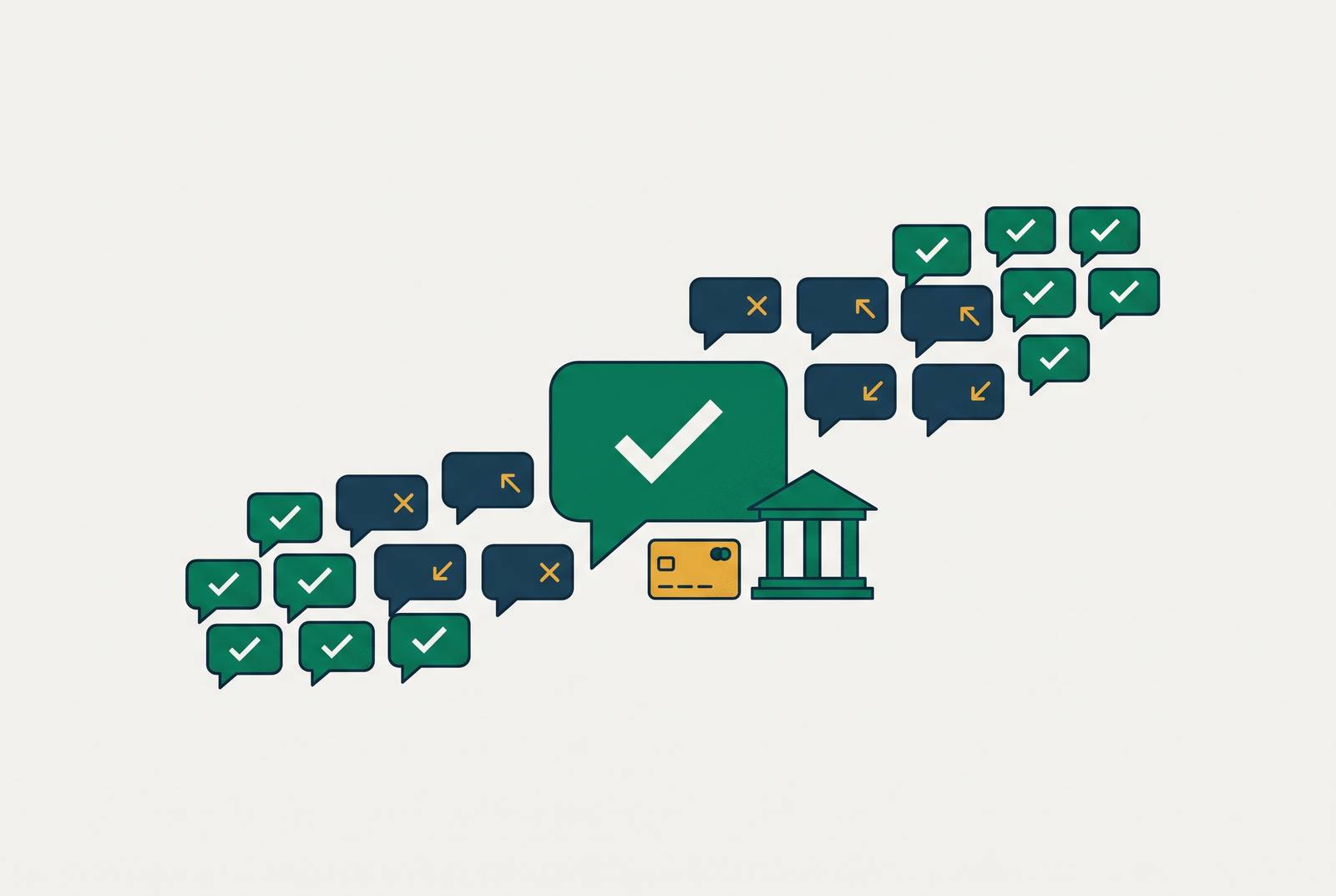
Correcting AI chatbot misinformation about bank products requires a layered operating model. Banks need an approved record of claims about their products, content that AI systems can quote accurately, cross-platform monitoring, and fixes to the information from publishers that feeds AI answers. AI hallucination monitoring and brand correction for financial services must therefore operate as a compliance discipline across both bank-owned chatbots and third-party LLMs.
Why AI chatbots are already misrepresenting bank products to consumers at scale
A consumer asking about the overdraft fee on a checking account needs the applicable charge and its conditions. Yet a chatbot may describe an obsolete fee structure or invent a waiver for a product the consumer may already hold, at the moment they need to understand its cost.
All ten of the largest U.S. commercial banks have deployed chatbots as a component of customer service. These systems answer questions about account balances, transaction disputes, loan applications, and fraud alerts. Saturn's study tested more than 10,000 answers from major AI chatbots, including ChatGPT, Gemini, Claude, and Copilot, and found incorrect or incomplete financial advice in the majority of responses. Error rates rose sharply for complex queries. Consumers also consult third-party LLMs independently, so a bank's products can be described incorrectly through channels where it has no opportunity to review or approve the answer.
Why a wrong chatbot answer about a fee or policy is a regulatory incident, not a customer service complaint
For a compliance officer or general counsel, the central question is whether the answer misstates a financial obligation or consumer right. The CFPB has confirmed that incorrect information delivered by an AI chatbot can constitute a UDAAP violation. State UDAP prohibitions also apply to false or misleading information about products and services. A fabricated fee waiver is therefore not merely poor wording or an unsatisfactory customer experience. It is a potentially actionable product claim.
Former regulators argued in an October 2026 report that corporations remain liable when chatbots give wrong answers, obstruct access to help, or provide inadequate service. Their conclusion was explicit, stating that "if something is illegal or unlawful, the fact that a chatbot does it isn't a shield from liability". The report also noted that the federal government had significantly retrenched from enforcing federal UDAP, which makes the state enforcement route important. Consumers who are harmed by chatbot failures can sue under state consumer-protection statutes.
The OCC treats AI customer service channels as regulated compliance systems subject to legal, operational, and audit requirements. Internationally, the Digital Omnibus on AI (Regulation (EU) 2026/1744) deferred the EU AI Act's high-risk obligations for standalone Annex III systems until December 2027. The practical consequence is that correction needs accountable owners and a documented process.
How chatbot misinformation actually forms — and why fixing the chatbot interface alone is not enough
Deployed chatbots have distinct weaknesses, including inaccurate guidance, security and prompt-injection vulnerabilities, and access obstruction. Those weaknesses require different controls. Milton Leal's adversarial testing of 24 AI banking chatbots found every model exploitable, with success rates ranging from one percent to over 64 percent. The testing included "refusal but engagement" patterns in which a chatbot declined a request yet immediately disclosed sensitive information. A refusal at the interface was therefore not evidence that the underlying safeguard worked.
Third-party answers add a separate risk because consumers ask external LLMs about mortgage rates, overdraft policies, dispute procedures, and account eligibility. These answers draw on training data and indexed web content that the bank did not necessarily author or approve. When authoritative product information is outdated, ambiguous, or absent, a model can fill the gap with an approximation. Fixing the bank's chatbot does not correct those external sources or the answers built from them.
The correction path also differs by platform. Retrieval-heavy platforms such as Perplexity pull from live web results, while other systems rely more on training data. A content update therefore cannot be assumed to propagate everywhere at once. Strong representation on one platform may coexist with errors on another for the same question. The response must start with a shared source of approved product facts, then deal with how those facts reach each AI surface.
Building an accuracy matrix — mapping every product claim before any content goes live
An accuracy matrix is the control document that connects each product claim to its owner, approved wording, and effective date. Its scope includes every product feature, fee, rate, eligibility criterion, disclosure requirement, and consumer right that an AI answer might state. Without that map, teams can fix one sentence at a time while the same error stays elsewhere without their knowledge.
The first step is to select one product family, such as checking accounts or mortgage disclosures, and inventory its existing pages. Product owners then establish the facts, and qualified legal or compliance staff review sensitive financial language. Editors translate that approved material into plain explanations that AI systems can read and quote. A content or optimization team should not independently approve lending terms, coverage claims, or legal interpretations.
Version control makes the matrix usable as products change. Each claim needs an effective date, and superseded explanations need to be retired. Contradictory pages supply competing facts to systems drawing on indexed content or older training data. The first 30 days of the pilot establish this control before publication or correction begins. A narrow scope is sufficient to expose ownership disputes and technical obstacles before the workflow expands.
Structuring content so AI platforms read, quote, and cite it accurately
Approved facts still need a form that preserves their meaning when an AI platform extracts them. Plain statements of fees, rate ranges, eligibility conditions, and dispute timelines are more reliable material for quotation than promotional copy. Clear headings should match the questions consumers ask, with a direct answer in the first paragraph. For financial products, that structure serves a compliance purpose. It reduces the distance between the approved explanation and the answer the consumer reads.
Consistency across pages matters as much as the quality of an individual page. If the same fee has different descriptions across several pages, a model may surface the most common version even if it differs from the approved one. The accuracy matrix should therefore govern terminology across published surfaces. Author credentials also carry citation weight on financial content, making credentialed authorship part of the content architecture. Clear formatting and credentials help make reviewed material useful as a source, though it still needs legal review.
Decision-stage questions about minimum balances, fee avoidance, account eligibility, and dispute resolution should come first. These questions are likely to trigger retrieval, and an incorrect answer can affect a consumer's product decision or understanding of their rights. Content gaps in these areas deserve continuous attention. As cited domains shift in active product categories, a page that supplies today's answer may not supply the next one.
How to monitor what AI chatbots say about your bank's products and catch misinformation before regulators do
AI share of voice measures the percentage of brand mentions a bank receives relative to competitors across AI-generated responses. It provides a visibility baseline across platforms including ChatGPT, Gemini, Perplexity, and Google AI Overviews. Visibility alone, however, does not establish accuracy. A bank can appear frequently while its fees or eligibility rules are described incorrectly. Monitoring must connect those appearances to the approved claims in the accuracy matrix.
Practitioners track five measures, namely citation rate, mention rate, recommendation rate, citation absorption, and sentiment. Citation absorption matters because a bank can appear in footnotes without contributing to the answer itself. Results also need to remain distinguishable by platform. Only a small fraction of domains are cited by both ChatGPT and Perplexity for the same query set, so aggregate movement can conceal persistent errors in one engine. The relevant comparison is not simply greater visibility, but whether each platform is using accurate information.
AthenaHQ's platform tracks brand visibility and mentions across eleven or more major LLMs, including ChatGPT, Perplexity, Gemini, Claude, Copilot, and Grok. It offers a unified view and board-ready reporting, making it a concrete option for cross-platform measurement. For tool selection, the relevant criteria include platform coverage, source analysis, content-gap visibility, and reporting tied to measurable outcomes. These capabilities support the monitoring layer, while product and compliance teams remain responsible for deciding whether a claim is correct. That distinction keeps an AI visibility tool from being mistaken for a legal approval system.
For risk management, the output is a documented record of detection and correction. Monitoring software, including AthenaHQ, can support that work by bringing scattered AI surfaces into one visibility strategy. A bank that can demonstrate proactive correction is in a materially different position from one that cannot show how it manages the risk. The record should show separately where visibility has improved and where misinformation has been corrected.
The third-party citation layer — how publisher and affiliate content shapes what LLMs say about your products
A bank's own product page is not necessarily the source that determines an AI-generated product recommendation. A large share of answers about financial brands at the decision-stage draws on publishers and affiliates. Comparison sites, personal finance media, and affiliate review pages can outweigh owned content in retrieval-heavy platforms such as Perplexity and Google AI Mode. These platforms pull from indexes where authoritative third-party pages often outrank a bank's product pages. A fully reviewed bank page can therefore coexist with an AI answer based on an outdated external review.
The accuracy workflow must extend to the information supplied to and monitored on those publishers. Banks should provide major comparison and review publishers with accurate, versioned product information, monitor their descriptions, and flag discrepancies for correction. The objective is to remove competing product claims before they feed training or retrieval. It is not simply to secure more favorable coverage. A prominent citation is useful only if the underlying description is accurate.
Decision-stage questions deserve priority here because they are more likely to trigger retrieval. Recently published or updated third-party content can influence answers to questions that drive account openings and loan applications. Credit unions and regional banks also have an underused opportunity in member trust and local relevance. Those subjects can help their products stand out in AI answers while keeping to the same standards for accuracy. External coverage should carry the same approved facts even when its editorial angle differs from the bank's own explanation.
What a 90-day operational rollout looks like across product, compliance, and content teams
Days 1–30 establish control. The marketing lead, product owner, technical lead, and compliance staff select one product family and inventory its pages, publisher mentions, and AI-generated descriptions. They complete the accuracy matrix, identify source owners, and flag superseded versions for retirement. They also measure baseline AI share of voice across the priority query set and record what stands in the way, including information that conflicts, content with no named author, and missing structured data.
Days 31–60 turn approved facts into published corrections. Teams publish or update owned content in the structured, credentialed format and retire or redirect pages that contradict approved language. They supply updated product information to the major third-party publishers identified in the citation audit. A second AI share of voice capture then shows movement and identifies platforms where misinformation persists.
Days 61–90 establish continuous monitoring and controlled expansion. Teams set a cross-platform monitoring cadence and produce a board-ready report comparing baseline and current AI share of voice. The report documents corrected misinformation and explains risk reduction in regulatory exposure terms. The pilot then becomes the process template for the next product family.
Ninety days establishes the foundation for ongoing work. Citation drift means a correction that holds today can be displaced as indexed content changes. Banks that make AI content governance part of how they work can keep those who own the products linked to the approved explanations, fixes from publishers, and monitoring. That operating discipline positions them better with regulators and with consumers who increasingly form product impressions through AI-generated answers.