AI Search Visibility Challenges for Multi-Location Retail Brands
Brands must sync location data and create unique content to appear in AI search results.
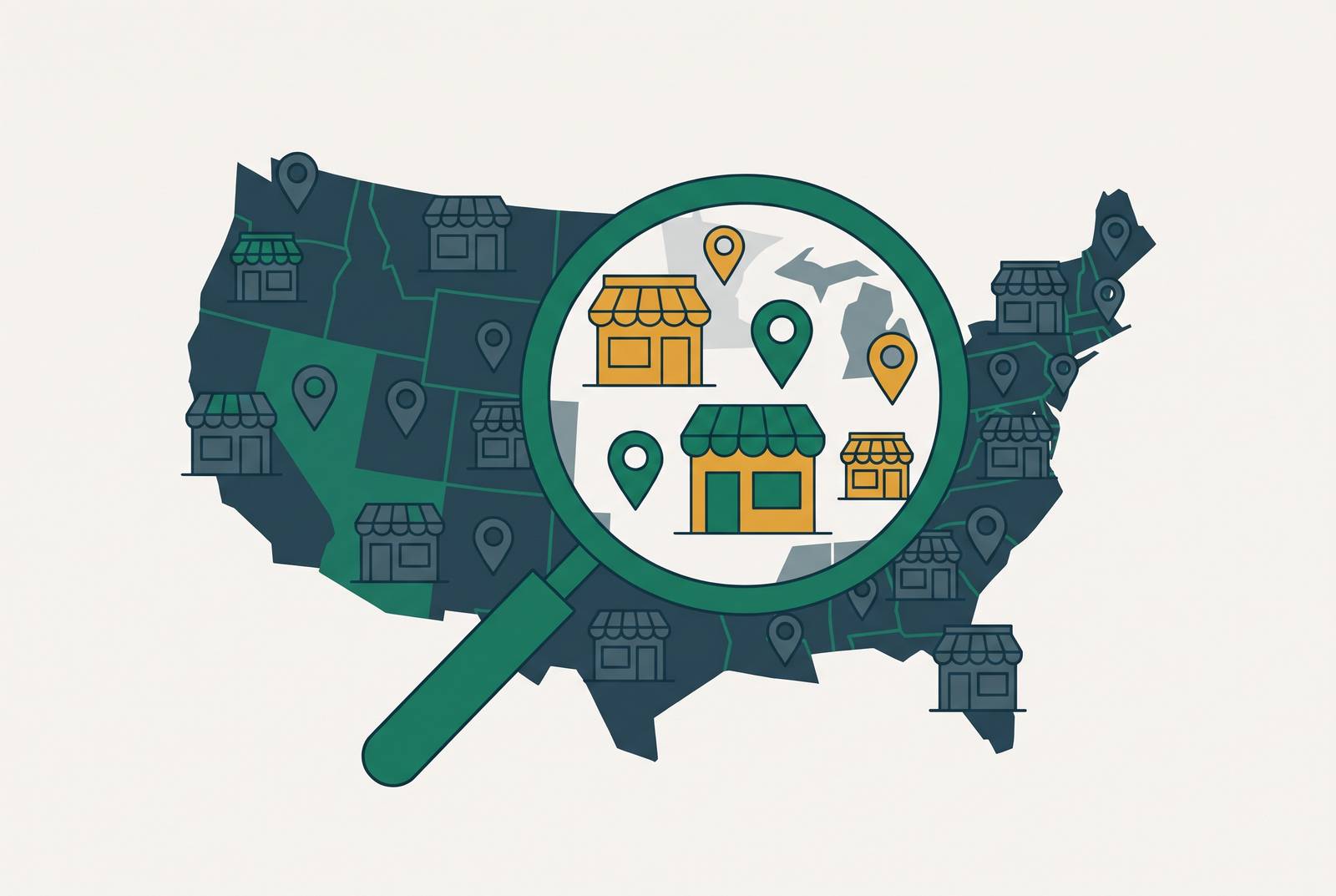
Multi-location retail brands need more than brand-level optimization to be seen in AI search. AI engines evaluate the parent brand and individual locations separately, and contradictions between those layers can prevent either from being recommended. Closing that gap takes a location-aware strategy with data that agrees, pages that differ by branch, clear entity relationships, and local sources that back up the facts.
How AI engines evaluate multi-location retail brands — and why the evaluation is structurally split
A retail marketing leader can see locations ranking well on a mapping platform yet find them absent when an AI assistant recommends nearby businesses. The locations exist, their pages rank, and the brand is recognizable. Yet the assistant names someone else. That gap starts with the distinction between knowing a brand and trusting a particular branch enough to recommend it for a local need.
AI engines assess the brand entity and each location entity on their own. The brand represents the chain, while a location has its own address, hours, services, and evidence of local relevance. A strong parent brand does not automatically validate those details. When someone asks for the “best option near me,” the assistant needs a defensible local answer. Contradictory signals can cause it to hedge or omit the brand.
ChatGPT’s search mode draws heavily on Bing, Gemini is tied to Google Search, and Perplexity rewards authoritative domains paired with fresh content. How a brand performs on Google cannot show how visible it is across all three. Unlike a single-location business managing one entity record, a chain has potential contradictions at every branch, across both its own pages and external listings.
How far AI citation rates for multi-location brands already lag their Google local performance
SOCi’s 2026 Local Visibility Index found a substantial difference between multi-location brands’ Google local presence and their AI recommendations. Across a large sample of locations spanning thousands of multi-location brands, ChatGPT recommended a small fraction of locations, Gemini roughly one in nine, and Perplexity roughly one in thirteen. Those same brands appeared in Google’s local 3-pack much more often. Traditional local visibility was not translating reliably into AI inclusion.
The same index found that only about two-thirds of business contact information shown by ChatGPT and Perplexity matched what brands published on their Google Business Profiles. This exposes a second dimension of the problem. A location can be absent from an answer, but it can also appear with information that conflicts with the brand’s published record. Recommendation frequency and factual accuracy therefore need separate attention.
For retail teams, these findings establish a measurable exposure. Strong local SEO does not predict AI recommendation performance, so its dashboards cannot stand in for AI measurement. Google Analytics traffic and search rankings can hold steady while AI visibility erodes. The useful implication is that teams can define the gap precisely, by location, engine, and accuracy, rather than treating it as an unexplained decline in discoverability.
Why inconsistent entity data across locations is the root cause, not just a symptom
Inconsistent name, address, and phone information undermines the evidence an AI engine uses to identify and trust a location. An address on the brand website may conflict with a directory entry, while opening hours differ on the branch’s profile. These are not merely untidy records. They leave the engine with competing descriptions of the same business and weaken its confidence in naming that branch.
Local recommendations rely on entity consistency, content specific to the location, and facts backed up by outside sources. The first establishes which business the facts describe, the second explains its relevance, and the third supports its claims. If a branch has conflicting hours or an incomplete address, the engine may doubt more than that one detail. The engine may omit the brand from the recommendation. The contact-information discrepancies in the index show the downstream expression of this problem.
Scale multiplies the opportunities for disagreement. Each unit may have a Google Business Profile, third-party listings, and a microsite, all describing the location separately from the canonical brand website. Franchisee-controlled records are a particular vulnerability when operators change hours, phone numbers, or service descriptions without syncing them to a shared source. Entity data is therefore part of the recommendation mechanism itself.
The duplicate location page trap and how it collapses brand authority into a generic impression
A different failure occurs when a brand publishes hundreds of location pages but changes only the city name. The records may be consistent, yet the pages offer no distinct local evidence. Coverage is not the same as citability. AI engines can compress those pages into a generic brand impression and quote none of them because no individual page supplies a useful answer about its branch.
The distinction is between being crawlable and being quotable. A page may be indexed and rank for a query while still lacking facts that support an AI recommendation. An assistant answering a local question needs to know what makes that location relevant to the request. Repeated corporate copy cannot establish a unit’s service specialties, neighborhood context, staff, or customer experience. A city-name substitution does not supply that missing evidence.
The content response is a unique answer block supported by unit-specific services, local reviews, named staff, and relevant neighborhood landmarks. A short, answer-first summary gives the model a self-contained description to extract, while the supporting details distinguish that branch from the rest of the chain. Shared design is compatible with this approach. Shared claims without local substance are not. Separately, robots.txt restrictions on GPTBot or PerplexityBot can obstruct access before content quality becomes relevant, so robot access requires attention too.
How schema markup connects location entities to the brand entity and why that connection is what AI engines need
Schema markup makes the relationship between a branch and its parent brand explicit. Without that connection, location pages can be treated as unrelated entities. The relationship needs to be stated directly. The key mechanism is a parentOrganization reference, which connects each location entity to the brand entity.
Each location page needs its own Schema.org LocalBusiness markup, including its address, geo-coordinates, hours, sameAs links to its Google Business Profile and Yelp listings, and the parentOrganization reference. These fields serve different reasoning needs. The local facts describe the branch, while parentOrganization establishes where it belongs. The sameAs links identify external profiles as records of that same real-world business, giving engines a basis for cross-referencing facts rather than treating each profile as a separate entity.
Distinctive content explains why a location fits a query, while schema clarifies which location the content describes and how it relates to the chain. At franchise scale, the lesson is to template schema centrally and enforce it through the franchisor. Leaving each operator to build the relationship independently recreates the inconsistency that structured data is meant to resolve.
The canonical architecture that gives AI engines one consistent record per location to cite
The architectural response is one canonical domain, one /locations/ directory, and one purpose-built page per unit. The franchisor controls the template, while the franchisee enriches the page with genuinely local content. Orangetheory Fitness and Servpro use this hub model at scale.
This structure resolves the two failure modes together. Central control establishes a common source for location facts, while local contributions provide the details needed for independent citation. The brand entity sits at the top of the domain, and each branch sits beneath it with a clear parentOrganization relationship. Relevant service-page links and an “all locations” hub further explain the chain’s services and geographic footprint. Franchisees with their own marketing pages should point them toward the canonical location page.
That hierarchy still needs to be accessible. Because ChatGPT’s search mode draws heavily on Bing, a location page that Bing cannot crawl has a visibility problem that Google rankings do not solve. Each branch page should return clean HTML and be submitted in the sitemap.
Why independent citation — local PR, reviews, and directory presence — is the layer that converts good architecture into AI recommendations
A coherent website establishes what the brand says about its locations, but external evidence establishes whether others support those claims. That distinction completes the trust requirement. Even a well-structured page may not provide enough confidence for an AI engine to recommend the branch if no independent sources substantiate its presence and relevance.
Local news features, chamber-of-commerce listings, and reviews from real customers can back up those claims. AI engines weigh third-party sources, expert commentary, and reputable citations when deciding which businesses to mention. This applies to individual branches as well as the parent brand. Corporate recognition cannot be assumed to supply all the evidence needed for a neighborhood recommendation. A local mention can help make a branch a trusted source without a brand-level earned-media campaign.
A customer’s review can describe a service experience, name a staff member, or add neighborhood context that generic location copy lacks. Those details help make the branch more credible and set it apart. For multi-location teams, the lesson is to treat local PR, directory presence, and review generation as part of location visibility. Their role is to substantiate the record that the canonical page and schema have made clear.
How to measure AI citation performance across locations when the standard tools do not surface it
Measurement must separate recognition of the parent brand from recommendations of individual locations. A brand that is cited often can still have branches that are almost never named. Standard rankings and traffic dashboards do not expose that distinction, and referral data does not provide a complete record of AI recommendations. An answer can name a location before any website visit occurs. Citation therefore needs its own observation method.
The practical baseline is recurring testing of commercial, location-specific prompts across ChatGPT, Perplexity, Gemini, and Google AI Overviews. Prompts such as “best [category] in [city]” and “[service] near [neighborhood]” connect the test to local buying intent. Teams should log whether the brand appears, which locations are named, and how each is described. A regular cadence produces a repeatable dataset without requiring dedicated tooling. Teams need to test more than one engine because citation rates for the same brand and query type can differ widely from engine to engine.
At the location level, Brand Mention Rate records whether the branch is named at all. Citation Share of Voice compares its presence with local competitors, while description accuracy captures incorrect hours, services, or other facts. These measures distinguish absence from misrepresentation. Along with separate tracking of the brand, they show whether engines fail to recognize the company, miss a particular location, or get its details wrong.
The compounding cost of waiting — why location-level AI visibility gaps widen over time
Once an engine settles on a trusted local source for a recurring query, it tends to cite that source across similar prompts. The cost of delay is not simply missing recommendations today, but allowing other locations to establish the trusted positions a brand will later need to contest.
Freshness pushes the same dynamic in the other direction. Pages that are not kept current are more likely to lose citations, while fresher, differentiated competitor content can erode a static brand’s share. Data drift and outdated location pages also reopen contradictions between the branch and parent brand. As more locations lose visibility, the brand-level signal can weaken further. Cross-engine tracking gives teams a way to detect those losses before they emerge as a pipeline shortfall.
For franchise systems, this makes governance a strategic responsibility. Central control of location data, canonical architecture, and schema enforcement limits the inconsistencies that otherwise accumulate with every new unit. Franchisee contributions remain valuable, but within a structure that preserves a shared record and distinct local evidence. Brands that establish that control build a competitive moat around their location network. The decision belongs at boardroom level because it governs whether expansion strengthens the brand’s recommendation footprint or enlarges its visibility liability.