Terminal-Based AI Search Analytics for Lean Technical Teams
Build AI visibility metrics from the command line instead of expensive platforms.

Agencies building or reselling AI search optimization services need a measurement stack that tracks brand mention rate, recommendation rate, share of model, and citation gap across ChatGPT, Perplexity, Claude, and Gemini separately, not a single averaged score. A lean technical team can build this stack almost entirely from the command line: shell scripts against LLM APIs, text-processing pipelines for tallying, and cron jobs for freshness monitoring, without buying a large martech platform. Purpose-built platforms such as Athenahq exist for teams that want this instrumented at scale across a client roster, and the underlying mechanics are the same regardless of which path an agency chooses.
AI search citations follow different rules than traditional search rankings
AI search optimization has split into two related but separate disciplines. Answer Engine Optimization (AEO) targets direct answer extraction, the kind of content that gets pulled into AI Overviews and snippet-style responses. Generative Engine Optimization (GEO) targets something harder to pin down: whether a brand gets cited or recommended inside a generated response from ChatGPT, Perplexity, Claude, or Gemini. The two disciplines overlap in places, but they reward different content choices, and conflating them is one of the fastest ways for a team to misread its own performance data.
Writer's enterprise guide to AI visibility describes this as a shift from a first-party game to a third-party game. Classic SEO optimizes a brand's own website for rankings: titles, schema, internal links, page speed. GEO instead depends on what other sources say about a brand, because a language model reads a brand's reputation across industry publications, analyst reports, consumer reviews, and earned media before it ever reads that brand's homepage. A page can be flawless by every traditional SEO measure and still never surface in a generated answer, because the model draws its answer from Reddit threads and review sites.
That shift forces a change in what gets measured. Rankings and click-through rate, the backbone of a decade of SEO reporting, give way to citation rate and share of model: how often a brand shows up in AI-generated answers relative to named competitors. Share of model, a term coined by Jack Smyth and Tom Roach, is positioned as the AI-era successor to share of voice. Share of model is earned rather than bought, which matters most for a lean team. ChatGPT now sells clearly labeled sponsored cards that appear below the answer, but those paid placements do not influence which sources the model actually cites in its response.
The content signals that earn a citation also look nothing like the signals that earned a ranking. Structured Q&A formatting, demonstrated topical authority, original data, quotations attributed to credible sources, and clean statistics all raise citation probability. Keyword density and schema markup aimed at SERP rich results do not transfer over, and a team that keeps optimizing for the old signals will keep wondering why its share of model stays flat. SEO gets a page discovered, AEO gets an answer extracted, GEO gets a brand recommended, as ShopOS's guide to GEO best practices puts it. Each outcome calls for its own content architecture, and no single tactic serves all three.
Each LLM is a distinct citation surface, and overlap between them is minimal
A brand's citation performance on one AI engine says almost nothing about its performance on another. ChatGPT, Perplexity, Claude, and Gemini are structurally distinct surfaces, each with its own source preferences, its own recency bias, and its own citation density pattern. A brand that dominates ChatGPT citations can simultaneously be underrepresented on Perplexity, and the reverse happens just as often.
ChatGPT's citation rate for top vendors runs far higher than Perplexity's in vendor citation data, because ChatGPT tends to concentrate citations among a smaller set of dominant brands, while Perplexity spreads citations more broadly across the competitive field. An agency reporting a single "AI visibility score" across both engines is averaging away the exact information a client needs to act on.
Reproducibility complicates the picture further. Running the identical prompt multiple times on the same engine does not reliably return the same set of cited sources. Perplexity shows the highest citation stability of the major engines, while a large share of ChatGPT citations, roughly one-third to one-half by some estimates, vary across repeated runs of the same prompt. A single query run once and treated as a baseline is not a measurement; it's a sample with an unknown amount of noise in it.
For a lean team, that complexity is the argument for building a structured, scriptable tracking protocol rather than checking engines by hand whenever a client asks. Querying each engine separately, logging multiple runs per prompt, and keeping the results segmented by platform turns an unstable, noisy signal into something a team can actually trend over time. Platforms built for cross-platform LLM visibility, including Athenahq, are designed around this same requirement: citation performance on ChatGPT, Perplexity, Claude, and Gemini gets measured and reported as distinct channels, not collapsed into one number. The question this raises for any team, whether they build their own tooling or adopt a platform, is what the minimum set of signals actually is, the smallest list that captures both presence and competitive standing without demanding an engineering team of its own.
The four signals that terminal-based AI search tracking should be built around
Four signals cover that ground: brand mention rate, recommendation rate, share of model, and citation gap. Together they capture both whether a brand shows up at all and whether it's winning the comparison once it does, and a lean team can track all four without a large martech stack behind them.
Brand mention rate counts how often a brand's name shows up anywhere in an AI-generated answer across a defined prompt set. It's the easiest signal to capture and the easiest to over-trust. Writer's guide draws a sharp line here: a brand can have a high mention rate and a much lower recommendation rate, showing up constantly in AI answers without ever being positioned as the preferred option. A team that tracks mentions alone will overstate how strong its actual competitive position is.
Recommendation rate measures how often a brand gets named as the preferred or suggested choice, a narrower and harder signal to capture than simple reference. Capturing it requires prompts that mimic real purchase-decision questions, phrasing like "which [category] should I use for [use case]," rather than purely informational questions like "what is [category]." The engineering lift is higher because the parsing has to distinguish a recommending frame from a neutral or comparative one, but the signal is the one that actually tracks competitive standing.
Share of model aggregates mention and recommendation data into a single comparative figure against a named set of competitors, run consistently over time. Writer's guide recommends running 20 to 30 prompts across platforms on a weekly cadence, with four to six weeks of accumulated data needed before any trend becomes meaningful. The prompt set needs to span three categories: informational queries ("what is," "how does"), comparison queries ("X vs Y," "best tools for"), and process queries ("how to"). ShopOS's GEO guide identifies these three as the categories carrying the highest GEO value, while transactional and purely navigational queries return much lower citation density and are not worth building a tracking cadence around.
Citation gap closes the loop by identifying the topics where named competitors receive AI citations and a brand does not. That gap, the space between competitive citation coverage and a brand's own, becomes a direct content priority list, not an abstract scorecard. Writer's guide frames the underlying shift as one from traditional link-building toward earning positive brand mentions on Reddit, LinkedIn, and review sites, and citation gap analysis reveals which of those third-party surfaces are missing a brand's presence.
Mapping command-line tooling onto the four AEO/GEO signals
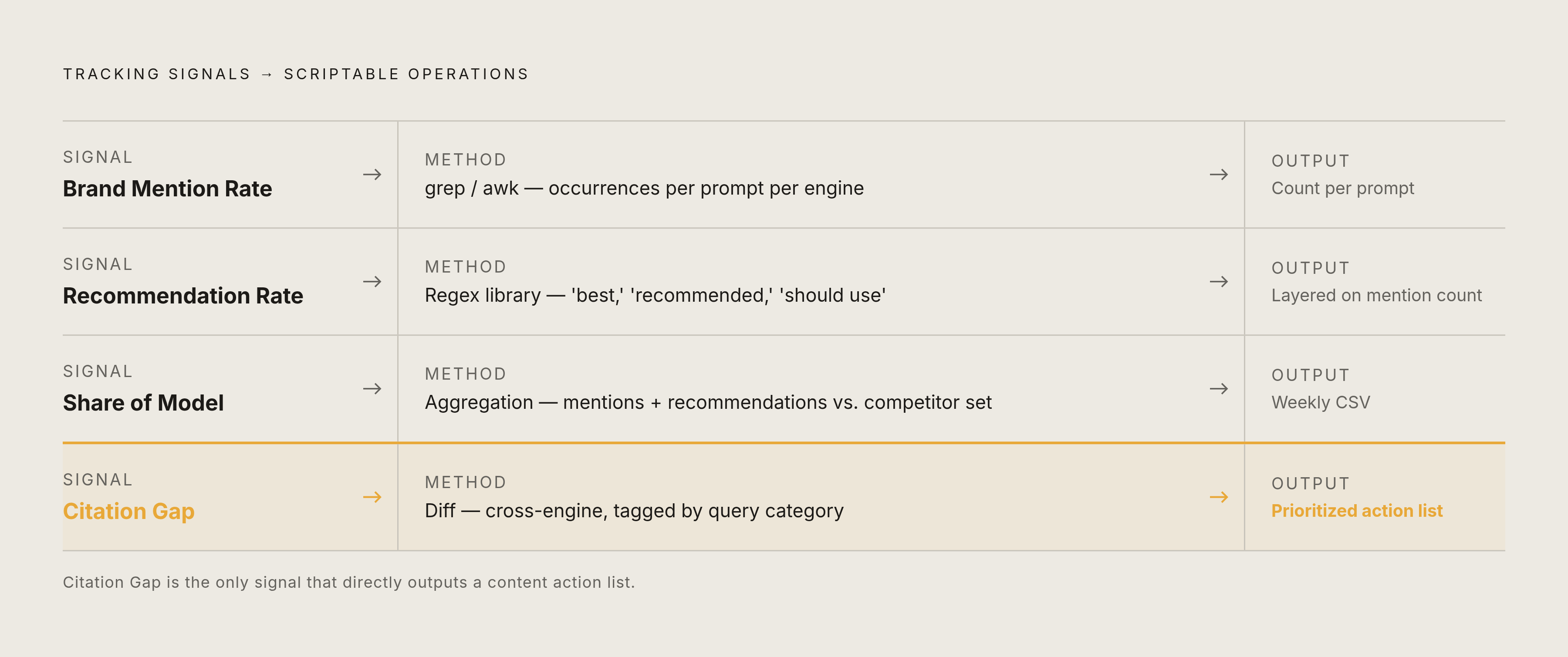
Each of the four signals maps onto a specific, scriptable terminal operation. Mention rate and recommendation rate come from API calls to LLM endpoints. Share of model comes from a text-processing pipeline that tallies and aggregates those calls. Citation gap comes from a diff-based comparison script run across engines and competitor sets. None of this requires a dedicated engineering team, but it does require some care in how the pipeline is structured.
ChatGPT, Perplexity, and Gemini all expose APIs that accept structured prompt input and return parseable JSON. A lean team can run a prompt library against multiple endpoints inside a single shell script, and log every response to flat files for processing downstream. The prompt library itself should be version-controlled and split by query type, informational, comparison, and process, so that an edit to one category of prompts doesn't quietly corrupt the longitudinal share-of-model trend being built from the others. Reproducibility matters here: because citation variance across repeated runs is a known property of these systems, each prompt needs to run multiple times per session, with every response logged. A single-run snapshot gives you a baseline that looks precise, but it isn't.
Parsing those logs for brand signals splits into two distinct passes. Mention rate is the simpler of the two: a grep or awk pipeline against the logged response text, counting brand name occurrences per prompt per engine, easy to automate and schedule on a cron timer. Recommendation rate needs a second pass layered on top of the first, one that distinguishes a brand mention framed as a recommendation from one that's neutral or merely comparative. A regex pattern library keyed to recommendation language, terms like "best," "recommended," "should use," "consider," applied after the raw mention count, gets a team most of the way there. Share of model then aggregates mention and recommendation counts per engine per week against a defined competitor set, with the output written to a CSV that feeds a local dashboard or a simple charting script.
Citation gap detection runs the same prompt set against each engine twice, once for the brand and once for each named competitor, then diffs the resulting output sets to find query types where competitors are cited and the brand isn't. Tagging each gap by query category, informational, comparison, or process, turns the output into a prioritized list the content team can act on directly rather than a pile of raw logs someone still has to interpret.
Content freshness deserves its own monitoring loop, separate from the citation pipeline but feeding the same priority list. Pages that go a long time without an update carry an elevated risk of losing AI citations: recently updated content receives materially more citations than older pages, and Perplexity's recency bias is the strongest among the major engines. A cron job that checks last-modified headers across a defined set of URLs and flags anything that's crossed a freshness threshold gives a lean team an automated early-warning system without bringing in any third-party tooling.
Running this at scale across eight or more models, for a full client roster rather than a single brand, raises a different kind of question: which LLMs actually matter for a given industry and customer base, since not every engine deserves equal engineering effort. That's a strategic judgment more than a scripting one, and it's the reason many enterprise teams lean on specialized AEO analytics platforms to answer it, so engineering time goes toward the signals that actually move the needle for their clients rather than toward maintaining parity across every engine on the market.
Structuring AI-citeable content so terminal-tracked signals improve
A tracking pipeline only has value if it tells a team which content changes to make, and the structural pattern that drives AI citations turns out to be learnable and consistent across engines. Answer-first formatting, original data, credible quotations, and structured lists all raise citation probability, and a terminal-tracked signal pipeline confirms whether that holds for a given brand's content over time, beyond a general claim.
The AEO/GEO guide on Surmado and ShopOS's GEO best practices guide both describe the same structural pattern as the one AI models extract most reliably: a question-phrased H2 or H3 heading, followed immediately by a direct answer in the range of forty to sixty words, then an expanded explanation, then structured examples, then a table or list. This order matters because it mirrors how a model pulls an extractable answer out of a page rather than having to synthesize one from scattered prose.
Original data and credible quotations are the highest-leverage interventions available to a lean team, and they're verifiable in a way that makes the whole pipeline worth the effort: a team running weekly share-of-model pulls should see measurable movement within four to six weeks of publishing content built around these tactics.
Google's own guidance on AI optimization draws a boundary around the more aggressive version of these tactics. Google advises against creating content primarily to manipulate AI Overview responses, warns that large volumes of low-quality pages do not improve AI visibility, and states that no special structured data is required for AI Overviews or AI Mode. That guidance functions less as a contradiction of the tactics above and more as a constraint on how far to push them: original data, real quotations, and clear structure all work because they reflect genuine topical authority, not because they're a loophole around Google's own rules.
The third-party dimension of GEO is where terminal-based tracking earns its keep most directly. Writer's guide frames this as the core strategic shift underlying all of GEO: it's primarily a third-party game, and citation gap analysis from a terminal pipeline reveals which external surfaces, Reddit threads, LinkedIn discussions, review platforms, industry publications, are missing a brand's presence. Domains with strong, diverse referring domain profiles are materially more likely to be cited by ChatGPT than domains with minimal backlinks, but the mechanism behind that pattern is referring domain diversity and overall trust signals, not raw link count. The actionable intervention is earning brand mentions on authoritative third-party platforms, not acquiring links for their own sake, which is a different exercise than the link-building teams spent the last decade optimizing for.
Using terminal-tracked data to build the pipeline attribution story for leadership
The strongest executive case for AI search investment rests on conversion quality, not citation volume, and a terminal-based tracking pipeline, paired with server log analysis, can produce that evidence without requiring a large analytics platform.
A significant share of AI search traffic lands in standard analytics tools labeled as direct traffic. Most teams are systematically undercounting the pipeline that AI search is actually driving for their clients. Server log analysis run from the terminal is one of the few methods able to surface AI crawler and referral patterns that session-based analytics tools miss entirely, because it works from raw request logs rather than from client-side tracking scripts that AI referrers often bypass.
For an agency building or reselling AEO and GEO services, this layer turns a measurement practice into a business asset. Understanding the shift from rankings to citation rate and share of model is foundational to any AI search analytics practice, and it's precisely the distinction that platforms like Athenahq are built to operationalize, helping a team measure which LLM surfaces actually cite a client's brand, and how often, relative to named competitors, instead of reporting the SEO metrics that no longer describe what's happening. Combining that signal data with server log evidence of AI referral traffic gives an agency something a client's finance team can actually evaluate: not a claim that AI visibility matters in the abstract, but a documented link between citation activity and the pipeline it produces.